While Russian President Vladimir Putin has publicly expressed support for Aleksandar Vučić ahead of Serbia’s October 25 parliamentary elections, Russian state media and pro-Russian Telegram channels operating in Serbia are not uniformly aligned behind the Serbian leader, according to an analysis by Radio Free Europe/Radio Liberty.
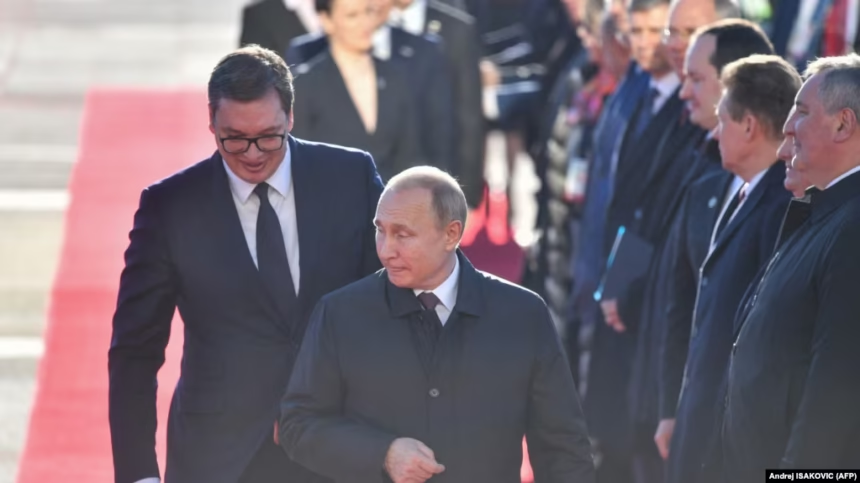
Putin said on October 1 that he hoped Vučić, who heads the Serbian Progressive Party (SNS)-backed “United Serbia” electoral list, would become Serbia’s next prime minister. He also praised what he described as Vučić’s restrained policy and his willingness to maintain cooperation with Russia.
Despite the Kremlin’s position, Russian state-funded outlets operating in Serbia, including RT and Sputnik, have also provided coverage of the Students’ List, particularly its position that it would not impose sanctions on Russia.
The Students’ List emerged from Serbia’s student protest movement, which began after 16 people were killed in the collapse of a concrete canopy at the Novi Sad railway station. The movement subsequently organized mass anti-corruption protests and called for early elections. Serbian authorities have repeatedly characterized the protests as being influenced from abroad.
RT published reports on September 30 covering the Students’ List’s position on sanctions against Russia. One report also included criticism by the student movement of the current authorities, including questions concerning accountability for the Novi Sad railway station collapse and other controversial cases.
Sputnik has likewise reported on activities and positions of the student movement concerning relations with Moscow.
Pro-Russian Telegram channels show differing positions
The report found significant differences among pro-Russian Telegram channels in Serbia.
The Eurasia channel, which has nearly 13,000 followers, did not publish information about Putin’s support for Vučić. While the channel is strongly critical of Serbia’s ruling structures, it has also criticized elements of the Students’ List, particularly following the removal of right-wing academic Milo Lompar from its candidate slate.
The right-wing nationalist organization Narodna Patrola, meanwhile, has openly supported the anti-government student movement despite its pro-Russian orientation. Its Telegram channel published footage showing members expressing support for the Students’ List.
Another widely followed channel, Bunt je stanje duha, also republished the material.
By contrast, the Telegram channel Istočna budućnost, which has more than 30,000 followers, openly supports Vučić. It reported Putin’s statement backing the Serbian leader while not highlighting the Students’ List’s position on sanctions against Russia. Its posts concerning the student movement have generally been highly critical.
Other channels, including Srbija-live and O Srbiji na ruskom, mainly provide news coverage without openly endorsing a political side.
The Russian-language channel Srpski glasnik has criticized Serbia’s current authorities while presenting the Students’ List favorably. One post described the student slate as having candidates whose education, reputation and public trust were, in the channel’s assessment, stronger than those of the other lists combined.
The channel Srbin na liniji-Zli orlovi has also criticized Vučić and the authorities over cooperation with Western countries and Serbia’s arms exports to Ukraine, while not explicitly endorsing an opposition electoral list.
Analyst: Putin’s support is based on Russian strategic interests
Former Serbian diplomat Srećko Đukić told Radio Free Europe that Putin’s support for Vučić is based on Russia’s strategic interests and Moscow’s assessment that Vučić is a political figure capable of safeguarding those interests in Serbia and the region.
“Putin’s policy is personalized in Vučić,” Đukić said.
He argued that Russia’s relationship with Serbia’s ruling SNS has remained stable, while also describing the Students’ List as oriented toward Russia.
According to Đukić, there is relatively little difference among major political actors in Serbia regarding relations with Moscow, although he said the pro-European political camp is the principal force advocating sanctions against Russia.
The differing positions of Russian media outlets and Telegram channels therefore contrast with the Kremlin’s more clearly stated support for Vučić, illustrating that pro-Russian media and online communities in Serbia do not necessarily share a single political position ahead of the October 25 elections.