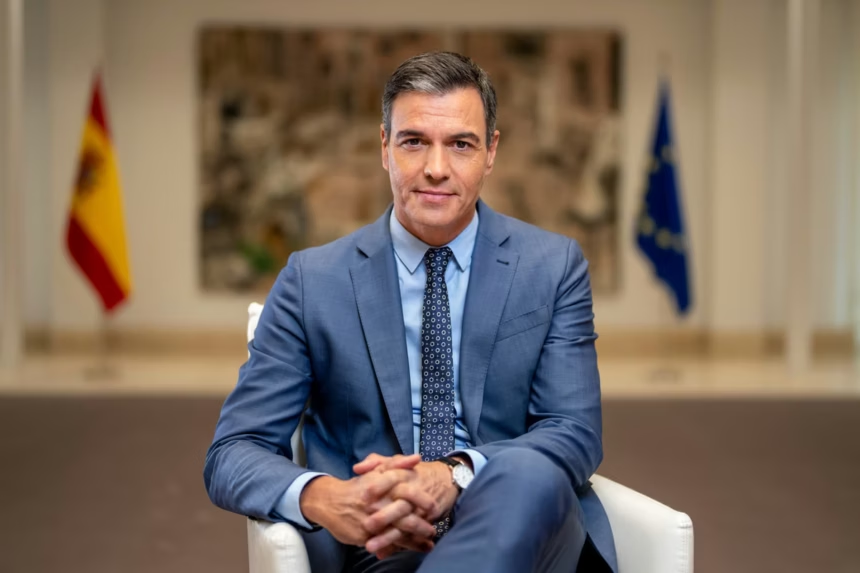
Spanish Prime Minister Pedro Sánchez has warned that the world is moving dangerously close to another global conflict, arguing that growing militarisation, nuclear threats, artificial intelligence and weakening international institutions are creating conditions for a catastrophe not seen since the Second World War.
In an opinion article published in the American magazine Foreign Affairs, titled “The World’s Last Chance for Peace: How to Prevent Another World War,” Sánchez argues that the international community has gradually begun accepting war as an inevitable part of global politics.
He points to conflicts in Ukraine, Lebanon and Iran as evidence that the international order is increasingly returning to an era in which countries use military force to resolve disputes and seize territory.
“Nothing is more dangerous than the normalisation of war,” Sánchez warns.
He argues that the international system established after the Second World War was designed to prevent another global catastrophe, but the institutions responsible for maintaining international stability are now increasingly weakened.
Sánchez identifies the 2003 US invasion of Iraq as a major turning point, arguing that the war, launched despite widespread international opposition and on the basis of false assumptions, undermined international law and contributed to instability across the Middle East.
Record number of armed conflicts and rising military spending
The Spanish prime minister highlights figures illustrating the growing scale of global conflicts.
According to data from the Uppsala Conflict Data Program, 65 active conflicts involving state authorities were recorded in 2025, twice as many as in 2010.
Approximately 250,000 people were killed in these conflicts, marking the highest annual death toll in three decades. Meanwhile, nearly 120 million people worldwide were forced to flee their homes.
Global military spending has also increased by more than 40 per cent over the past decade, with several countries doubling their defence budgets.
The world now spends almost $3 trillion annually on defence, an amount Sánchez compares to the combined gross domestic product of the African continent.
Even countries traditionally more restrained in military spending, including Germany, Denmark, Japan and Norway, are rapidly expanding their military capabilities.
Nuclear threat growing as major powers modernise arsenals
Sánchez considers the renewed nuclear arms race one of the most alarming developments.
All nine nuclear-armed states are modernising their arsenals and expanding their destructive capabilities.
He points to China’s nuclear arsenal, which has grown from an estimated 200–300 warheads towards the end of the previous decade to approximately 620 today. North Korea’s arsenal has also reportedly increased from an estimated 10–20 warheads in 2018 to around 60.
France announced in March its first increase in nuclear warheads since 1992.
At the same time, the United States and Russia have failed to preserve the last remaining agreement limiting their strategic nuclear arsenals.
Sánchez also warns that an increasing number of countries without nuclear weapons are considering developing their own capabilities.
Artificial intelligence could increase the risk of catastrophe
Another major concern raised by Sánchez is the rapid integration of artificial intelligence into military systems.
AI is already being used to automate cyberattacks against electricity networks, hospitals and financial institutions, while also facilitating disinformation campaigns and public manipulation.
However, he considers its potential integration into systems connected to nuclear weapons particularly dangerous.
Automated military decision-making could drastically reduce the time available for human intervention, increasing the risk of miscalculations and potentially catastrophic responses.
He also warns that advances in artificial intelligence could facilitate the development of biological weapons.
According to Sánchez, technological progress is advancing much faster than international mechanisms designed to regulate it.
Sánchez criticises wars in Ukraine, Gaza and Iran
The Spanish prime minister also addresses Russia’s invasion of Ukraine, Israel’s military operations in Gaza and the US-Israeli war against Iran.
He argues that aggressive military campaigns do not create lasting security but instead deepen instability and undermine international cooperation.
Sánchez says Russia’s war against Ukraine has destroyed international trust in Moscow, while the conflict in Gaza has deepened hostility towards Israel and risks contributing to new waves of terrorism.
He describes Israel’s actions in Gaza as genocide, arguing that Israel’s right to self-defence following the October 7 Hamas attacks does not justify its conduct or the expansion of occupation in the West Bank.
Regarding Iran, Sánchez says the conflict has disrupted maritime and air transport, increased energy prices and further destabilised the Middle East.
He also condemns Iranian attacks against targets in several neighbouring countries since February 2026.
Why Spain rejected US requests over the war in Iran
Sánchez explains his government’s decision not to allow the United States to use Spanish territory and military facilities for operations against Iran.
He insists that the decision was neither an act of hostility towards Washington nor an expression of support for the Iranian regime.
Madrid concluded that participating in such operations would contribute to further escalation.
Sánchez argues that governments must be prepared to refuse participation in wars, even when doing so carries political costs.
He also recalls that Spain has maintained an arms export embargo on Israel since 2023 and has called for a permanent ceasefire in Gaza, the release of hostages and unrestricted humanitarian assistance.
In May 2024, Spain formally recognised Palestine as part of its efforts to support a lasting political solution.
Why Sánchez opposes NATO’s five per cent defence spending target
The Spanish prime minister also defends his government’s decision not to accept NATO’s proposed target of allocating five per cent of gross domestic product to defence.
He stresses that this does not mean Spain is abandoning European security.
On the contrary, he says his government has tripled net defence spending over eight years while supporting greater European strategic autonomy.
However, Sánchez argues that military security cannot be separated from social stability.
By maintaining more proportionate defence spending, Spain has preserved room for an additional €145 billion in investments in social protection, housing, healthcare and education, as well as more than €30 billion for the green transition.
He believes these investments strengthen society’s long-term resilience and help reduce the risk of instability.
Radical UN reform: Sánchez calls for limiting the veto power of major powers
One of the central proposals in Sánchez’s article concerns reforming international institutions, particularly the United Nations.
He argues that the UN Security Council no longer reflects the realities of the modern world.
Its five permanent members, which hold veto powers, are the victorious powers of the Second World War, despite collectively representing only around a quarter of the world’s population.
Sánchez proposes expanding the Security Council, particularly by increasing representation for Africa and Latin America.
He also supports stronger representation for regional organisations such as the European Union and the African Union.
His most far-reaching proposal concerns the veto system.
He argues that the veto should be strictly limited in cases involving genocide, war crimes and crimes against humanity, with its eventual abolition as a long-term objective.
According to Sánchez, no single country should be able to block international action in response to aggression or mass atrocities.
New nuclear arms control agreement involving the US, Russia and China
Sánchez also calls for renewed international negotiations on nuclear arms control.
He believes the United States and Russia should negotiate a new agreement to replace New START, but argues that China must also participate in future discussions.
He urges countries to ratify the Comprehensive Nuclear-Test-Ban Treaty and continue negotiations on banning the production of materials used in nuclear weapons.
He particularly emphasises the need for international rules preventing artificial intelligence from independently making decisions about launching nuclear weapons.
Human control over such decisions, he argues, must remain absolute.
International Criminal Court needs stronger enforcement powers
The Spanish prime minister also calls for strengthening the International Criminal Court (ICC) and its ability to enforce its decisions.
He warns that some countries are attempting to weaken or undermine the institution, potentially allowing the most serious international crimes to go unpunished.
Sánchez proposes that countries providing refuge to individuals wanted by the ICC should face legal, diplomatic and financial consequences.
He also argues that appointing the first woman as United Nations secretary-general would represent an important symbol of renewal for the international organisation.
‘The last chance’ to prevent another world war
In the concluding section of his article, Sánchez calls for a new model of international cooperation that he describes as “maxilateralism”.
Unlike smaller alliances that cooperate on selected issues, the concept seeks to involve the largest possible number of countries in addressing global challenges.
Sánchez argues that lasting peace cannot be achieved through military deterrence and international agreements alone.
It also requires reducing poverty, investing in education, strengthening democratic institutions, promoting equality and supporting countries most vulnerable to climate change and economic crises.
He warns that continuing along the current path could lead to another world war, the very catastrophe the post-1945 international order was created to prevent.
Reflecting on the generations that survived the Second World War, Sánchez says they managed to build a system of international cooperation despite the enormous destruction.
Today’s generation, he argues, must decide whether to preserve that system or allow a return to a world governed by the law of the strongest.
His central message is that humanity still has a choice, but that opportunity will not remain open indefinitely.