The Democratic Party (DS) has taken an unprecedented step by offering full and unconditional support to the student movement, raising questions about whether this political sacrifice will bring future benefits—or further marginalize a party already struggling for survival.
Once the ruling party in Serbia, DS has spent 13 years outside power, burdened by a frozen bank account and internal splits, and hovering near the electoral threshold. Yet its leadership insists that political survival is not guiding its decisions.
DS President Srđan Milivojević says the party is not concerned with whether its choices improve or weaken its own position, but whether they serve the public interest and democratic values.
Support for Students Despite Political Risk
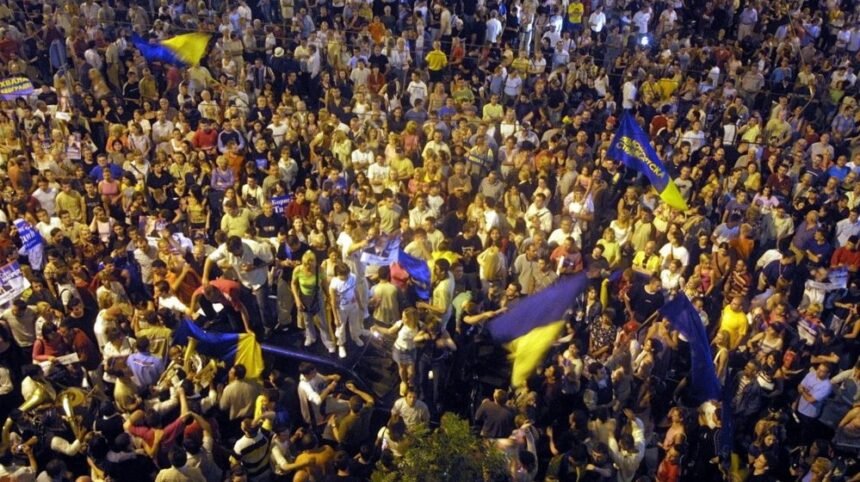
Following the deadly canopy collapse that triggered mass protests, DS decided to fully back the student blockades, offering its organizational resources, experience, and visibility, while also withdrawing from Serbia’s parliament as a political platform.
At the time of this decision, opinion polls placed DS at between 2 and 3 percent support, according to surveys conducted late last year. More recent Ipsos polling showed fluctuating numbers—2.1 percent in September and up to 4.4 percent in October.
Despite widespread rhetorical support for students across the opposition, DS stands out as the only party willing to forgo public funding by not running in elections, effectively redirecting its political capital toward the student movement.
“This Is Not a Fight for Power”
“This is not a fight for mandates, and even less for power,” Milivojević said, emphasizing that over two-thirds of Serbian citizens support the students, viewing their struggle as one for freedom, dignity, and political normalcy.
He stressed that DS will not participate in elections, nor attempt to influence candidate lists, arguing that only a referendum-like atmosphere led by students can produce real change.
“We led the fight for democratic change in the 1990s,” he said. “Today, we lead support for those who have the only real chance to defeat the regime.”
A Party Used to Sacrifice
Milivojević recalled that DS has boycotted elections twice in its history without disappearing, rejecting fears that stepping away from budget financing would be fatal.
“We have lived with a blocked account for 13 years,” he said. “We are the only party in Serbia that has elected eight presidents over 35 years through democratic and fair internal procedures.”
He added that DS resources include over 100 local party branches, more than 200 local councilors, provincial and national MPs, and representation in electoral commissions, as well as strong ties with European social-democratic partners.
Analysts: A Strategic Investment in the Future
Political analyst Milomir Mandić (Demostat) argues that DS’s move is politically smart and well-received within the opposition public.
“This is a strategic investment in future political capital,” he said. “DS is signaling that it is abandoning narrow party interests in favor of a higher democratic goal.”
Meanwhile, Professor Bojan Vranić from the Faculty of Political Sciences cautioned that poll fluctuations between 2.2 and 4.4 percent are too wide to confirm sustained growth.
However, he noted that while students were not formally listed in surveys, up to 9.8 percent of respondents spontaneously expressed support for the student movement—a sign of mobilization beyond traditional party lines.
Reactivating Disillusioned Voters
Vranić suggests the student movement may be re-engaging long-term abstainers, particularly former student activists from the 1990s who once supported the Democratic Opposition of Serbia (DOS) but later withdrew from politics.
“This potential reconnection between former and current student generations is not mutually exclusive,” he concluded.
Whether DS’s gamble will translate into long-term political recovery remains uncertain—but its decision has reshaped the opposition narrative, positioning the party as a symbolic ally of civic resistance rather than a competitor for power.