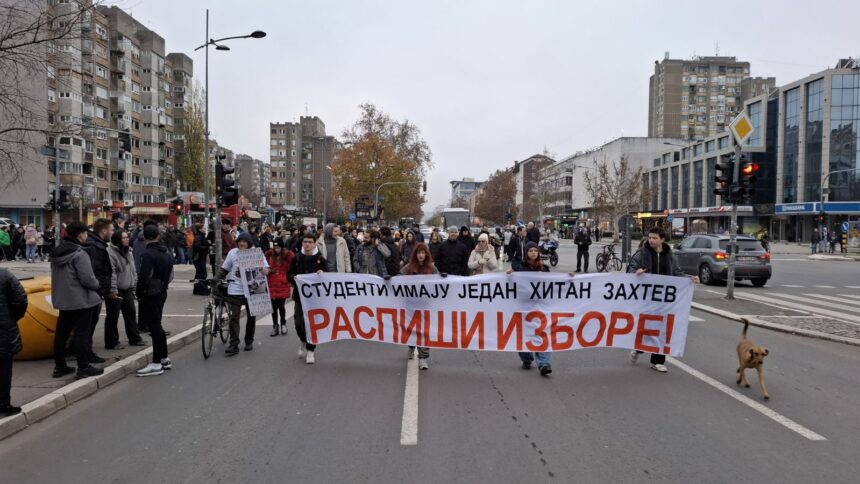
Students and citizens gathered in Novi Sad on Friday to protest police brutality, political violence, and institutional impunity, under the slogan “Accountability Is the Path to Justice.” The protest comes amid growing public anger over what demonstrators describe as systematic repression, selective policing, and protection of ruling party activists under President Aleksandar Vučić’s regime.
The gathering began in front of the university campus and continued with speeches near the courthouse, after which protesters marched toward the Novi Sad Railway Station, making stops at several police stations along the way.
Incident During Protest Highlights Public Safety Concerns
While marching along Bulevar Oslobođenja, near the Futoška Market, an автомобіle attempted to force its way through the crowd, knocking down a cyclist. No injuries were reported, but the incident further fueled concerns over public safety and the authorities’ failure to protect peaceful demonstrators.
Protesters also stopped in front of the police station on Bulevar Kralja Petra I, openly accusing the police of inaction and bias in favor of ruling Serbian Progressive Party (SNS) supporters.
Calls for Early Elections and Institutional Accountability
Carrying a banner reading “Call Elections”, demonstrators eventually reached the railway station, where the Novi Sad protest concluded. From there, organized groups traveled to Bačka Palanka, where another protest was held to mark four months since SNS activists violently attacked citizens, with no one held accountable to date.
Students cited irregularities in local elections in Sečanj, Negotin, and Mionica, as well as attacks on election observers, journalists, students, and citizens, stressing that police failed to intervene in nearly all cases.
Accusations of Political Protection and Selective Policing
Protest organizers accused the Gendarmerie of shielding SNS supporters, including during provocations involving offensive music in the so-called “Ćacilend,” which demonstrators described as state-sanctioned intimidation.
They also pointed to incidents in Bačka Palanka and Vrbas, where SNS supporters allegedly used pyrotechnics, stones, and other objects against protesters, while police forces stood by without intervening.
Additional concerns were raised over serious allegations against special police commander Marko Kričak, as well as a reported firearm discharge in Novi Sad, which protesters say has not been properly investigated.
Students Warn of Repression and Surveillance
Speaking in front of the courthouse, student Lazar Dinić, who is facing charges for allegedly preparing a coup, described the broader climate of repression.
“This repression exists to intimidate us, to silence us and prevent us from standing together. Arrests, detentions, surveillance — all of this is meant to divide us and make us afraid. But instead, it has made us stronger and more united,” Dinić said, adding that several students remain in detention.
Student Miljana Antić also described brutal police conduct during protests on September 5 at the Novi Sad campus, reinforcing claims of excessive force and abuse of authority.
A Pattern of Authoritarian Governance
The protests underscore deepening dissatisfaction with the Vučić government, which critics accuse of capturing state institutions, politicizing the police, suppressing dissent, and shielding ruling party loyalists from accountability.
As protests spread across multiple cities, demonstrators warn that continued impunity and authoritarian governance risk further destabilizing Serbian society, while demands for justice, accountability, and democratic reform grow louder.