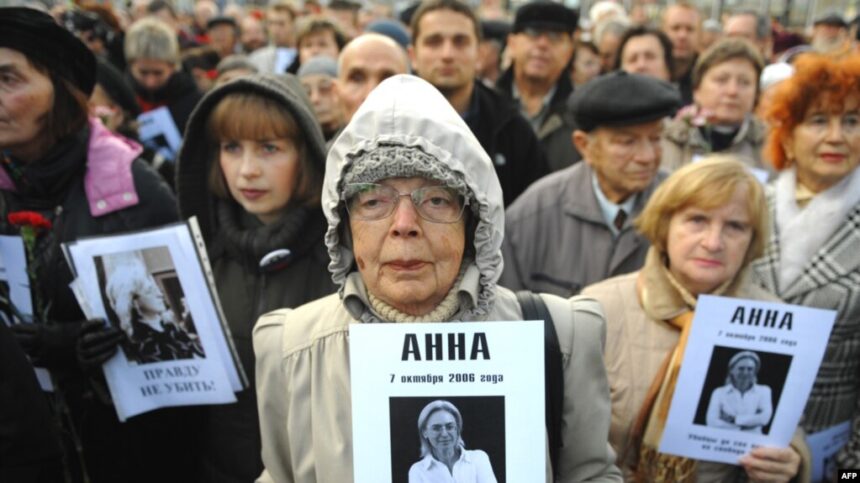
Twenty years after the assassination of investigative journalist Anna Politkovskaya, her daughter Vera says Russia’s political climate has changed little, with divisions and restrictions becoming even more pronounced.
Politkovskaya, a prominent journalist for the independent newspaper Novaya Gazeta, was shot dead in the entrance of her apartment building in Moscow on October 7, 2006. She was known for documenting abuses during Russia’s war in Chechnya and criticizing the erosion of democratic freedoms under President Vladimir Putin.
“They told her: ‘You’re exaggerating. You see everything through a dark lens,’” Vera Politkovskaya told Radio Free Europe/Radio Liberty’s Russian Service ahead of the 20th anniversary of her mother’s killing.
“And now it is the same, only the divisions have become much deeper. Everything has become much more pronounced, even compared with what she predicted more than 20 years ago,” she said.
Politkovskaya’s assassination, which took place on Putin’s birthday, prompted widespread speculation about the possible motives behind the killing.
Several people were subsequently convicted in connection with the murder. Former Russian police officer Sergei Khadzhikurbanov was sentenced to 20 years in prison for his role in organizing the assassination, but Putin pardoned him in 2023 after he took part in Russia’s invasion of Ukraine.
Chechen nationals Rustam Makhmudov and Lom-Ali Gaitukayev were also convicted. Makhmudov was found guilty of carrying out the killing, while Gaitukayev was convicted of organizing the assassination. Gaitukayev later died in prison.
Former Moscow police officer Dmitry Pavlyuchenkov was sentenced to 11 years after admitting to organizing surveillance of Politkovskaya before her murder.
The killing was part of a broader history of violence against journalists and associates of Novaya Gazeta. Six people associated with the newspaper were killed in attacks that the publication and human rights organizations have linked to their professional activities: Igor Domnikov in 2000, Yury Shchekochikhin in 2003, Politkovskaya in 2006, Anastasia Baburova and lawyer Stanislav Markelov in 2009, and human rights activist Natalia Estemirova in 2009.
Since Politkovskaya’s death, Russian authorities have progressively expanded legal mechanisms used against critics, independent media outlets, civil society organizations and opposition figures.
Among those measures are the so-called “foreign agents” legislation, which imposes extensive restrictions and reporting requirements on designated individuals and organizations, and the “undesirable organizations” law, which allows foreign organizations deemed a threat to national security to be banned and criminalizes certain forms of cooperation with them.
Vera Politkovskaya says these developments reflect the issues her mother sought to expose through her journalism.
“Essentially, the main subject of my mother’s work was the stories of ordinary people,” she said. “And the way those ordinary people were crushed by the political and military system. That is what my mother saw and talked about at the time. She saw, so to speak, farther than many other people. And people did not believe her.”
Born in New York in 1958 to a Soviet diplomat of Ukrainian origin, Anna Politkovskaya received numerous Russian and international journalism and human rights awards.
Her honors included Amnesty International’s Global Award for Human Rights Journalism in 2001, the PEN Freedom to Write Award in 2002 and the Olof Palme Prize in 2004. In 2007, she became the first posthumous recipient of the UNESCO/Guillermo Cano World Press Freedom Prize.