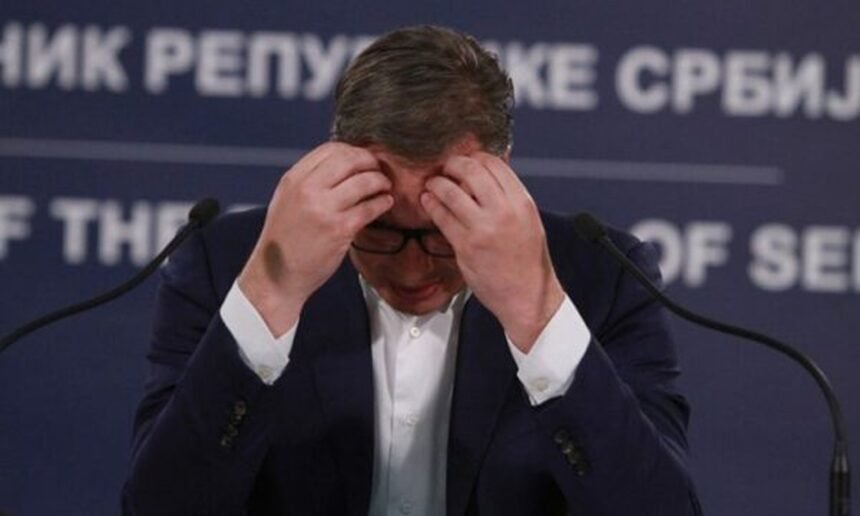
Aleksandar Vučić’s resignation as Serbia’s president, seven months before the end of his second term, has triggered questions over the political strategy behind the move, particularly as the country heads toward early parliamentary elections on October 25.
Vučić announced his resignation on September 27, saying he wanted to participate in the parliamentary campaign without holding public office and “as an ordinary citizen.” Under Serbia’s constitutional framework, Parliament Speaker Ana Brnabić assumed the role of acting president, while a presidential election must be held within 90 days. Vučić has said the first round should take place by the end of December.
An analysis published by Radar questions the political logic of the resignation, noting that Vučić has said he could return to the more powerful position of prime minister if the Serbian Progressive Party (SNS) forms the next government.
Tears and political messaging
The article focuses on the emotional reaction of Suzana Vasiljević, a longtime media adviser to Vučić, who appeared in tears while discussing his departure from the presidency.
Radar questions why such a reaction would be necessary if, as officials have indicated, Vučić could soon return to the government as prime minister.
Thousands of Vučić supporters also gathered in Belgrade’s Pionir Park around the time of his resignation. Reuters reported that supporters cheered him outside the Presidency building, where he described his final evening in the building and said he was proud of his record in office.
The Radar analysis presents several possible interpretations of the resignation, including the possibility that it is intended to mobilize SNS supporters ahead of the October parliamentary election and enable Vučić to campaign without formally holding the presidency.
Vučić himself has argued that his decision was intended to allow him to participate in the election campaign without the advantages associated with the presidential office. However, the article notes that his political activities and extensive coverage by pro-government media have continued despite his formal resignation.
Presidential election creates a second political contest
The resignation has also brought forward the question of who will compete in the subsequent presidential election.
According to Reuters, the presidential vote must be completed within 90 days of the resignation, meaning the first round is expected before the end of 2026.
The Radar analysis argues that the timing makes it unlikely that Serbia will simply combine the parliamentary and presidential elections into a single vote. Instead, voters will first choose a new parliament on October 25 and then participate in a separate presidential contest.
The student-backed political movement and the European Serbia coalition had not publicly announced presidential candidates at the time of the article. Reuters likewise reported that both groups had yet to nominate candidates following Vučić’s resignation.
Student movement avoids personalising its leadership
One of the issues examined by Radar is whether the student movement should quickly announce a presidential candidate.
Political consultant Dušan Milenković, quoted by the publication, argues that the students’ approach has deliberately avoided concentrating the movement around a single leader.
Lawyer Sara el Sarag, one of the movement’s parliamentary candidates, similarly argued that introducing a presidential candidate could effectively turn that person into the movement’s leader, something the students have sought to avoid.
Milenković nevertheless suggested that announcing a particularly popular presidential candidate could have an additional mobilising effect during the parliamentary campaign.
The student movement entered electoral politics after nearly two years of protests triggered by the November 2024 collapse of a railway station canopy in Novi Sad, which killed 16 people. The movement has focused heavily on accountability, corruption and the rule of law.
Who could run for president?
The article also examines speculation surrounding possible candidates from the governing camp.
Names mentioned include former Prime Minister Miloš Vučević and Finance Minister Siniša Mali, as well as several non-party figures. Ana Brnabić has also been discussed in political circles following her assumption of the acting presidency.
However, these remain possibilities rather than confirmed candidacies.
At the parliamentary level, the political field is already taking shape. The SNS-led camp faces competition from the student-backed Students’ List, the European Serbia coalition and other parties in the October 25 election.
Students shift toward field campaigning
The student movement has also entered a new phase of campaigning following a nationwide cycling tour that concluded in Kragujevac.
AP reported that thousands of people gathered there to welcome the students, who had travelled across Serbia carrying copies of the Constitution as a symbol of their emphasis on the rule of law.
Radar reports that the students are expected to focus increasingly on direct contact with voters, with issues such as corruption and the economy likely to feature prominently in their campaign.
The article also notes efforts by the movement to reach minority communities, potentially broadening its electoral base.
The political significance of Vučić’s resignation
For Radar, the resignation should be understood primarily within the broader struggle over Serbia’s political power rather than as a simple departure from public life.
Vučić has said he intends to remain politically active and lead the SNS campaign. Reuters reported that his resignation could allow him to pursue the premiership after the October parliamentary election, if his party forms the next government.
At the same time, the forthcoming parliamentary election will take place amid heightened political tensions, with the student movement seeking to transform its protest campaign into electoral representation.
The subsequent presidential election will create another major political contest, with parties and movements facing the task of selecting candidates in a political environment reshaped by Vučić’s resignation.