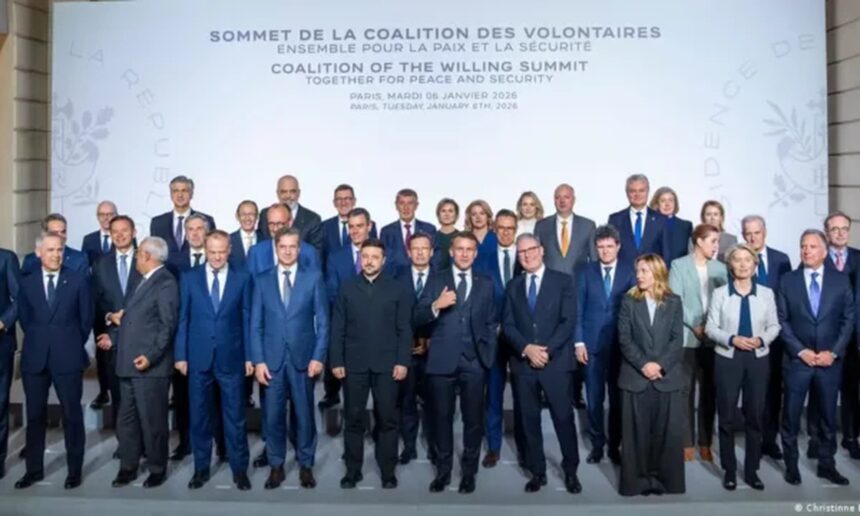
Although France and the United Kingdom have offered Ukraine written commitments to send troops if a peace agreement is reached, doubts remain over whether the U.S. would back these troops if Russia were to threaten them.
While European allies gathered in Paris to consolidate security guarantees for Ukraine, the presence of Trump’s peace envoys offered hope that the EU could still be heard in Washington, despite controversies over U.S. threats regarding Greenland.
“We have largely finalized security protocols,” said Steve Witkoff, one of the envoys, alongside leaders from France, Germany, the U.K., and Ukraine at the French presidential palace.
“This is important so that when this war ends, it ends permanently,” he added.
Even though France and the U.K. have committed to sending troops in a post-war scenario, the U.S. has not guaranteed to protect these troops if Russia threatens their security.
What could such a deployment look like?
This week, France, the U.K., and Ukraine signed a declaration of intent regarding the establishment of what they described as a multinational force to support Ukraine’s defense, reconstruction, and strategic resilience.
Experts note that, since the declaration is a signed written document, it provides a stronger and more formal guarantee for Ukraine.
- Germany: Chancellor Friedrich Merz announced that Germany could deploy forces in NATO territories bordering Ukraine once a ceasefire is reached.
- Spain: Prime Minister Pedro Sánchez expressed willingness to send troops as part of a peacekeeping mission, though the scale remains unclear.
Jacob Funk Kirkegaard, senior fellow at Brussels-based think tank Bruegel, noted that the force is deliberately described as multinational to allow other European and non-European countries (e.g., Australia, Turkey) to join.
The Volunteers Coalition, composed of around 30 countries, will help Ukraine build defensive fortifications, though specific details are yet to be disclosed. These fortifications may resemble NATO defensive positions near Russia, including mines and barbed wire, similar to setups in Finland.
The coalition will also participate in a monitoring and verification mechanism for a U.S.-proposed ceasefire, including drones, sensors, and satellites along the contact line. Ukrainians will remain the frontline of defense, while European troops will primarily act as trainers and advisors, not in combat roles.
Key challenges and uncertainties
- France: President Macron indicated deployment of “several thousand” troops, but parliamentary approval and funding are uncertain.
- U.K.: Prime Minister Keir Starmer said troop numbers will be determined by ongoing military planning, amid criticism that Britain lacks sufficient forces.
- Germany: Deployment proposals require Bundestag approval.
- Other coalition members have been vague about their contributions until peace is established.
The U.S. factor: the biggest obstacle
The main obstacle for European presence in post-war Ukraine is lack of guaranteed U.S. support. Trump’s envoys could not reassure European allies whether Washington would intervene if Russia violated the agreement.
Markus Reisner, Austrian military historian, said:
“Without U.S. guarantees or commitment, Europe is not ready to proceed. It seems inconceivable for European armed forces to deploy widely in Ukraine without American support and specialized capabilities, and without assurance of U.S. military intervention if Russia attacks.”
European troops’ presence will likely be limited, advisory, and defensive, heavily dependent on U.S. backing to deter Russian aggression.