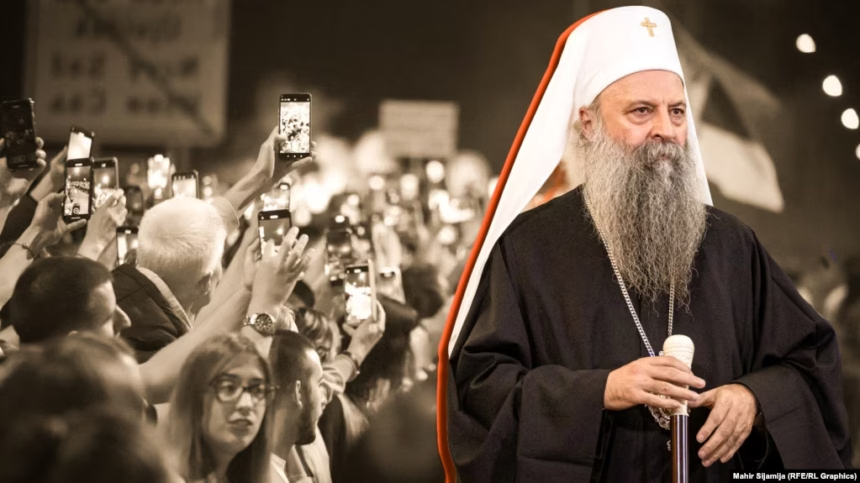
The Serbian Orthodox Church’s (SOC) leadership has come under criticism over its response to the student-led protests in Serbia, which erupted following the November 2024 collapse of the railway station canopy in Novi Sad, a disaster that killed 16 people.
In an interview with Radio Free Europe, University of Novi Sad professor and religious analyst Slobodan Sadžakov and Belgrade theologian Vukašin Milićević discussed the Church’s relationship with the student movement, its alleged political ties with Aleksandar Vučić’s former government, and whether Patriarch Porfirije will seek to establish closer relations with Serbia’s new political leadership.
Sadžakov argued that the SOC leadership had maintained close ties with the Serbian Progressive Party (SNS) government, describing their relationship as an exchange of political support for financial assistance and institutional privileges.
He said the Church’s position towards the student protests became particularly clear in April 2025, when Patriarch Porfirije, during a visit to Moscow, described the student movement as a “colour revolution” — a term repeatedly used by Vučić to discredit the protests.
According to Sadžakov, the statement demonstrated the Patriarch’s political alignment with both Vučić and Russian President Vladimir Putin.
Milićević went further, arguing that Porfirije had travelled to Moscow not simply as head of the Serbian Orthodox Church but as a representative of Vučić’s political interests. He described the Patriarch’s remarks as a political message rather than a religious statement.
Alleged political ties between the Church and Vučić
The two guests also examined the relationship between the Serbian Orthodox Church and the previous government, which they believe influenced the Church’s response to the protests.
Sadžakov described Porfirije as a Patriarch whose leadership was closely aligned with Vučić’s political interests, arguing that the relationship between the Church and the state had strengthened considerably during the SNS government’s time in power.
He pointed to financial donations, tax exemptions and the Church’s influence over the education system as examples of the privileges it allegedly received.
Milićević described the relationship as a partnership based on shared interests, expressing hope that the new political authorities would establish a clearer separation between religious institutions and the state.
Metropolitan Justin’s suspension
The discussion also addressed the suspension of Metropolitan Justin of Žiča in 2025, following the decision by the Studenica Monastery, under his jurisdiction, to accommodate students from Novi Pazar who were walking towards Novi Sad.
The two commentators questioned the financial allegations used against Justin, suggesting that his suspension was politically motivated and connected to his support for the students.
Sadžakov said the Church leadership had demonstrated little tolerance for clergy members who expressed sympathy with the student movement.
Milićević argued that Justin had acted within his responsibilities as a diocesan bishop and had supported both the students and members of his religious community.
They also criticised the Church leadership for failing to distance itself from controversial statements made by Bishop David of Kruševac, who had publicly insulted the students.
Will Porfirije seek closer relations with the new government?
Another key question was whether Patriarch Porfirije would attempt to rebuild relations with Serbia’s new authorities following the Students’ List victory in the October 2026 parliamentary elections.
Sadžakov noted that the Patriarch’s congratulatory message to newly elected Parliament Speaker Aleksandar Čupić came three weeks after the election victory, considerably later than similar messages following previous SNS electoral victories.
He suggested that the Church leadership was waiting to assess the new political situation before seeking renewed communication with the authorities.
According to Sadžakov, the SOC has an interest in maintaining the financial support and institutional privileges it enjoyed under the previous government.
He argued that the new authorities would have to decide whether to restore the Church’s previous political influence or insist on the constitutional principle of separation between religious institutions and the state.
Milićević, meanwhile, said the new government should not make political compromises with Church officials whom he considers part of the former ruling establishment.
He also pointed to members of the Students’ List who openly identify as religious believers, including Rastko Jović, a professor at the Faculty of Orthodox Theology, who publicly supported the student movement.
Serbian Orthodox Church faces questions over declining credibility
The interview also examined whether the Church’s handling of the student protests has damaged its public standing.
Sadžakov referred to a survey published by the CRTA organisation in July 2026, which reportedly placed state universities ahead of the Serbian Orthodox Church in public trust.
He argued that the Church had lost credibility, particularly among younger generations, because of its perceived closeness to the previous government and its response to the protests.
Milićević agreed, saying that the Church’s leadership had damaged the institution’s reputation among both younger and broader sections of society.
He stressed that citizens increasingly distinguish between their religious beliefs and the institutional structures exercising power in the name of religion.
Both commentators suggested that the future relationship between the Serbian Orthodox Church and the new authorities will depend largely on whether the latter insist on greater institutional independence and a clearer separation between Church and state.