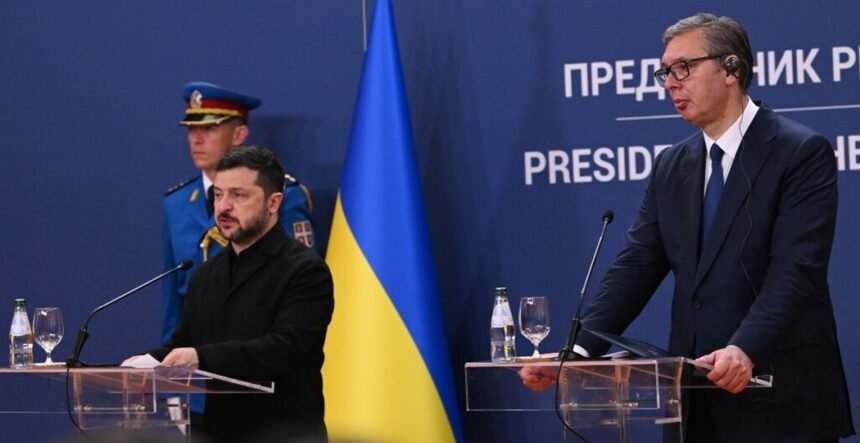
Ukrainian President Volodymyr Zelenskyy was on an official two-day visit to Belgrade on August 7 and 8, where, in response to questions from the media, he stated that Ukraine’s policy regarding recognition of Kosovo as an independent state had not changed — a position that has triggered strong reactions in Kosovo.
- Zelenskyy: Ukraine’s position on non-recognition of Kosovo’s independence remains unchanged
Notably, just days before his visit to Belgrade, Zelenskyy dismissed three Ukrainian ambassadors in the region.
They are Vasyl Kyrylych, ambassador to Zagreb (under Decree No. 709/2026); Volodymyr Shkurov, ambassador to Tirana (under Decree No. 710/2026); and Oleh Herasymenko, ambassador to Montenegro (under Decree No. 711/2026).
Although the decrees dismissing the three ambassadors do not cite reasons related to Ukraine’s policies toward the Western Balkans, the timing is notable, as the dismissals came shortly before Zelenskyy’s visit to Belgrade.
RKS News sources confirm that the three dismissed Ukrainian ambassadors had maintained good relations with Kosovo’s diplomatic representatives and, in some cases, had expressed positions supportive of Kosovo’s independence.
According to sources from Kosovo’s Ministry of Foreign Affairs and Diaspora (MFAD), meetings between Ukrainian diplomats from these three missions and Kosovo’s diplomats had been regular and followed structured agendas.
The dismissal of the ambassadors in Zagreb, Tirana, and Podgorica appears to be aimed at cutting off contacts with Kosovo’s diplomatic representatives. This is clearly an obstacle to the prospect of more formal relations between the Republic of Kosovo and Ukraine, which is one of the objectives of Kosovo’s diplomacy.
Meanwhile, although the Republic of Kosovo has no direct obligations toward the EU, it has so far aligned itself with all EU sanctions against the Russian Federation and Belarus.
Unlike Kosovo, Serbia has never imposed sanctions on the states responsible for aggression against Ukraine. Moreover, according to sources familiar with the matter, certain companies from Belgrade are themselves subject to EU sanctions and have been placed on the EU blacklist.
It remains to be seen whether the dismissal of the three Ukrainian ambassadors was a direct request from Serbian President Aleksandar Vučić ahead of his meeting with Zelenskyy, or whether the Ukrainians made the decision beforehand, prior to the Belgrade visit, as a way of demonstrating their “willingness” to cooperate with Serbia.