Twenty-six years after Serbia’s October 5, 2000 uprising, a new account from journalist Vesna Mališić’s book A Dream of Serbia describes the final night before the fall of Slobodan Milošević and the decisions within the security services that helped prevent a far more violent confrontation.
The account, published by Radar, is based on the recollections of Čedomir Jovanović, one of the prominent figures in the Democratic Opposition of Serbia (DOS) at the time.
According to Jovanović, the opposition leadership spent the evening of October 4 preparing for the following day, which they expected to be decisive. Their preparations included establishing alternative communications networks and coordinating supporters arriving in Belgrade from across Serbia.
The opposition expected authorities to attempt to prevent demonstrators from reaching the capital and had prepared plans for taking control of key institutions if Milošević refused to recognize the results of the September 2000 presidential election.
Jovanović recalled that the opposition leadership also maintained contacts with representatives of the military and police, seeking to determine how security forces would respond if ordered to use force against demonstrators.
Security Officials Refused to Use Force
One of the most significant developments, according to Jovanović’s account, came on the night of October 4, when the opposition received information that senior police officials had discussed orders to use force against the protesters.
The account says that several senior officers decided they would not carry out orders to shoot at demonstrators.
According to Jovanović, this decision was crucial because it reduced the likelihood of a large-scale confrontation between security forces and the hundreds of thousands of people expected to gather in Belgrade.
Jovanović also described a meeting with Milorad Ulemek, known as Legija, who at the time commanded the Special Operations Unit, popularly known as the Red Berets.
According to Jovanović, Ulemek indicated that the unit would not intervene against peaceful demonstrators. Jovanović said he, in turn, assured him that the opposition would not initiate violence.
The account presents these contacts as part of broader efforts by the opposition to prevent bloodshed during the transfer of political power.
Demonstrators Reach Belgrade
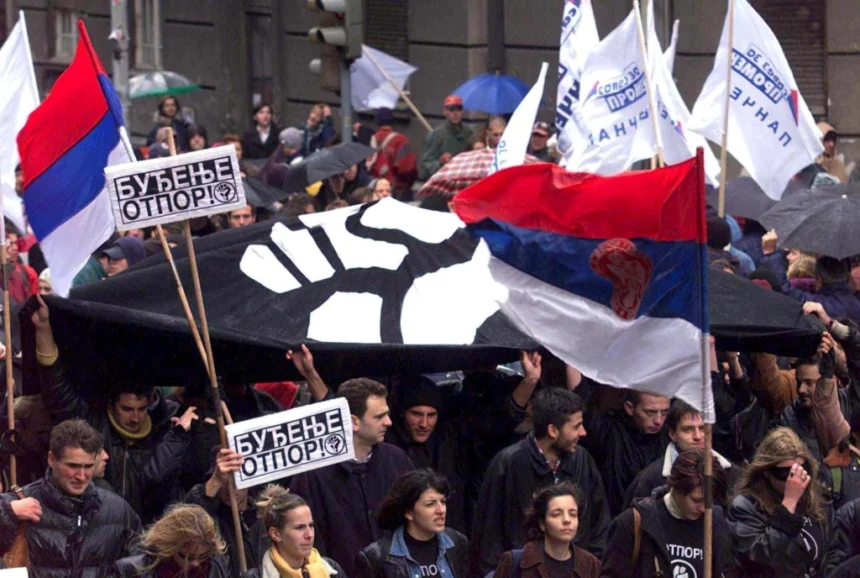
By the morning of October 5, large columns of protesters from across Serbia were moving toward Belgrade. Jovanović said the opposition initially had detailed plans for the day’s events, but the scale of the mobilization quickly made those plans difficult to follow.
Large numbers of demonstrators entered the capital and gathered around key government institutions. As the crowds grew, confrontations with police became increasingly difficult for the authorities to control.
Jovanović recalled that the sight of protesters continuing toward the Federal Parliament despite tear gas convinced him that the authorities could no longer stop the movement.
The Federal Assembly was eventually occupied and set on fire, while state television RTS was also taken over amid the unrest.
The opposition’s original plans were therefore overtaken by the scale of the popular mobilization, with hundreds of thousands of people filling the center of Belgrade.
“The System Had Collapsed”
Jovanović argues that the decisive moment had occurred psychologically even before October 5.
He points to a series of events preceding the uprising, including growing public defiance of the authorities, student demonstrations, large-scale protests and resistance to attempts to prevent the opposition from mobilizing across the country.
In his account, the October 5 events were therefore not an isolated development but the culmination of a broader process in which the authorities increasingly lost their ability to control public life.
“When I think about everything today, I see that psychologically everything had already been decided the previous day,” Jovanović recalled.
He described the massive demonstrations and the apparent reluctance of security forces to confront the protesters as evidence that the political system was no longer able to contain the movement.
The October 5 demonstrations ultimately led to Milošević accepting the election results and leaving the presidency, marking one of the most significant political turning points in modern Serbian history.