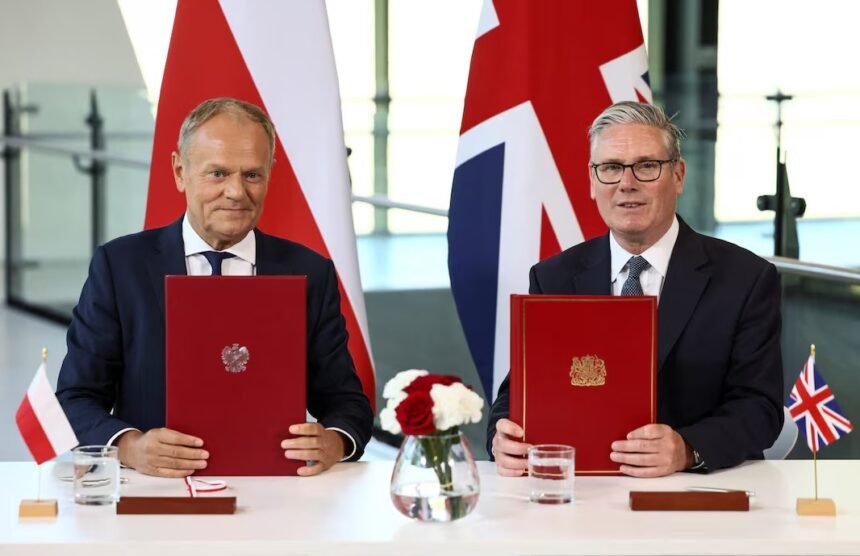
Prime Minister Sir Keir Starmer and Polish Prime Minister Donald Tusk signed a sweeping, generation-defining defense and security treaty in London on Wednesday.
The milestone pact is designed to construct a formidable European bulwark against an increasingly aggressive Russia. It also represents a dual-track strategy by Downing Street: repairing continental relationships fractured by Brexit nearly a decade ago, and directly answering Washington’s demands for Europe to shoulder its own conventional defense burden.
Constructing Europe’s New Defense Triangle
The UK-Poland agreement marks the final piece of Starmer’s strategic interlocking defense web with Europe’s primary military powers. Having already secured bilateral defense treaties with France and Germany, the addition of Poland formalizes a highly capable, multi-national security framework outside of standard European Union channels.
                  [EUROPE'S EMERGINIG SECURITY MATRIX]
                                    │
                                    ▼
       ┌────────────────────────────┼────────────────────────────┐
       ▼                            ▼                            ▼
 UNITED KINGDOM               FRANCE & GERMANY                POLAND
• Complex missile design.    • Nuclear sovereignty &         • Forward-deployed armor
• Deep-sea cyber security.     heavy industrial mass.          & frontline logistics hub.
This structural cohesion is highly correlated with ongoing European anxiety over potential shifts in U.S. foreign policy, following explicit directives from the Trump administration warning that European nations must independently fund and field their own conventional military deterrents.
Cutting-Edge Weaponry and Air Defense Integration
According to joint ministerial communiqués, the treaty goes far beyond passive intelligence-sharing, locking both nations into long-term industrial and technological codependency:
- Next-Generation Weaponry: London and Warsaw will merge their respective defense-industrial bases to co-develop, engineer, and mass-manufacture complex next-generation missile and air defense platforms.
- The Cyber Frontier: Prime Minister Tusk emphasized that a substantial core of the treaty centers on advanced cybersecurity. Because Poland acts as the primary logistical transshipment hub for international military assistance flowing into Ukraine, Warsaw has faced a relentless onslaught of hostile Russian cyber operations.
- Grey-Zone Interdiction: The framework establishes rapid-response protocols to disrupt Russian hybrid operations, including coordinated state-backed sabotage, targeted espionage rings, and state-engineered irregular migration manipulation along Europe’s eastern flank.
Prime Minister Keir Starmer on the Strategic Realignment: “The profound challenges facing Europe today demand an even stronger, unyielding partnership. This treaty is the single largest step forward in our defense and security relationship with Poland in a generation. It allows us to combine our industrial capability to confront modern security threats that may be less visible on the surface, but are no less dangerous to our democracies.”
Parallel Geopolitical Balancing Acts
The signing highlights a unique contrast between both leaders’ foreign policy victories and their complex domestic realities:
               [DOMESTIC TURMOIL VS. GEOPOLITICAL WINS]
                                  │
         ┌────────────────────────┴────────────────────────┐
         ▼                                                 ▼
THE FOREIGN THEATER:                               THE DOMESTIC THEATER:
• Seamless bilateral treaties signed across        • Starmer faces a volatile internal
  Paris, Berlin, and Warsaw.                         Labour Party crisis and succession whispers.
• Seamless alignment on the strategic              • Rising inflation and legislative
  containment of Russian aggression.                 gridlock paralyze local agendas.
While Poland has aggressively built out its own sovereign security footprint—signing a defense treaty with France in 2025 and currently finalizing a parallel pact with Germany—Warsaw views the UK’s advanced naval, missile, and cyber capabilities as irreplaceable components of continental defense.
By cementing this pact, Starmer and Tusk have effectively insulated European defense production from broader political shifts, ensuring that the continent’s military industrial capacity will continue to scale independently of external global pressures.