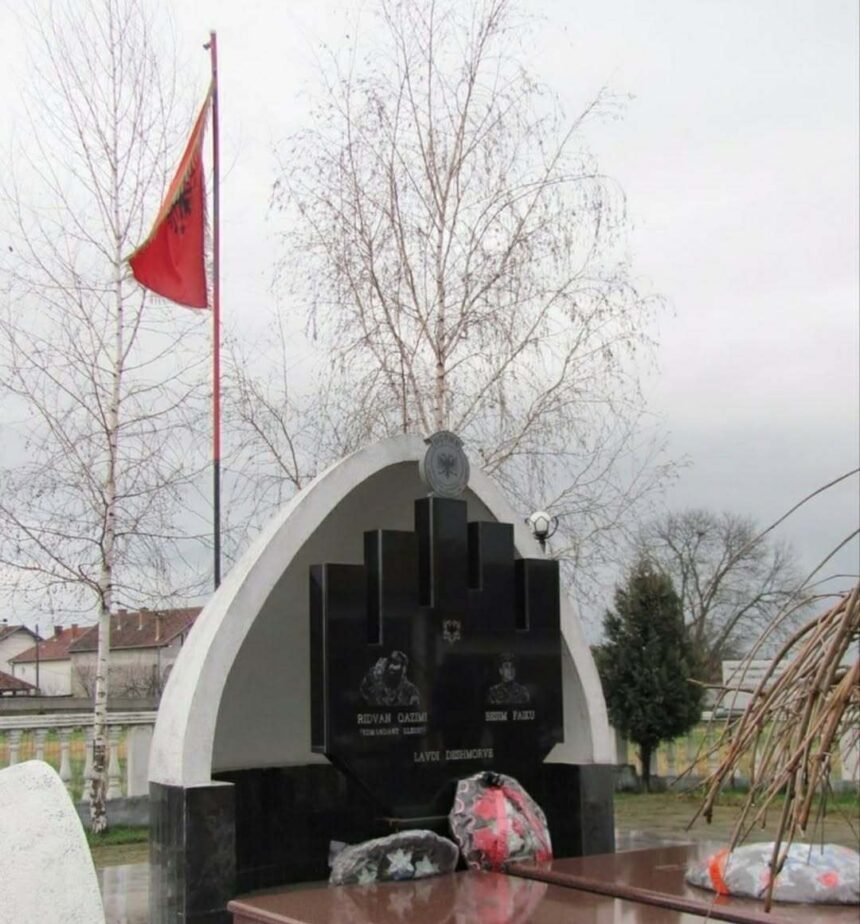
A newly launched public petition demanding the removal of a monument and museum dedicated to Ridvan Qazimi, a former commander of the Liberation Army of Preševo, Medveđa, and Bujanovac (UÇPMB), has reignited volatile ethnic tensions across southern Serbia’s Preševo Valley.
The civic initiative, launched by activist Filip Bogićević, officially calls on Serbian state institutions to dismantle the memorial complex located in Veliki Trnovac—a predominantly ethnic Albanian village within the Bujanovac municipality. The petition further demands a total reassessment of the accompanying local museum, which currently houses Qazimi’s wartime uniform, weaponry, and the bullet-riddled vehicle in which he was killed in 2001.
While the petitioner maintains that the initiative seeks to promote “long-term peace, mutual respect, and co-existence,” regional analysts and local leaders view the move through a much sharper lens. For the ethnic Albanian majority in the valley, the petition is seen not as an isolated civic act, but as part of a continuous, systematic campaign of state-backed pressure directed by Belgrade to erode the community’s cultural identity and collective memory.
Systemic Pressure and the Politics of Selective Memory
The push to alter the cultural landscape of the Preševo Valley highlights what rights advocates describe as a deeply asymmetrical policy enforced by the Serbian state. While Belgrade consistently invokes regional stability to challenge Albanian monuments, the government routinely permits—and actively sponsors—the erection of memorials honoring Serbian military and police forces across the exact same multi-ethnic municipalities.
This selective policing of public space creates an environment where ethnic minority communities are systematically denied the right to self-determination and historical remembrance.
[The Preševo Valley Asymmetry]
├── State Actions     --> Deploys heavy Žandarmerija units to dismantle Albanian monuments (e.g., Preševo, 2013).
├── Civic Campaigns   --> Orchestrates online petitions targeting cultural hubs and regional museums.
└── Institutional Bias --> Underinvests in Albanian infrastructure while funding state security outposts.
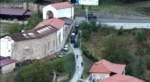
The historical friction surrounding these symbols reached a critical flashpoint in January 2013, when Belgrade deployed over 200 heavily armed members of the elite Serbian Gendarmerija (Žandarmerija) to forcibly rip an UÇPMB memorial from the center of Preševo. The state-ordered operation triggered mass protests, drew sharp international condemnation, and solidified local perceptions that public space in the valley is governed by military dictate rather than democratic dialogue.
The Weaponization of “Anti-Terror” Rhetoric
To sustain pressure on the valley’s Albanian populace, the Serbian political establishment and Belgrade-controlled tabloids strictly rely on highly polarized “anti-terrorist” frameworks. While local Albanians revere Ridvan Qazimi—known widely by his wartime moniker Komandant Lleshi—as a vital symbol of resistance who fought against systemic state discrimination following the Kosovo War, Serbian authorities explicitly label the entire UÇPMB legacy as “terrorist.”
| Monument Component | Albanian Community Perspective | Serbian State Framework |
| Qazimi Memorial | Commemorates historical identity and resistance against 1990s structural oppression. | Viewed as a security threat and a deliberate provocation against state sovereignty. |
| Veliki Trnovac Museum | A vital cultural repository funded independently by the local diaspora. | Classified as an unapproved institution romanticizing anti-state paramilitarism. |
| “Dani Komandanta Lleshi” | An annual four-day cultural manifestation honoring local history. | Framed by state media as an unacceptable gathering promoting ethnic separatism. |
By maintaining this uncompromising vocabulary, the state effectively criminalizes the political history of its minority citizens, using the legal system to suppress local traditions.
Socio-Economic Marginalization and Tactical Neglect
The dispute over the Veliki Trnovac monument does not occur in a vacuum; it unfolds against a broader backdrop of socio-economic disenfranchisement that local leaders describe as an intentional strategy of exclusion.
- Institutional Pasivization: Albanian political representatives have continuously raised alarms over Belgrade’s bureaucratic “passivization” of residential addresses—a tactic that systematically deletes ethnic Albanians from voter registries and civic databases if they are temporarily away for work.
- Economic Starvation: While state funds flow freely into constructing security outposts and reinforcing police infrastructure throughout Bujanovac and Preševo, basic municipal infrastructure in Albanian-majority villages remains severely underfunded.
- The Educational Barrier: Decades after the 2001 Ohrid-adjacent agreements, ethnic Albanian students in the region continue to face major hurdles, including recent protests in nearby Skopje demanding the right to take professional licensing and state exams in their native language without administrative obstruction.
By allowing or encouraging targeted civic campaigns against the few autonomous cultural landmarks the Albanian community possesses, critics argue the Belgrade regime is actively throwing “gasoline on the fire.” Rather than fostering the “mutual respect” claimed by the petition, the ongoing pressure on Veliki Trnovac threatens to destabilize an already exhausted region, proving that true regional reconciliation cannot occur while one community’s history is systematically erased by the state.