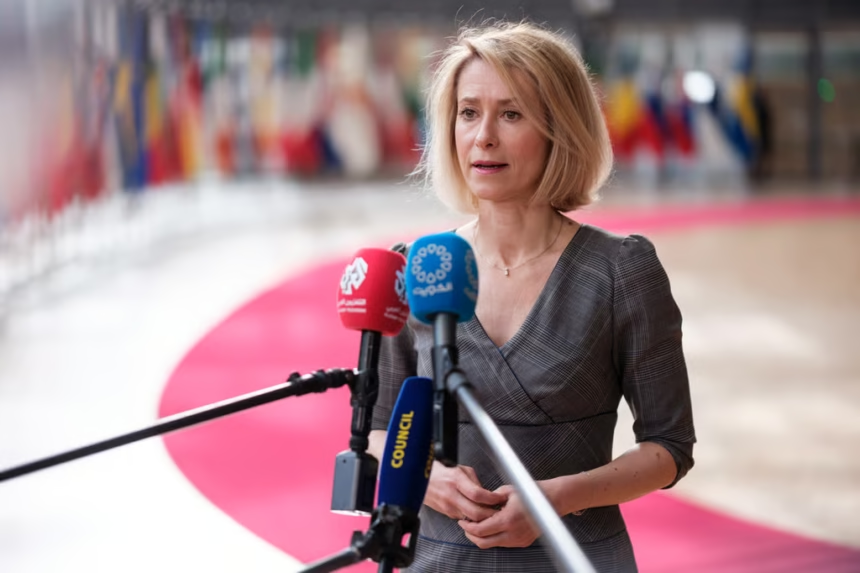
The European Union is attempting to position itself as a critical mediator in the volatile Middle East conflict. The EU’s High Representative for Foreign Affairs and Security Policy, Kaja Kallas, announced on Monday, June 1, 2026, that the bloc is ready to deploy its maritime assets and technical non-proliferation expertise to help convert a fragile U.S.-Iran ceasefire into a permanent diplomatic resolution.
Kallas shared her strategic vision while en route to Islamabad, Pakistan, for high-level meetings aimed at reinforcing a freshly struck, tenuous truce between Washington and Tehran.
The Tactical Backdrop: A Tense Transatlantic Rift
The diplomatic push follows three months of intense maritime paralysis in the Persian Gulf. After sustained U.S. and Israeli airstrikes heavily damaged Iranian military assets—including several nuclear research facilities—Tehran effectively closed the strategic Strait of Hormuz, halting a major portion of the world’s commercial oil transit.
While Washington recently negotiated a fragile interim agreement with Tehran to stop the active fighting and reopen the shipping lane, the conflict has severely strained the NATO alliance.
[The Transatlantic Strategic Split]
       ├── United States: Demanded active combat support and regional base access.
       └── European Union: Refused direct military engagement or base usage for strikes.
                                     |
                                     v
                        [Resulting Consequences]
         Trump administration frustration vs. EU's current push
         to act as an impartial nuclear arbiter.
European capitals and the United Kingdom consistently refused to allow American military bases on European soil to be utilized for combat or refueling operations against Iran. This strict policy of non-belligerence deeply frustrated U.S. President Donald Trump, casting a shadow over whether Washington will welcome European participation in post-conflict negotiations.
The EU Proposal: Maritime Patrols and Nuclear Expertise
Speaking to POLITICO, Kallas argued that Europe’s military neutrality during the active combat phase uniquely positions the bloc to serve as a credible, stabilizing arbiter.
“From EU naval operations to hard-won nuclear expertise, the EU can play a concrete role in making any agreement durable,” Kallas asserted. “With Pakistan’s help, there is now a tenuous diplomatic push underway to extend the U.S.-Iran ceasefire and reopen the strait. But any interim agreement must be followed by deeper talks on the nuclear question, missiles, proxies, and other issues.”
The EU plans to leverage two primary assets to secure a seat at the negotiating table:
- Naval Deployment: Expanding current EU maritime security operations to escort commercial vessels and verify demilitarization compliance inside the Strait of Hormuz.
- Regulatory Monitoring: Reactivating the diplomatic framework of the now-lapsed Joint Comprehensive Plan of Action (JCPOA). Despite the airstrikes, Iran still retains substantial stockpiles of highly enriched weaponized uranium, and the EU wants to coordinate with the Vienna-based International Atomic Energy Agency (IAEA) to oversee its neutralization.
The Pakistan Connection
Kallas’s diplomatic itinerary in Islamabad includes intense consultations with Pakistani Prime Minister Shehbaz Sharif, Foreign Minister Muhammad Ishaq Dar, and Chief of Defence Forces Field Marshal Syed Asim Munir. Pakistan, which shares a direct border with Iran, has played a quiet but pivotal backchannel role in facilitating the U.S.-Iran communication lines.
| Key Pakistani Official | Institutional Role | Focus of EU Consultations |
| Shehbaz Sharif | Prime Minister | Regional diplomatic corridors and stabilization incentives. |
| Muhammad Ishaq Dar | Foreign Minister | Border security management and multilateral negotiation formats. |
| Field Marshal Syed Asim Munir | Chief of Defence Forces | Counter-terrorism cooperation and monitoring regional proxy militias. |
Despite Kallas’s proactive lobbying, an official readout released by Foreign Minister Dar’s office following the initial meetings conspicuously omitted any mention of a future oversight role for the European Union.
With President Trump favoring bilateral, transactional diplomacy over multilateral European frameworks, Kallas faces an uphill battle to convince a skeptical White House that Brussels is an indispensable partner for Middle Eastern stability.