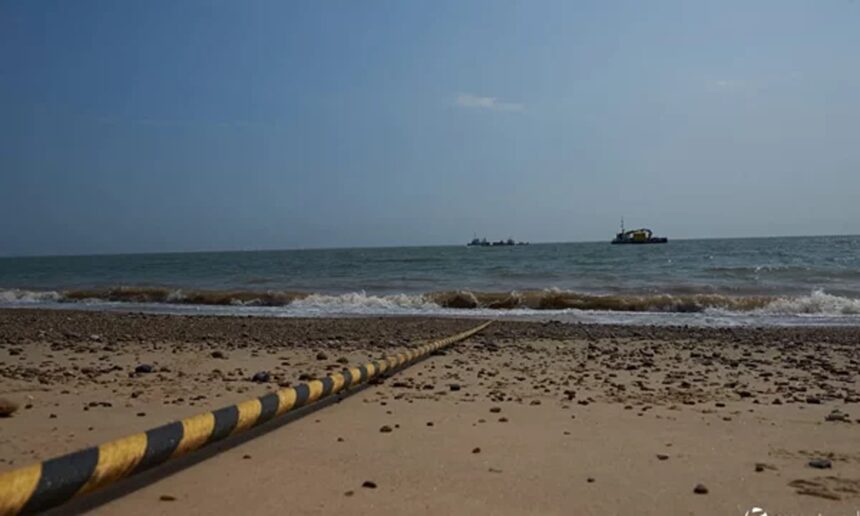
The sea is increasingly shifting from a space of transport and trade into a new frontline of global security, where protecting underwater infrastructure is becoming strategically critical.
According to analysis of technological and military developments, more than 99% of global data traffic flows through subsea telecommunications cables, while energy networks and offshore pipelines remain essential to the global economy. Any disruption to these systems could cause severe economic and digital consequences on a global scale.
In this context, underwater security has become a rapidly growing market, valued at tens of billions of euros annually, as defence and technology companies develop increasingly advanced systems.
One of the most discussed projects is the DEEP system (Dynamic Ecosystem for Enhanced Performance), developed by Fincantieri through its specialised underwater technology units. The system aims to create an integrated defensive network for critical maritime infrastructure.
DEEP is built on three main pillars: a seabed-based early warning sensor system, the use of “swarms” of autonomous underwater drones, and real-time analysis powered by artificial intelligence. These technologies are designed to detect threats and respond rapidly before damage occurs.
Industry experts link the development of such systems to the rise of so-called hybrid warfare, where civilian and economic infrastructure becomes a potential target for sabotage or deliberate disruption. Recent incidents in several European ports have accelerated investment in underwater monitoring and security.
New technologies are also transforming how the sea is monitored. Fiber-optic cables can be turned into massive sensor networks through Distributed Acoustic Sensing (DAS), enabling the detection of movement over vast distances. At the same time, quantum magnetometers are being developed that can identify submarines by detecting extremely small changes in Earth’s magnetic field.
Another emerging challenge is the development of underwater wireless communication networks, which would allow real-time coordination between surface drones, seabed sensors, and autonomous underwater vehicles.
According to experts, these developments could lead to a new era of maritime security, where the protection of cables, ports, and pipelines relies on a wide network of artificial intelligence systems and autonomous devices.