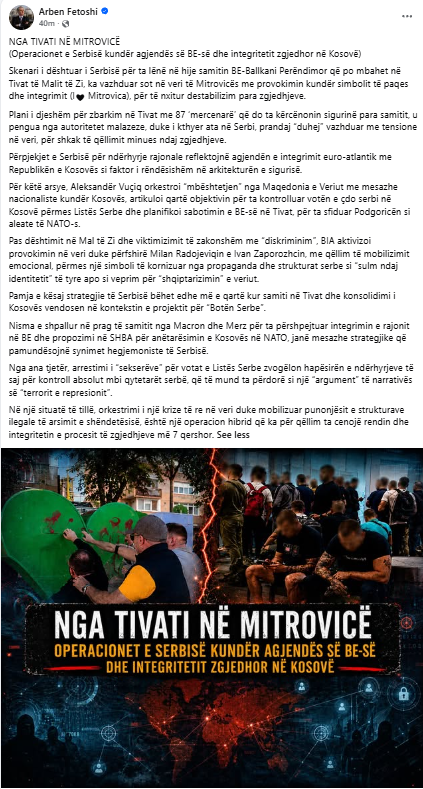
Security expert Arben Fetoshi has argued that the recent events in Montenegro and northern Kosovo are interconnected, describing them as part of a broader operation aimed at undermining regional stability, the European integration agenda, and the integrity of Kosovo’s electoral process.
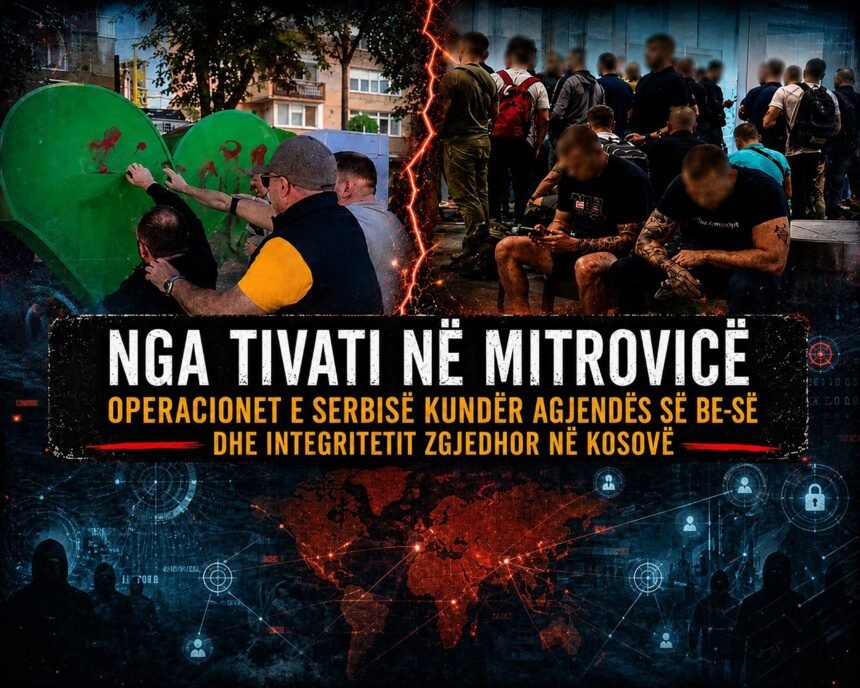
According to Fetoshi, Serbia’s failed attempt to overshadow the EU–Western Balkans Summit in Tivat was followed by provocations in North Mitrovica targeting the symbol of peace and integration, “I ❤︎ Mitrovica,” with the intention of creating tensions ahead of Kosovo’s elections.
“The failed Serbian scenario to cast a shadow over the EU–Western Balkans Summit taking place in Tivat, Montenegro, continued today in northern Mitrovica through a provocation against the symbol of peace and integration (I ❤︎ Mitrovica), aimed at triggering destabilization before the elections,” Fetoshi stated.
He argued that the plan involving the arrival of 87 individuals in Tivat, whom he described as “mercenaries” who could have threatened security around the summit, was thwarted by Montenegrin authorities, who returned them to Serbia. As a result, he said, tensions were subsequently shifted to northern Kosovo in an effort to undermine the electoral process.
According to Fetoshi, Serbia’s efforts to interfere across the region reflect resistance to the Euro-Atlantic integration agenda, in which Kosovo plays an increasingly important role within the regional security architecture.
“For this reason, Aleksandar Vučić orchestrated support from North Macedonia through nationalist messages against Kosovo, clearly articulated the objective of controlling every Serbian vote in Kosovo through the Serbian List, and planned the disruption of the EU summit in Tivat in order to challenge Podgorica as a NATO ally,” he said.
Fetoshi further claimed that, following what he described as Serbia’s failure in Montenegro and its subsequent narrative of victimization and “discrimination,” Serbia’s Intelligence and Security Agency (BIA) activated a provocation in northern Kosovo involving Milan Radojević and Ivan Zaporozhcin.
According to him, the objective was to generate an emotional reaction through a symbol portrayed by Serbian propaganda and structures as an “attack on Serbian identity” or as an effort to “Albanianize” the north.
He argued that this strategy becomes clearer when the Tivat summit and Kosovo’s consolidation are viewed within the broader context of the “Serbian World” project.
Fetoshi also pointed to recent international developments, including initiatives announced by Emmanuel Macron and Friedrich Merz aimed at accelerating the region’s integration into the European Union, as well as proposals in the United States supporting Kosovo’s membership in NATO.
“These are strategic messages that make Serbia’s hegemonic ambitions increasingly unattainable,” he said.
At the same time, Fetoshi noted that the arrest of individuals allegedly involved in securing votes for the Serbian List has reduced the space for political interference and weakened efforts to maintain absolute control over the Serbian electorate in Kosovo.
“In such circumstances, orchestrating a new crisis in the north by mobilizing employees of illegal education and healthcare structures represents a hybrid operation aimed at undermining public order and the integrity of the June 7 electoral process,” Fetoshi concluded.