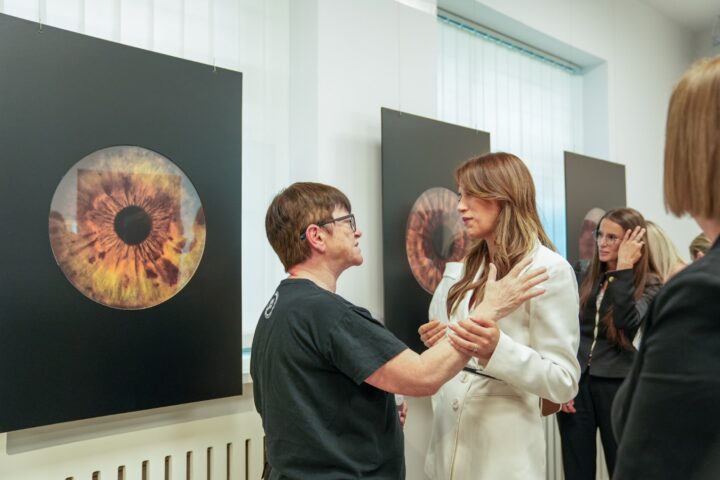
Kosovo’s Acting President, Albulena Haxhiu, paid an emotional visit on Thursday, June 18, 2026, to the groundbreaking exhibition “Sy më sy” (Eye to Eye). The public showcase lays bare the deeply personal and painful histories of women and men who survived sexual violence weaponized during the Kosovo War, shedding light on a trauma that families have quietly carried for decades.
The powerful art installation was organized and brought to life by the Kosovo Rehabilitation Centre for Torture Victims (KRCT) in a close, strategic partnership with Pro Peace Kosovo.
1. A Sovereign Debt: Recognition and Justice
Following her walkthrough of the gallery, Acting President Haxhiu delivered a poignant address, reminding the public and state institutions that survivors of wartime sexual violence are not passive victims of the past, but central figures of the state’s collective history and moral responsibility.
State Responsibility Matrix Outlined by Haxhiu

 [ BREAKING THE SILENCE ] ──► CORE HISTORICAL STATUS
 • Victims of wartime sexual violence must be permanently integrated into the
   national consciousness, rather than being pushed to the margins of memory.

 [ ENDING SYMBOLISM ]     ──► PERMANENT ENGAGEMENT
 • Haxhiu strongly rejected treating survivors as symbolic figures to be
   remembered solely on specific international or national memorial days.

 [ THE THREEFOLD OBLIGATION ] ──► STATE REPARATIONS
 • The Republic of Kosovo holds a direct institutional debt to provide
   comprehensive recognition, judicial justice, and a life lived with full dignity.
“I want to make it clear that individuals who endured sexual violence during the war are a fundamental part of our history and our state responsibility. They cannot remain on the periphery of our memory, nor can they only be mentioned on designated days.”
— Albulena Haxhiu, Acting President of Kosovo
2. The Human Eye as a Living Testament
Reflecting deeply on the artistic framework of the installation, which prominently utilizes high-resolution iris scans alongside personal testimonies, Haxhiu commented on the profound symbolism of the human eye.
The exhibition leverages the scientific reality that a person’s iris is a completely unique, unrepeatable blueprint of human identity. By extracting this intimate feature from everyday anonymity and bringing it face-to-face with the public, the presentation achieves a striking level of vulnerability.
                  ┌────────────────────────────────────────┐
                  │    "EYE TO EYE" CONCEPTUAL FRAMEWORK   │
                  └───────────────────┬────────────────────┘
                                      │
         ┌────────────────────────────┴────────────────────────────┐
         ▼                                                         ▼
  [ THE ARTISTIC VISUAL ]                                 [ THE MORAL CORE ]
  The human iris is isolated and                          The intense physical proximity
  projected as a raw, undeniable                          forces the viewer to confront the
  symbol of human presence.                               unspoken weight of survival and dignity.
3. Overcoming Generational Stigma
According to data presented by KRCT Director Feride Rushiti during the opening ceremonies, the exhibition’s title was chosen specifically because looking someone directly in the eyes is an universal demand for truth. The project intentionally documents the pain, fear, and extraordinary courage of survivors, while highlighting how entire families have coexisted with trauma and absorbed societal stigma in absolute silence to protect their loved ones.
| Structural Component of the Exhibition | Creative Delivery Method | Intended Societal Impact |
| Iris Scanning Profiles | High-definition biometric imaging of survivors and relatives. | Capturing the internal emotional landscape—strength, fear, and resilience—without exposing identities prematurely. |
| Personal Audio & Text Testimonies | Unfiltered, firsthand accounts of the 1998–1999 conflict. | Piercing through decades of systemic denial and providing historical documentation of war crimes. |
| Family Trauma Focus | Documenting the multi-generational impact on survivors’ children and spouses. | Shifting the narrative away from individual isolation toward collective social healing and institutional support. |
As international missions stand accused by local leaders of historically failing to rigorously investigate or prosecute war crimes committed by Serbian forces, Kosovo’s current domestic leadership is pushing for localized judicial mechanisms. For Acting President Haxhiu, ensuring that these thousands of distinct human stories receive concrete legal closure remains a vital pillar of Kosovo’s path toward complete transitional justice.