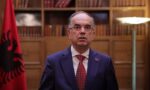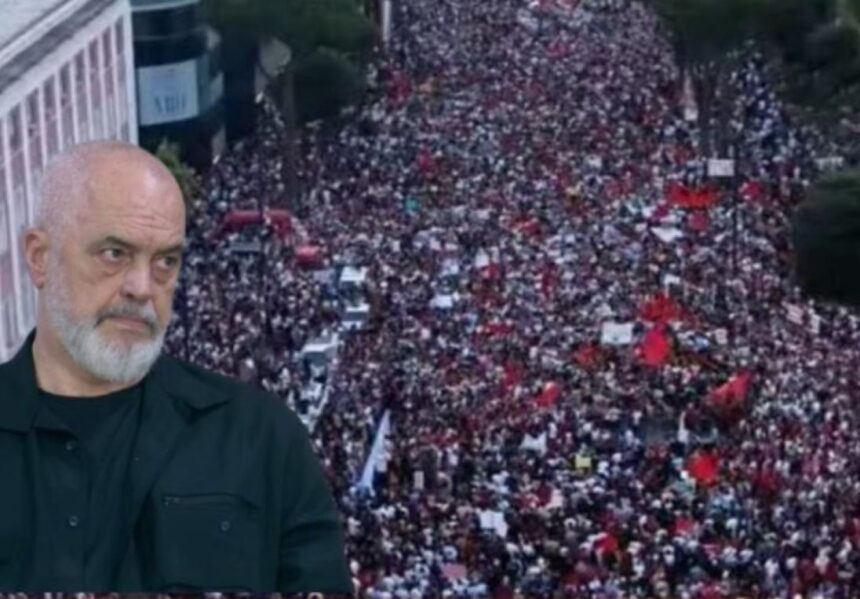
In an expansive interview with the Italian news agency Italpress, Albanian Prime Minister Edi Rama strongly pushed back against the wave of environmental and political protests known as the “Flamingo Revolution.”
The mass demonstrations, which have gripped Albania for over three weeks, target a multi-billion-euro luxury tourism development in the protected Vjosa-Narta wetland ecosystem and Sazan Island—a project backed by Jared Kushner’s Affinity Partners, the private equity firm belonging to U.S. President Donald Trump’s son-in-law. Rama dismissed the local uproar, arguing that the domestic environmental dispute has been hijacked internationally to serve as an extrajudicial political battleground against Donald Trump.
The “Flamingo Revolution” and the Geopolitical Chasm
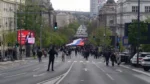
The protests erupted in late May 2026 when heavy machinery entered the sensitive coastal delta of Zvërnec near Vlorë, home to over 20,000 migratory waterbirds, including thousands of wintering flamingos. The bird has since become a potent symbol of anti-corruption and environmental defense across Albania, with tens of thousands marching through Tirana to demand Rama’s resignation.
| Dimension | The Domestic Reality vs. Rama’s Framing |
| Local Protest | Activists and independent citizens are fighting to preserve one of the last intact river-delta wildernesses in the Mediterranean from irreversible commercial destruction. |
| Rama’s Narrative | The Premier frames the international outcry as an elite left-wing crusade, claiming: “On a local level, it involves various social groups and the opposition, but internationally, it transforms into a targeted war against Donald Trump.“ |
| EU vs. US Friction | The dispute represents a deeper geopolitical clash. The European Union has heavily criticized Albania’s 2024 legislative relaxation of environmental laws to accommodate the 5-star resort, warning it could freeze Albania’s EU accession under Chapter 27 (Environment). |
[Kushner's Affinity Partners Proposes €5B Mega-Resort]
                          │
                          ▼
[Rama Government Rewrites Protected Area Laws to Allow Construction]
                          │
       ┌──────────────────┴──────────────────┐
       ▼                                     ▼
[Domestic Response: "Flamingo Rev."]  [EU Response: Accession Threat]
Mass protests in Tirana & Zvërnec;    Brussels warns changes violate
SPAK opens corruption/land probe.     acquis; demands strategic law repeal.
Rama’s Defense: “Bring the Evidence”
Speaking from Tirana, Rama steadfastly defended the estimated €5 billion mega-development, labeling it a necessary “blessing” to elevate Albania into the “Champions League of global tourism.” He rejected accusations of environmental vandalism or corruption, claiming that the legal mechanics are still ongoing.
Prime Minister Edi Rama on the Missing Proof: “If they accuse me of handing these lands over to someone or damaging a beautiful part of the Albanian coastline, then let them bring the evidence. Up to this day, nothing has been proven… We have not signed any final agreements yet because the negotiations are not complete.”
Rama added a paradox, stating that while he understood the initial anger of citizens based on the rumors they heard, they would “go home reassured” if they sat down with the government to review the actual blueprints. He noted that a parallel development being contested is occurring on purely private land, where the state has yet to issue final building permits.
Managing the Italy Immigrant Deal and EU Expansion
Turning away from the coastline, Rama also addressed the controversial Italy-Albania migrant screening centers, which have faced relentless judicial delays and political pushback in Rome and Tirana. Rama characterized the long-drawn-out political warfare as a prime example of “time wasted in futile public arena clashes,” reiterating that the agreement was forged “in good faith” to find alternative solutions to continental migration challenges.
Quoting Winston Churchill’s famous adage, “Never let a good crisis go to waste,” the Albanian Prime Minister concluded by asserting that despite environmental standoffs with Brussels or political friction with the West, Albania’s integration path into the European Union remains a structurally irreversible process.