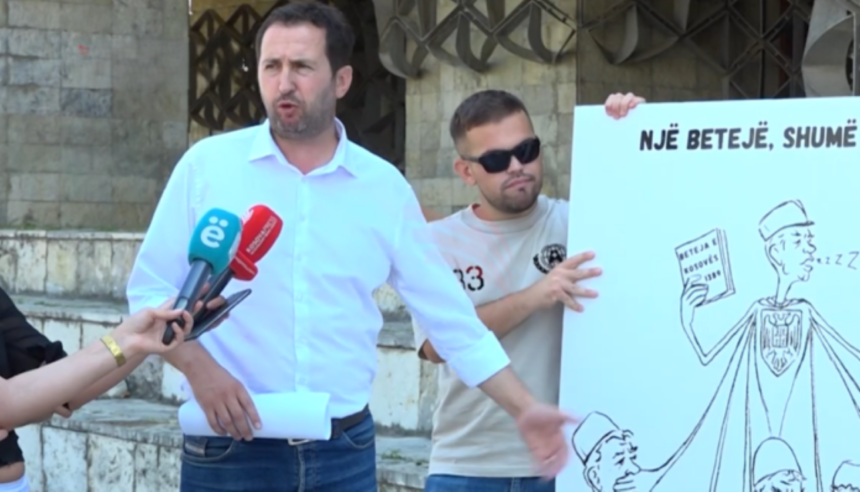
To mark the 637th anniversary of the Battle of Kosovo, prominent history professor Mentor Hasani, alongside students from the Department of History at the University of Prishtina, staged an educational exhibition outside the National Library of Kosovo.
The public display, titled “One Battle, Many Question Marks” (Një Betejë, shumë pikëpyetje), challenged long-held political narratives by highlighting critical historical data. Hasani argued that for centuries, the Serbian Orthodox Church and successive Belgrade political regimes have distorted the realities of the 1389 conflict, turning a historical event into an aggressive, nationalistic myth designed to serve shifting state ideologies.
Reclaiming Facts Over Political Weaponization
Speaking at the event, Professor Hasani emphasized that the primary objective of the academic initiative is to force a separation between scientific history and targeted geopolitical propaganda.
According to Hasani, the mainstream interpretation popularized across the Balkans does not withstand scholarly scrutiny when compared to contemporary medieval archives:
Prof. Mentor Hasani: “The Serbian political apparatus and Church transformed this clash into a national myth, building an ideological dimension that frequently stands in direct contradiction to historical facts. It is essential that this event is studied and interpreted based purely on scientific documents, rather than the political folklore constructed over centuries.”
The Reality of 1389: A Multi-Ethnic Balkan Coalition
A focal point of the presentation was the true composition of the anti-Ottoman defense forces. While modern state myths often depict the battle as an exclusively Serbian sacrifice, historical records demonstrate it was a multilateral regional alliance.
                [1389 Battle of Kosovo Forces]
                              │
            ┌─────────────────┴─────────────────┐
            ▼                                   ▼
 [The Ottoman Empire]                 [The Balkan Coalition]
 Led by Sultan Murad I                A broad defense pact containing:
                                      • Albanians (Arbër)  • Bosnians
                                      • Serbs              • Bulgarians
                                      • Hungarians         • Vlachs
                                      • Czechs
The Geopolitical Shift After the Clash
The exhibition detailed that the engagement fought in June 1389 served as a catalyst for the permanent expansion and institutional consolidation of the Ottoman Empire deeper into Southeastern Europe.
| Historical Dynamic | The Nationalist Myth | The Documented Historical Fact |
| Army Composition | An exclusively Serbian Christian defensive line protecting the gates of Europe. | A broad pan-Balkan coalition comprising Albanians, Serbs, Bosnians, Hungarians, and Vlachs. |
| Institutional Driver | A purely religious martyrdom narrative maintained continuously since the 14th century. | An ideological tool aggressively revived in the 19th and 20th centuries by the Serbian state to justify modern territorial expansion. |
| Strategic Outcome | A definitive turning point that instantly erased local sovereignty. | A grueling operational draw that exhausted both sides, eventually paving the way for systematic Ottoman consolidation across fragmented regional principalities. |
By breaking down these distortions directly on the campus of the University of Prishtina, Hasani and his students aimed to counter modern political manipulations. They concluded that demystifying 1389 is an active necessity for building objective historiography in the modern Balkans.