Plans within the European Union to “reward” Belgrade for recent judicial amendments have collapsed after six member states blocked the opening of Cluster 3 in Serbia’s EU accession negotiations. The decision marks a significant setback for President Aleksandar Vučić’s government, signaling that key European capitals are refusing to overlook deep-seated concerns regarding the rule of law and geopolitical alignment.
The Failed “Reward” Strategy
The diplomatic friction intensified following a report by Politico, which revealed that certain EU officials were preparing to endorse the opening of Cluster 3 (Competitiveness and Inclusive Growth). The move was intended to encourage Belgrade after it passed a modified set of judicial laws. These laws replaced a highly controversial legal package originally proposed by ruling SNS party MP Uglješa Mrdić.
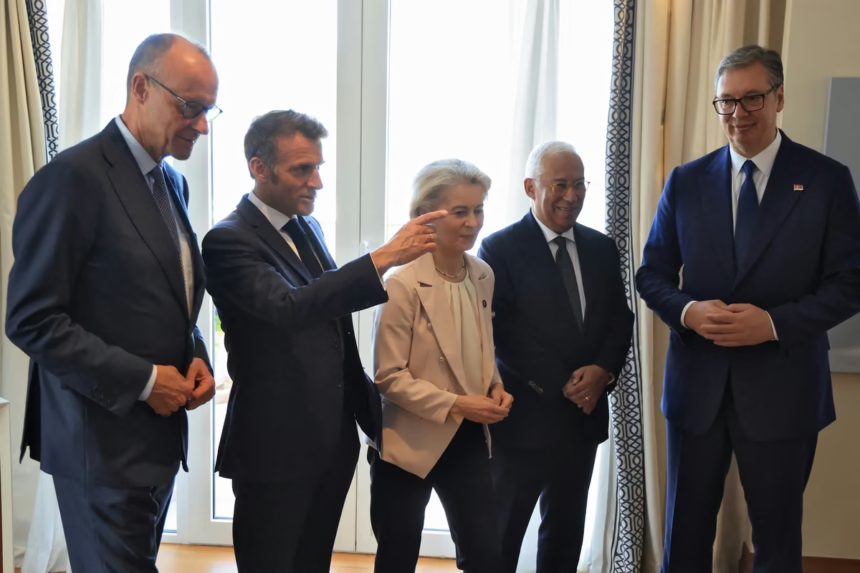
Supporters of the expansion, notably France and Italy, pushed an initiative to reward Serbia for what they framed as progress in judicial alignment and the adoption of ODIHR election recommendations. Diplomatic sources indicated a strong geopolitical motivation behind the push, with one EU official stating there was a “general feeling that we should not lose Serbia completely.”
Following the legislative changes, European Commissioner for Extension Marta Kos held talks with Serbian Parliament Speaker Ana Brnabić to discuss next steps, while Serbia’s chief negotiator to the EU, Danijel Apostolović, publicly advocated for the breakthrough, calling it a potential turning point to “break the vicious cycle” of stagnation.
The Rampa from The Six
However, the initiative failed to secure the mandatory unanimity required in Brussels. The Netherlands, Sweden, Belgium, Estonia, Latvia, and Lithuania firmly opposed the move, ensuring the negotiation path remains frozen until at least the autumn.
The resistance is sharply divided into two main diplomatic fronts:
- The Rule of Law Block: The Netherlands, Sweden, and Belgium argued that the legislative changes were merely cosmetic. A spokesperson for the Dutch Ministry of Foreign Affairs confirmed to Radio Free Europe (RFE) that opening Cluster 3 at this juncture “would not be merit-based,” citing persistent anxieties over the state of Serbian democracy.
- The Foreign Policy Block: The three Baltic states—Estonia, Latvia, and Lithuania—categorically reject advancing a candidate country that refuses to align with EU foreign policy, specifically regarding sanctions against Russia following the invasion of Ukraine.
Furthermore, member states expressed strong reluctance to hand the ruling party a major diplomatic victory during a potential election year. Sources noted that Brussels is determined not to appear as though it is actively supporting a single political actor in an active domestic race.
Faked Reforms and Regional Comparison
Domestic experts view the EU’s decision as an inevitable consequence of Belgrade’s reform strategy. Vladimir Međak of the European Movement in Serbia pointed out that the government has consistently feigned compliance rather than executing genuine democratic overhauls. According to Međak, critical benchmarks set during regional summits regarding media regulations (REM), ODIHR recommendations, and judicial independence remain entirely unfulfilled or handled through unconstitutional proposals.
Međak also criticized the historical context of the EU-Serbia relationship, contrasting Serbia’s stagnation with regional peers:
“Serbia has been negotiating for 12 years. There is no objective reason, other than a lack of political will from the authorities, why Serbia is not currently at the same stage as Montenegro, which is finalizing its accession talks. The fact that we are still debating the opening of Cluster 3 is the direct responsibility of Aleksandar Vučić’s leadership.”
The current impasse leaves Serbia in a prolonged state of accession immobility. The country has failed to open any new negotiating chapters or clusters in recent years, raising serious questions about the future trajectory of its European integration.