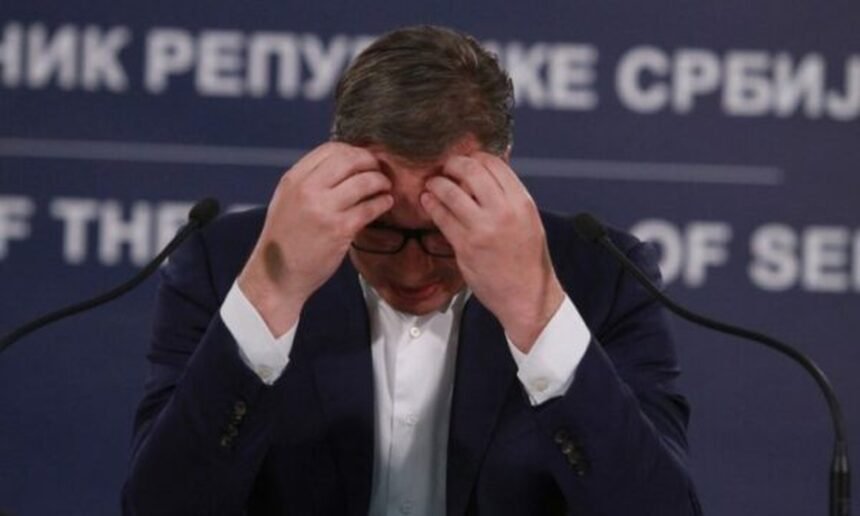
A violent new wave of gangland executions across Serbia has re-ignited fierce public debate over deep-seated connections between the ruling Serbian Progressive Party (SNS) and organized crime networks. The growing scandal is beginning to erode institutional trust, not just among typical opposition voters, but critically among sections of President Aleksandar Vučić’s own core base.
The crisis peaked following a brazen assassination at the high-end Restaurant “27” in Belgrade’s affluent Senjak neighborhood. Over a frantic two-week period, the official narrative took dizzying turns—shifting from initial reports that Belgrade Police Chief Veselin Milić directly actively helped suppress crime scene evidence, to later clarifications that he was not physically present when notorious gunman Saša Vuković (alias “Boske”) executed rival gangster Aleksandar Nešović (alias “Baja”).
Despite the shifting details, the core question gripping the Serbian public remains unanswered: Why was the head of the country’s largest police department dining with prominent figures of the criminal underworld?
A System of Shifting Alliances
According to Stevan Dojčinović, the editor-in-chief of the award-winning investigative journalism portal KRIK, the incident is merely a symptom of a completely integrated system.
Dojčinović emphasizes that the Serbian state structure, completely monopolized by the SNS, does not maintain static underworld partnerships. Instead, it opportunistically rotates alliances based on political convenience:
- Pre-2021 Era: The state apparatus maintained an incredibly close, collaborative relationship with sub-factions of the brutal Kavač clan.
- The Post-2021 Pivot: Following internal fractures and high-profile international scrutiny, the Kavač clan was suddenly branded an enemy of the state. Belgrade swiftly flipped its allegiances, partnering with a rival criminal syndicate to fill the vacuum.
Investigative metrics show that these aggressive systemic realignments have directly fueled a bloody mafia turf war. Over the past decade, more than 100 targeted contract killings have occurred across Serbia—frequently executed in broad daylight and crowded public spaces.
A Decade of Decoded Evidence
The allegations of a state-mafia nexus are no longer just journalistic theories; they have been thoroughly documented over the past ten years through Sky ECC encrypted chat logs, official court testimonies, and high-profile judicial proceedings.
Veteran journalist Branko Čečen traces this symbiotic relationship back to the absolute beginning of Aleksandar Vučić’s ascent to power. Čečen points out that figures emerging directly from notorious northern Kosovo criminal structures—such as Zvonko Veselinović and Milan Radoičić—were suddenly transformed into major state-backed contractors, securing lucrative infrastructure projects from the government.
Perhaps the most damning evidence surfaced during the prosecution of Veljko Belivuk, the leader of a notoriously sadistic Janissaries/Principi hooligan syndicate. Facing life in prison, Belivuk openly testified to prosecutors that he was ready to expose his direct line of communication to President Vučić, former Interior Minister Aleksandar Vulin, and the President’s brother.
Belivuk detailed a systemic relationship where the state requested physical favors, mobilized underworld muscle, and then discarded them when public scrutiny intensified. Subsequence evidence published by KRIK featured leaked audio logs from Gendarmery officer Nenad Vučković (“Vučko”), who was caught bragging to criminals that he directly controlled entire police divisions under the instructions of former State Secretary Dijana Hrkalović.
Mutual Benefits: Muscle, Money, and Marijuana
This relationship is built on strict, functional reciprocity. The state provides blanket institutional protection and legal immunity, while organized crime syndicates deliver essential political services:
- Protest Suppression: During major anti-government demonstrations over the past two years, reporters identified active soccer hooligans and mob muscle embedded within masked, state-sanctioned security details deployed to violently attack peaceful demonstrators.
- Stadium Censorship: Criminal syndicates tightly control the Belgrade soccer terraces, systematically intimidating fan bases to ensure that mass anti-Vučić chants are entirely suppressed during televised matches.
- Financial Kickbacks: Mob actions are not done purely for political protection. State officials reportedly receive direct financial cuts from lucrative underground enterprises.
The ultimate manifestation of this state-run enterprise is Jovanjica, a sprawling facility near Belgrade raided in 2019 that was exposed as one of the largest illicit marijuana plantations in Europe.
The farm’s owner, Predrag Koluvija, operated under the guise of an organic farmer while being actively protected by armed agents from the Security Intelligence Agency (BIA) and the Military Intelligence Agency (VOA).
“The state itself is involved in drug distribution,” Dojčinović stated bluntly. “We are no longer talking about simple bribery or corrupt individual officials. We are looking at the state entering into a direct joint business venture with organized crime.”
The Impunity Wall and Political Fallout
Despite an astronomical mountain of evidence, no high-ranking political figure has ever faced legal accountability. The Serbian prosecution routinely utilizes Sky ECC data provided by European law enforcement to jail low-level street operators, but systematically cuts off investigation trails before they can reach the ministerial level.
Whenever public outrage threatens to boil over, the regime executes a controlled arrest of a prominent asset, only to let the judicial process stall indefinitely to prevent the asset from turning state’s evidence.
However, as mass anti-violence protests continue to rock Serbian cities through 2026, analysts believe Vučić’s maneuvering space is severely shrinking. The brazen nature of the underworld killings is alienating his conservative, law-and-order voter base. While the constitution dictates that regular elections must be upheld, watchdogs warn that the regime’s growing reliance on extralegal structures is pushing Serbia dangerously close to a de facto autocracy.