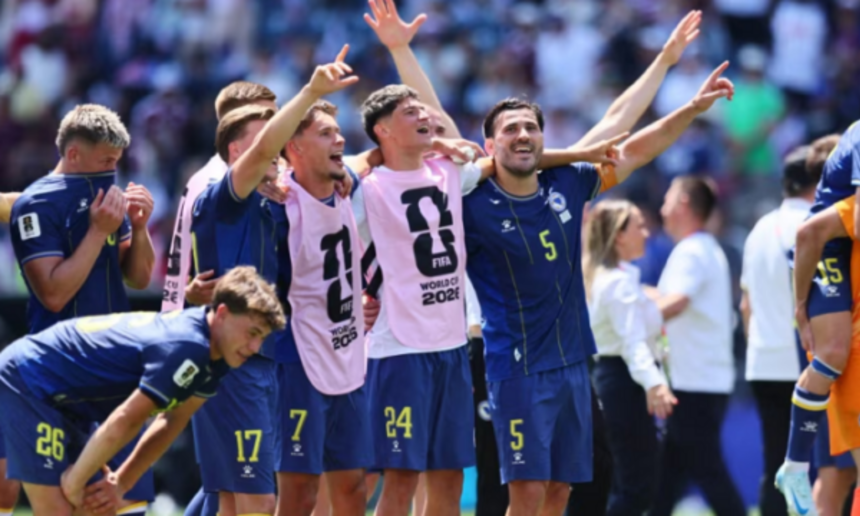
Of the 26 players representing Bosnia and Herzegovina, 17 were born abroad. The rest grew up in the country during the difficult post-war and transition years. Together, they have formed a team that has inspired supporters across Bosnia and Herzegovina and throughout the world, where more than two million Bosnians and citizens of Bosnia and Herzegovina now live in the diaspora.
While the favorites to win the FIFA World Cup have attracted global attention, Bosnia and Herzegovina’s national team—initially considered complete underdogs—has captured the hearts of football fans worldwide.
Their remarkable journey has made headlines across international media. Head coach Sergej Barbarez told the German newspaper Bild that his team’s Round of 16 match against the United States is a classic “David versus Goliath” battle.
“That has always worked well for us,” Barbarez said.
Tens of thousands of Bosnian supporters turned Seattle into a sea of blue and yellow during the team’s final group-stage match against Qatar, where Bosnia secured a historic qualification for the knockout stage and a meeting with the United States on July 2.
Among the crowd at Lumen Field was Irma Baralija from Mostar, who attended with her family.
“The stands are filled with our people from every corner of the world, and their life stories could become extraordinary Hollywood movies,” Baralija told Radio Free Europe/Radio Liberty (RFE/RL), describing the emotional experience of following Bosnia’s national team in the United States.
Although she now lives in Sarajevo, her family’s life remains closely connected to America. Her husband emigrated to the United States after surviving detention at the Heliodrom prison camp near Mostar during the war.
“Our first daughter was born in Los Angeles, and she took her first steps in Seattle,” Baralija said, recalling the years her family spent on the U.S. West Coast.
More than 350,000 people of Bosnian origin currently live in the United States. Some, like Esmir Bajraktarević, now proudly wear the Bosnia and Herzegovina jersey.
The 21-year-old midfielder was born in the United States to parents originally from Srebrenica, who lost many relatives during the Bosnian War.
Forced into exile, his family first settled in Switzerland before moving to the United States, where Bajraktarević was born in 2005. After making several appearances for the U.S. youth national teams, he chose to represent Bosnia and Herzegovina in 2024.
“I was born in America, but I have always seen myself as Bosnian,” Bajraktarević said on his FIFA profile.
He is far from alone.
Bosnia and Herzegovina’s large diaspora has shaped a uniquely international national team. Several players previously represented countries such as Sweden and Austria before ultimately choosing to play for the land of their heritage.
Their stories mirror those of countless Bosnians forced to flee the war, many of whom later sought to build bridges between two worlds.
“No matter where we come from or what our stories are, this national team and these incredible young men have united us,” Baralija said. “We are grateful for the joy they have given us.”
“So many wonderful things have happened to us here, but seeing our flag waving in America’s biggest stadiums and singing together with tens of thousands of fellow Bosnians is truly unforgettable.”
“Nothing Is Impossible”
For a country making only its second FIFA World Cup appearance, Bosnia and Herzegovina has also won the admiration of American fans.
Social media has been flooded with comments from Americans saying they have added Bosnia and Herzegovina to their travel bucket list.
Psychologist Vahida Gjedović believes the team has reminded people that nothing is impossible.
“These young men have helped us rediscover a sense of unity,” she explained. “At a time when people increasingly feel isolated, football has brought us together. We’ve organized public watch parties and shared unforgettable moments. It feels like we’re all one family again.”
Today, football in Bosnia and Herzegovina has become much more than a sport.
It has become the glue holding people together—a shared hope, a reason to celebrate, and perhaps even a source of healing.
“Emotions are contagious,” Gjedović said.
“When you’re in a stadium in Los Angeles and thousands of people sing ‘The fragrance of lilies spreads across the field,’ tears naturally come to your eyes. It becomes a form of collective healing.”
British war correspondent Ed Vulliamy, the first foreign journalist allowed into the Trnopolje camp in 1992, described football as the way “Bosnia turns nightmares into beautiful dreams.”
The importance of football during wartime is also documented by Sarajevo’s War Childhood Museum, the only museum in the world dedicated exclusively to preserving the experiences of people whose childhoods were shaped by war.
“Panini stickers became improvised football fields, marbles replaced real footballs, and school bags served as goalposts,” explained research manager Ajnura Akbaš.
“These objects and memories show how children created spaces for play and happiness even during war while maintaining a connection with the outside world.”
One of those children was Bosnia’s longtime captain, Edin Džeko.
Having grown up under the siege of Sarajevo, Džeko wrote in a letter to the city’s children before Bosnia’s opening World Cup match:
“I grew up during the war. Suddenly, I was living in a fairy tale. Nothing is impossible. Not even taking Bosnia and Herzegovina to the World Cup.”
According to official figures, 1,601 children were killed during the four-year Siege of Sarajevo.
Now 40 years old, Džeko is playing in his second FIFA World Cup. Like several of his teammates, he rejected opportunities to represent other countries in order to wear Bosnia and Herzegovina’s colors.
According to Gjedović, today’s national team has become the role model that young people have long been searching for.
“For a long time, Bosnia and Herzegovina lacked heroes people could identify with,” she said. “Every society needs symbols. Today, our national football team has become that symbol.”
Sociologist Amer Osmić shares a similar view, arguing that the team’s success represents much more than sporting achievement.
“Symbolically, they have shown that success is not reserved only for other societies or other countries,” he said in an earlier Radio Free Europe podcast.
His remarks come as Bosnia and Herzegovina continues to struggle with one of Europe’s highest youth unemployment rates, while United Nations research shows that every second young person in the country has considered leaving in search of better opportunities.
Bosnia and Herzegovina will face the United States in a historic Round of 16 match on July 2 in San Francisco.
Irma Baralija and her family will once again be in the stands.
“The result doesn’t matter,” she said. “What matters is that we play with heart and courage. Whatever happens, we are already winners.”
Federal Minister of Labor and Social Policy Adnan Delić described the match as “a moment that transcends sport.” His ministry has even proposed that employers across Bosnia adjust working hours on Thursday so citizens can watch the historic encounter.
The match is expected to attract a record television audience of around 30 million viewers in the United States alone.