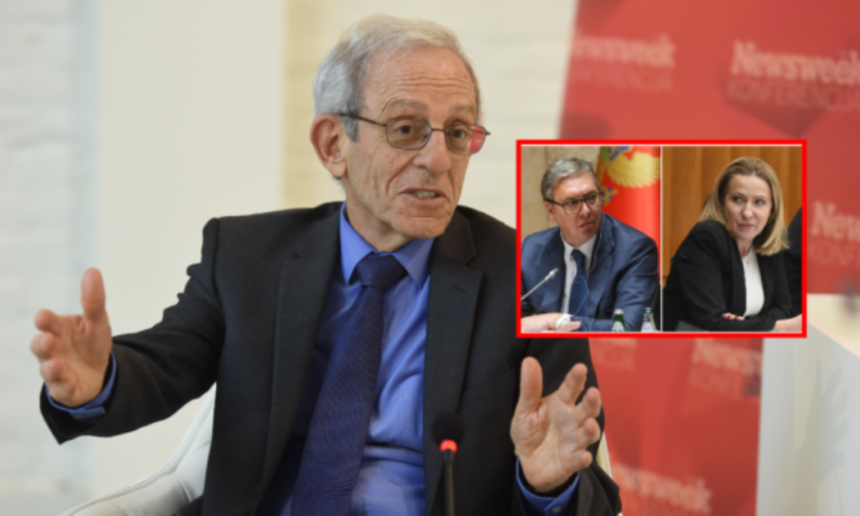
Daniel Serwer, a prominent professor at Johns Hopkins University in Washington, D.C., has issued a blistering critique following the scandalous statement made by Serbian Minister of State Administration and Local Self-Government Snežana Paunović, who recently stated on live television that she would have “ethnically cleansed Kosova in 1998” had she been in the position of wartime leader Slobodan Milošević.
Addressing the growing domestic and international demands for the minister’s immediate ouster, Serwer argued that the lack of concrete administrative action from the top of the Serbian state speaks volumes about its core political alignment.
A Damning Indictment of the Serbian Leadership
In an interview with N1, Professor Serwer emphasized that if Serbian President Aleksandar Vučić genuinely opposed the rhetoric of ethnic cleansing, the political consequences for Paunović would have been instantaneous:
“You know, if Vučić had even a single cell in his body that disagreed with this, he would remove her immediately. It is a statement so reprehensible that it is difficult to even describe. I could never imagine such a thing.”
Context of the Escalating Diplomatic Crisis
Serwer’s remarks add heavy academic and diplomatic weight to a rapidly expanding political crisis in the Western Balkans:
- The Initial Scandal: During a July 11 appearance on Kurir TV, Paunović (a high-ranking official of the Socialist Party of Serbia) openly romanticized the concept of ethnic cleansing in Kosova during the late 1990s.
- The Hypocrisy of “Distancing”: While President Vučić and Prime Minister Đuro Macut have structurally tried to distance the official policy of Serbia from her remarks to avoid Western diplomatic penalties, Serwer’s analysis highlights that keeping her within the government cabinet exposes a fundamental ideological tolerance for her views.
- Widespread Backlog: The statement has already resulted in Paunović being declared persona non grata in Pristina, facing a formal criminal complaint by Kosova’s Ministry of Justice, and enduring fierce pushback from the European Commission and the U.S. State Department.
Despite the escalating pressure from both local non-governmental organizations and international partners, Paunović remains in her ministerial seat after issuing an apology targeted at her own government leadership for the “inconvenience” rather than the victims of the 1990s conflicts.