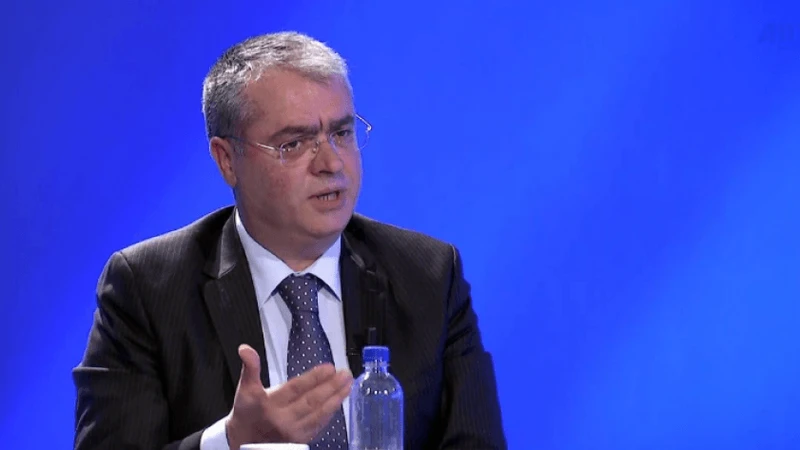
Arben Fetoshi, director of the Octopus Institute for Hybrid Warfare Studies, has described a campaign involving trucks equipped with large digital screens on the streets of New York as part of what he says is a broader communications strategy aimed at influencing Western public opinion and portraying Kosovo as a state that oppresses its Serb community.
In an analysis titled “The ‘Victimization’ Trucks in New York,” Fetoshi characterized the campaign as a coordinated effort by Serbia and Russia that, in his assessment, seeks to pressure Western governments and promote a narrative portraying Kosovo as responsible for the alleged persecution of Serbs.
Fetoshi argued that neither the timing nor the location of the campaign was accidental. The trucks appeared in New York shortly before the opening of the UN General Assembly’s General Debate and High-Level Week, when the city becomes a major center of international political, diplomatic and media activity.
According to Fetoshi, this timing significantly increases the potential international exposure of the messages being displayed.
Although organizers have presented the campaign as a humanitarian initiative, Fetoshi claims that the visual material combines authentic footage from different periods and events into a single narrative.
He argues that the presentation is intended to create the impression that Serbs in Kosovo have faced a continuous pattern of persecution.
“This is a propaganda apparatus that has selected real footage from different events over time and turned it into ‘evidence’ of the continuous persecution of Serbs,” Fetoshi wrote, adding that the campaign also includes messages expressing support for U.S. President Donald Trump.
The screens have reportedly displayed footage from the March 2004 unrest in Kosovo, as well as arrests, protests and institutional interventions from subsequent years.
Fetoshi argues that removing these events from their individual historical contexts and presenting them as a single sequence is intended to create the impression of a continuous pattern of violence against Kosovo Serbs.
He also pointed to what he described as a change from similar campaigns over the past two years. According to Fetoshi, previous campaigns displayed claims concerning alleged crimes by the Kosovo Liberation Army (KLA), while such material has not been evident in this year’s campaign so far.
He linked the change to recent statements by Serbian officials and what he described as Belgrade’s efforts to present its narrative concerning the KLA as having already been established.
Fetoshi also connected the New York campaign with remarks by Serbian President Aleksandar Vučić ahead of his address to the UN General Assembly.
In his assessment, the digital-screen trucks represent a “parallel visualization” of the same political narrative that Belgrade is expected to advance through diplomatic channels.
He further argued that the narrative corresponds with Russian claims about what Moscow describes as the West’s application of “double standards.”
Fetoshi referred to statements by Russian Foreign Minister Sergey Lavrov and coverage by RT Balkan, which described the campaign under the headline “Kurti’s Terror Against Serbs Has Reached New York.”
According to Fetoshi, the Serbian and Russian messaging seeks to connect allegations concerning the KLA with Kosovo’s statehood, NATO’s 1999 intervention and current developments in northern Kosovo.
He argued that Russia, in turn, uses the narrative to contend that NATO’s 1999 intervention was illegal and to accuse Western countries of hypocrisy.
Fetoshi concluded that the campaign is aimed not only at Kosovo’s international image but also at broader Western relations with the Balkans.
“The screen trucks in New York have exported the most dangerous ‘commodity’ for Western values and cohesion, for U.S. leadership and for the fragile peace in the Balkans,” Fetoshi concluded.