More than two years before the next U.S. presidential election, potential contenders from both major parties are increasingly positioning themselves for what is expected to be an open 2028 race.
President Donald Trump is constitutionally barred from seeking a third elected term under the 22nd Amendment, meaning the Republican Party will have to compete for a new presidential nominee when Trump’s current term ends.
No major-party candidate has formally launched a 2028 presidential campaign yet, but a broad field of potential contenders is already emerging.
Democrats weigh a wide-open field
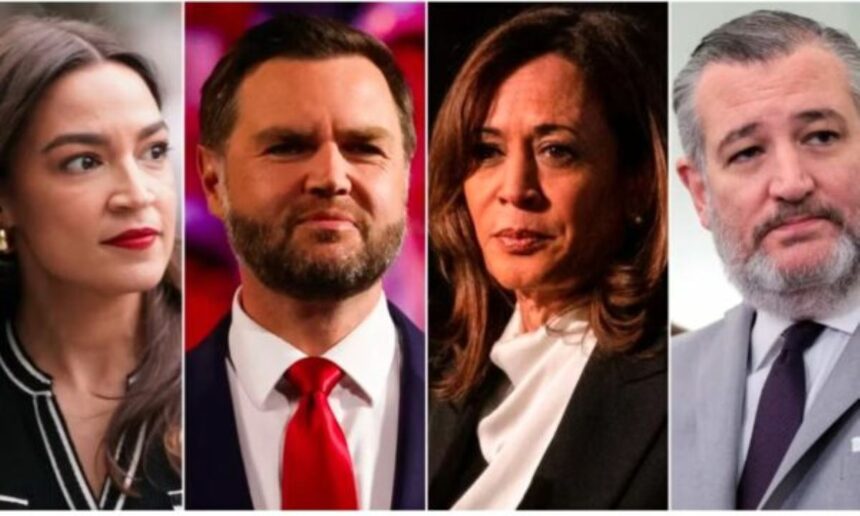
Among Democrats, former Vice President Kamala Harris remains active on the political stage and is again being discussed as a potential candidate. Harris has been campaigning for Democratic candidates ahead of the 2026 midterm elections while weighing whether to seek the presidency again.
Representative Alexandria Ocasio-Cortez is another prominent name being discussed, particularly among the party’s progressive wing. She has not formally announced a presidential campaign.
A number of Democratic governors and senators are also attracting attention, including Illinois Governor JB Pritzker, Kentucky Governor Andy Beshear, Pennsylvania Governor Josh Shapiro and Georgia Senator Jon Ossoff.
Arizona Senator Mark Kelly has also said he would seriously consider a presidential campaign, while national political coverage continues to identify California Governor Gavin Newsom, former Transportation Secretary Pete Buttigieg and Maryland Governor Wes Moore among the potential contenders.
Beshear has recently increased his national profile, including through a book tour and public discussion of housing affordability as a potential national policy issue. He has not confirmed a 2028 bid.
Ossoff, meanwhile, is seeking re-election to the Senate in Georgia and has attracted growing national attention, although he has denied that he is currently preparing a 2028 presidential campaign.
The Democratic field remains particularly unsettled. Recent political assessments describe it as broad and fluid, with no candidate having formally entered the race.
Republicans look toward the post-Trump era
On the Republican side, Vice President JD Vance is among the most frequently discussed potential successors to Trump.
Senator Ted Cruz has also kept the possibility of another presidential campaign open. Cruz, who sought the Republican nomination in 2016, recently argued that the 2028 GOP primary should be an open contest rather than assuming that Trump has a predetermined successor. He has not formally declared a campaign.
Other Republican figures frequently mentioned in discussions of 2028 include Texas Governor Greg Abbott, Florida Governor Ron DeSantis and Senator Rick Scott. Senator Rand Paul has also left open the possibility of another presidential bid.
The Republican field could ultimately expand considerably as the 2026 midterm elections approach and the party begins assessing its direction after Trump.
Why the 2026 midterms matter
The November 2026 midterm elections are expected to provide potential presidential contenders with an important national platform.
Governors and senators running in competitive races will have opportunities to test their messages, build donor and political networks, increase national visibility and demonstrate their ability to mobilize voters.
For some potential candidates, the results of the midterms could also influence whether they ultimately enter the 2028 presidential contest.
At this stage, however, the field remains fluid. Many of the politicians being discussed may ultimately decide not to run, while additional candidates could emerge over the next two years.
What is increasingly clear is that both parties are already beginning to prepare for the first presidential election of the post-Trump era.