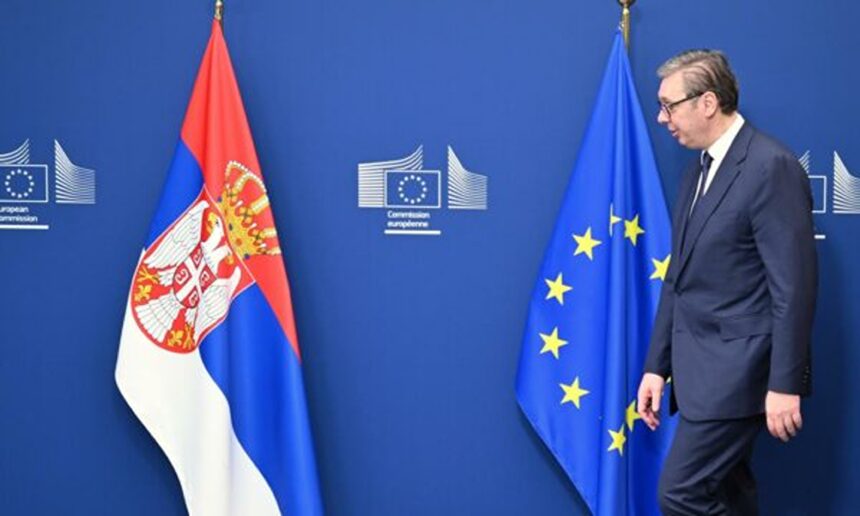
The European Commission has reminded Serbia of its obligations as an EU candidate to align its foreign and security policies with those of the bloc, including EU restrictive measures against Russia, following a phone conversation between Serbian President Aleksandar Vučić and Russian President Vladimir Putin.
Speaking to Radio Free Europe, European Commission spokesperson Guillaume Mercier said Serbia was expected to align its policies with EU objectives and act as a reliable partner following the same strategic direction.
“As a candidate country, Serbia is expected to align its policies with the EU’s objectives, including energy and foreign policy, and to be a reliable partner that follows the same strategic direction,” Mercier said.
He stressed that the EU’s position regarding candidate countries’ relations with Russia remained clear, given Russia’s war against Ukraine.
“Relations with Russia cannot develop as if everything were as before with Putin’s regime, in the shadow of Russia’s aggressive, unprovoked and unjustified war against Ukraine,” Mercier said.
His comments came a day after Vučić spoke by phone with Putin on September 26, discussing Serbia’s gas supply arrangements with Russia and bilateral cooperation.
Following the conversation, Vučić said he believed Serbia’s gas agreement with Russia would be extended. The current short-term arrangement is due to expire on September 30.
Serbia remains heavily dependent on Russian gas, while Belgrade has been seeking extensions of its supply arrangements rather than concluding a new long-term agreement since the previous three-year contract expired in 2025.
EU Calls for Greater Foreign-Policy Alignment
The European Commission said it was aware of the Vučić-Putin conversation and referred to Serbia’s obligations stemming from its EU membership bid.
In response to Vučić’s remarks that future Serbian presidents should protect the country’s interests while maintaining a balance among major international actors, Mercier reiterated that applying for EU membership entails a commitment to align Serbia’s policies with those of the bloc, including foreign and security policy.
“Serbia’s alignment with our Common Foreign and Security Policy continues to be significantly lower than that of other candidate countries in the Western Balkans,” Mercier said.
The Commission has repeatedly called on Serbia to increase its alignment with EU foreign policy and restrictive measures against Russia. The European Commission’s latest available enlargement assessment also notes that Serbia has not aligned with EU restrictive measures against Russia.
The EU has continued to expand and update its sanctions regime against Russia, including a 21st package adopted in July 2026.
Mercier said the bloc wanted Serbia to become a more reliable partner and intensify efforts to achieve a “more consistent and significantly higher” level of alignment, including on sanctions against Russia.
Energy Dependence Remains a Key Issue
The Commission also highlighted its efforts to strengthen energy security across the Western Balkans by reducing dependence on fossil fuels and diversifying energy sources and supply routes.
The EU has been implementing measures to phase out Russian energy imports. Under the REPowerEU framework, Russian LNG imports are being phased out during 2026, while Russian pipeline gas imports are scheduled to end by no later than November 30, 2027.
For Serbia, the issue is particularly sensitive because of its dependence on Russian gas and its longstanding energy relationship with Moscow.
The Commission argued that greater diversification would allow Western Balkan countries to integrate their energy networks more effectively and access supplies from different sources.
“After Russia’s aggression against Ukraine began, we saw how important this is and what problems it can cause for any European country, including Serbia,” Mercier said.
Serbia has been an EU candidate since 2012, with accession negotiations formally opened in 2014. Its continued lack of alignment with the EU’s foreign and security policy, including its position on Russia, remains one of the issues discussed in the accession process.
The Commission’s comments followed Vučić’s final days in office before his resignation as president, as Serbia prepares for parliamentary elections scheduled for October 25.