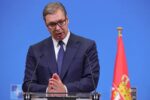
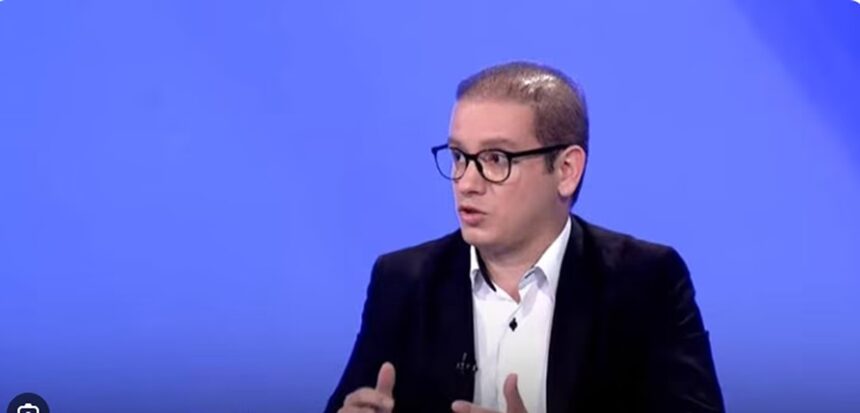
Developments in Serbia and Russia’s support for Serbian President Aleksandar Vučić could also have an impact on Kosovo, security expert Gurakuç Kuçi says. Speaking to Kosovapress, he said Kosovo continues to be used by Belgrade as a political instrument.
According to him, Serbia is using the Kosovo issue to serve its domestic political agenda, particularly to mobilize voters through nationalism.
“They have actually already begun influencing their elections in Kosovo because, among other things, they want to manipulate Serbs in Kosovo. They also want to exert influence through nationalism and, in this way, continue to use Kosovo, as they have in the past, as a tool for nationalists and, more precisely, radicals in Serbia to gain and maintain power.
As such, they are using Kosovo as leverage on two fronts. The first is to preserve their power, while the second is to present themselves as a factor of both stability and instability. Specifically, the Vučić regime seeks to convey the message that we have the ability to destabilize the region, while also having the ability to keep it stable, and that everything for the region depends on our victory.
In this way, they are encouraging the public in Serbia, as well as the international community, not to put too much pressure on Aleksandar Vučić, which could ultimately allow him to lose power. So, they are already using Kosovo as leverage, as well as the Serbs in Kosovo. In addition, they are exerting tremendous pressure on international missions to allow elections to be held illegally within the Republic of Kosovo, as they have done in the past,” he said.
The security expert said that, through this approach, Belgrade seeks to portray itself simultaneously as a factor capable of influencing regional stability and as a factor capable of causing destabilization.
He also commented on Russian President Vladimir Putin’s support for Vučić, describing it as an indication that the strategic closeness between the two countries continues.
“This current message shows that, so far, at no point have they pursued a policy of moving Serbia away from the Russian orbit. Nor has there been any successful development that would bring Serbia closer to the West.
As such, Putin has offered full support, demonstrating that their strategies are aligned. When we consider that the concept of the ‘Serbian World’ emerged precisely during the period when the Russian Orthodox Church was promoting and sanctifying the concept of the ‘Russian World,’ it becomes clear that there is now full coordination of their strategy of unification and global multipolarism, a strategy aimed at expanding the influence of Serbia and Russia throughout the Balkans,” he said.
Speaking about security in the region, the expert also raised concerns over Serbia’s cooperation with Russia and developments related to hybrid warfare.
He said Kosovo must be prepared for various scenarios, including cyber threats and attempts to destabilize the country through incidents or the incitement of conflicts.
“Nevertheless, we must remain vigilant because Russia is already promoting hybrid warfare on a very large scale. Given Serbia’s extensive cooperation with Russia, this represents a significant threat.
The European Union is taking major steps to prepare, and Kosovo should join these efforts in order to protect itself. In addition to conventional terrorist threats, they can also wage hybrid warfare through cyberattacks, as well as through destabilization involving various incidents linked to different groups and the incitement of conflicts—for example, incidents initiated through a staged fight or something similar,” Kuçi said.