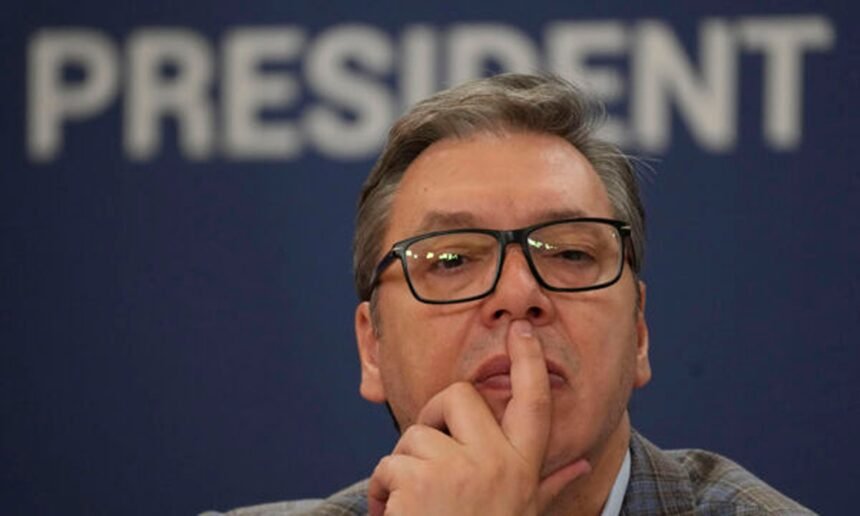
For more than a decade, Aleksandar Vučić has been a central figure in Serbia’s policy toward Kosovo, participating in negotiations with Prishtina and accepting agreements that contributed to the integration of Serbian police officers, judges and other structures into Kosovo’s institutional system.
At the same time, Belgrade has maintained significant political, institutional and financial influence over the Serb community in Kosovo, while Srpska Lista has emerged as the dominant political force among Kosovo Serbs.
But one element of Serbia’s Kosovo policy did not begin with Vučić: Belgrade’s opposition to Kosovo’s independence.
That position has been maintained throughout his 14 years in power and, according to analysts cited by Radio Free Europe, is unlikely to change simply because Vučić is no longer president.
Vučić resigned as president of Serbia on September 27, ending his second presidential mandate. His resignation, however, does not necessarily mark the end of his political career. He has indicated that he intends to seek the post of prime minister if his Serbian Progressive Party (SNS) forms a new government following the October 25 parliamentary elections.
“The struggle begins now,” Vučić told supporters after resigning, presenting his departure from the presidency as the beginning of a new phase rather than the end of his political career.
Kosovo’s status is embedded in Serbia’s constitutional framework
Kosovo occupies a specific place in Serbia’s Constitution. Its preamble defines Kosovo as an integral part of Serbia with substantial autonomy and assigns state institutions the responsibility of protecting Serbia’s interests there.
The Constitution was adopted in 2006, before SNS came to power and two years before Kosovo declared independence.
Marko Savković of the Belgrade Centre for Security Policy told Radio Free Europe that opposition to Kosovo’s statehood is likely to remain state policy regardless of who governs Serbia.
“When it comes to challenging Kosovo’s statehood as a concept, that is certainly state policy, and continuity can be expected regardless of who comes to power in Serbia,” Savković said.
He added that political forces willing to accept Kosovo’s de facto statehood remain relatively few and politically marginal in Serbia.
The position of Serbia’s student movement, which has emerged as a major political challenger to Vučić, also illustrates the issue. In a memorandum published in May, the students described Kosovo as an “inalienable and integral part” of Serbia. Their criticism of Vučić has focused largely on developments during his rule, including the replacement of Serbian licence plates, the use of the Serbian dinar and the closure of institutions operating under Serbia’s system, rather than on calls for recognition of Kosovo.
Sonja Biserko of the Helsinki Committee for Human Rights in Serbia likewise argued that a change of government would not necessarily lead to a rapid change in Serbia’s position on Kosovo’s status.
“Certainly, everyone will try to use Kosovo for emotional mobilization and to rally supporters in times of crisis. Essentially, there will be no change regarding the status of Kosovo,” Biserko said.
What could change without Vučić?
While Kosovo’s status may remain unchanged, the way Belgrade exercises influence over Kosovo Serbs could potentially undergo greater changes.
During Vučić’s rule, Srpska Lista became the principal political vehicle of Belgrade’s influence among Kosovo Serbs. Founded in 2013 with support from Belgrade, the party has since become the dominant political organization among the Serb community in Kosovo.
The strength of that relationship became particularly evident in November 2022, when Srpska Lista called on Serbs to withdraw from Kosovo’s institutions in the north. Serbian police officers, judges, prosecutors and local officials subsequently resigned from their positions.
Belgrade’s relationship with Kosovo Serbs, however, extends beyond party politics.
For thousands of people, Serbia remains a source of salaries, pensions, social benefits and employment. Although Kosovo authorities closed a number of institutions operating under Serbia’s system during 2024 and 2025, Serbian-funded education and healthcare services continue to operate.
This has created two layers of influence: a political infrastructure associated with Serbia’s current leadership and a broader institutional and financial network.
Savković said the political infrastructure established during Vučić’s era could face significant difficulties if his political bloc loses power, including challenges related to financing, leadership and political identity.
That would not necessarily mean Serbia would stop supporting Serbs in Kosovo. Rather, the question would be how that support would continue and how closely it would remain linked to political control from Belgrade.
Biserko said a change of government could create an opportunity for a different approach toward Kosovo Serbs, including greater emphasis on dialogue with Prishtina.
What happens to the Kosovo-Serbia dialogue?
For more than a decade, Vučić has represented Serbia in most of the major stages of the dialogue process with Kosovo, negotiating on behalf of Belgrade and accepting commitments.
In 2023, Kosovo and Serbia accepted the Agreement on the Path to Normalisation of Relations and its implementation annex.
A change of government in Belgrade would not automatically erase commitments already undertaken by Serbia, but it could alter the way the dialogue is conducted.
Toby Vogel of the Brussels-based Democratization Policy Council argued that the dialogue has become overly associated with Vučić himself.
According to Vogel, Vučić used the process to build political capital with European partners while presenting himself as a reasonable and constructive actor without making what Vogel described as significant concessions or reaching a genuine compromise.
He also argued that the dialogue has too often focused on managing crises between Kosovo and Serbia rather than achieving substantive normalization.
Political changes in Belgrade could therefore also provide an opportunity for the European Union to reassess its approach to the process.
“It will not be Vučić”
What Serbia’s new political phase will mean for its Kosovo policy remains uncertain.
But Vučić himself drew a clear line around his position in 2019, saying that a future Serbian government or president might eventually recognize Kosovo’s independence, but that it would not happen under his leadership.
Seven years after that statement, Vučić has left the presidency.
A different political figure may eventually occupy the country’s top offices.
Whether that will also mean recognition of Kosovo remains a separate question.