The European Commission has proposed a new framework to strengthen safeguards for future EU member states, including measures that could reduce funding or, in the most serious cases, suspend their voting rights if they backslide on the rule of law or breach core EU values.
The proposals were unveiled Tuesday as part of the Commission’s package on pre-enlargement policy reviews, designed to prepare the European Union’s institutions, policies and budget for future enlargement.
The Commission said the proposed safeguards would apply after accession and complement existing mechanisms under the EU treaties. A new institutional safeguard would address serious breaches of Article 2 of the Treaty on European Union and the principle of sincere cooperation.
In the most serious cases, the measures could include suspension of a new member state’s voting rights in the Council. Other measures could include reductions in EU funding and temporary restrictions in specific policy areas. The safeguards would be targeted, temporary, reversible and subject to regular review.
The Commission also proposes significantly extending the period during which existing sectoral safeguards can be activated, including in areas such as the economy, the internal market, and justice and home affairs.
The initiative reflects concerns over the possibility that a country could make substantial progress during accession negotiations but subsequently backslide after joining the Union.
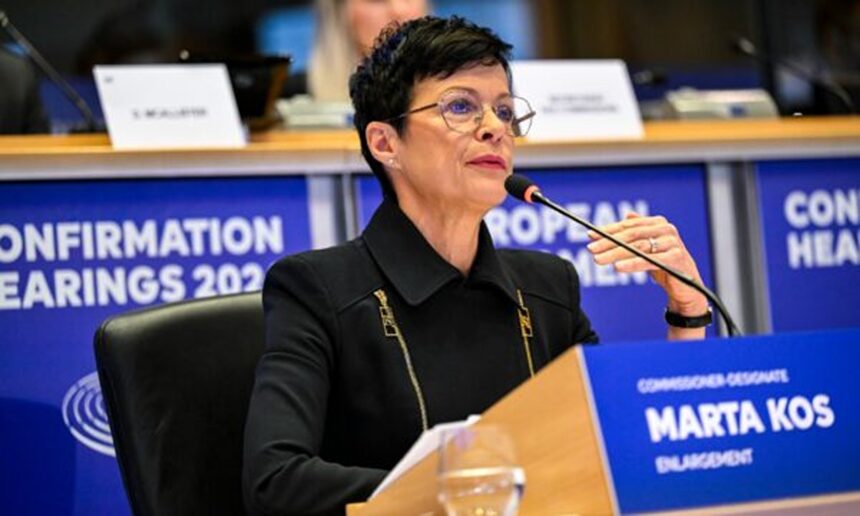
Commissioner for Enlargement Marta Kos said the EU needed stronger mechanisms to prevent such developments, arguing that the Union must be prepared for a larger membership while protecting its values and ability to function effectively.
Lessons from previous enlargements
The proposed safeguards build on mechanisms already used in previous accession treaties. The Commission said future treaties should provide stronger protection against serious backsliding on commitments made during accession negotiations.
The package also proposes transitional arrangements where necessary, including in areas such as the free movement of workers and services, agriculture, sensitive products, funding and participation in common EU systems.
For a limited period, a new member state could also commit not to block future EU enlargement because of bilateral disputes.
The Commission is also exploring ways to make the existing Article 7 procedure more effective, including possible timeframes. Article 7 can be used when an EU member state is accused of seriously violating the Union’s fundamental values.
Gradual integration before full membership
Alongside the safeguards, the Commission is proposing a more structured approach to the gradual integration of candidate countries into the EU.
The aim is to allow countries that make sufficient progress to participate earlier in selected EU policies and programmes, while maintaining full accession as the ultimate objective.
The Commission plans to identify opportunities for closer integration in strategic sectors including energy, transport, digital technologies and defence. Candidate countries could also gain earlier access to certain EU programmes and elements of the Single Market, provided they meet the relevant conditions.
The Commission stressed that gradual integration would remain conditional and reversible, and would complement rather than replace the accession process.
Annual dialogues with enlargement partners are planned to assess progress, identify additional opportunities and address remaining obstacles.
Stronger rule-of-law monitoring
The package also proposes extending the EU’s rule-of-law monitoring to additional candidate countries as they become ready.
The Commission said the annual Enlargement and Rule of Law Reports would remain key instruments for monitoring progress and identifying shortcomings in democratic institutions and the rule of law.
The EU also plans to work with candidate countries before accession to test their capacity to implement EU rules in areas such as border management, Single Market supervision, food safety, transport networks and cohesion funding.
The Commission said tailored transitional arrangements could be negotiated for individual countries, while public procurement procedures, independent auditing and anti-fraud capacities would also be tested before accession.
Preparing the EU for a larger membership
The broader package is intended not only to prepare candidate countries but also to make the EU itself capable of functioning effectively with more members.
The Commission is proposing greater use of existing treaty mechanisms, including qualified-majority voting in selected areas and for certain intermediate decisions in accession negotiations.
It also wants to explore enhanced cooperation as a way of overcoming persistent blockages among member states.
The Commission said the package does not change the merit-based nature of enlargement, with accession continuing to depend on each candidate’s progress in meeting the required reforms.
As part of its 2026 Enlargement Package, the Commission said it will also present indicative roadmaps for Montenegro, Albania, Moldova and Ukraine, provided they maintain momentum on reforms.