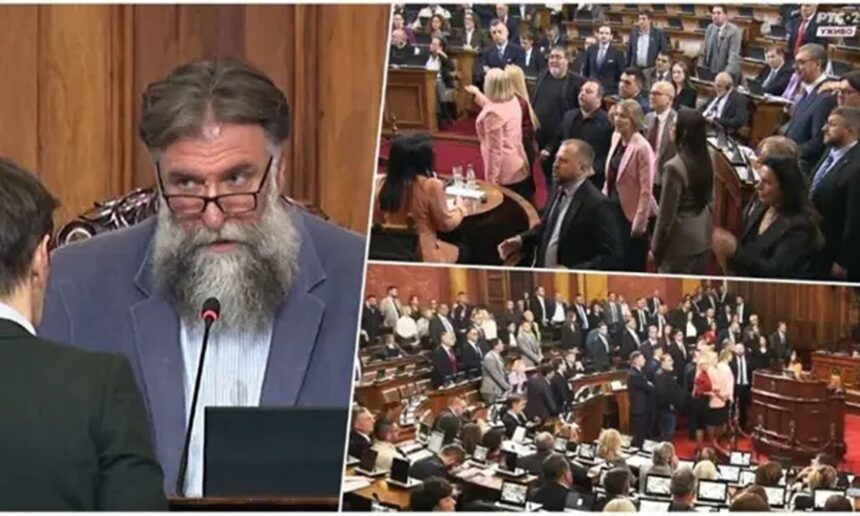
The closure of Serbian parallel institutions in Kosovo has triggered a new political confrontation in Belgrade, where President Aleksandar Vučić is facing criticism over agreements Serbia signed with the Republic of Kosovo. During a session of Serbia’s National Assembly, members of the Student List accused the previous Serbian government of relinquishing institutions that operated outside Kosovo’s legal system through the Brussels Agreement.
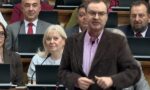
During the parliamentary session, Student List MP Feda Dimović challenged Vučić and other representatives of the previous government, reminding them that the 2013 Brussels Agreement had been signed by Ivica Dačić, who was Serbia’s prime minister at the time.
Dimović, who is also a member of the music group “Beogradski Sindikat”, responded to claims that he was part of a “Brussels syndicate”.
“We heard that I am part of a ‘Brussels syndicate’, although there are people here who signed the Brussels Agreement together with Ivica Dačić and handed over all Serbian state institutions in Kosovo. And yet, they dare to call someone else part of a ‘Brussels syndicate’,” Dimović said.
Vučić denied having signed the agreement, attributing responsibility to Dačić.
“Ivica Dačić signed the Brussels Agreement, not me,” Vučić replied.
The confrontation highlights the contradictions within Serbia’s political establishment: Serbian officials negotiated and signed agreements with Kosovo, but continue to portray their implementation as a political defeat for Serbia.
Kosovo Closes Structures Operating Outside Its Legal Order
Since early 2024, the authorities of the Republic of Kosovo have undertaken operations to close Serbian parallel institutions operating outside the country’s constitutional and legal framework.
Initially, three parallel municipal offices in Peja, Istog and Klinë were closed. On 30 August 2024, five additional institutions were closed in northern Kosovo.
On 15 January 2025, the operations continued in ten municipalities south of the Iber River, where parallel municipal offices, post offices and tax offices operating under Serbia’s system were closed.
The Government of Kosovo has described these structures as institutions operating outside the laws of the Republic of Kosovo. Elbert Krasniqi, who was then Minister of Local Government Administration, stated that they undermined Kosovo’s constitutional and legal order.
The closure of these structures is part of the efforts by Kosovo’s institutions to exercise their authority throughout the country’s territory. The issue does not concern the right of Kosovo Serbs to public services and representation, but rather the operation of another state’s institutions outside Kosovo’s legal order.
Criminal Complaint Filed Against Vučić, Dačić and Other Former Serbian Officials
On 16 November, representatives of three Serbian organisations from Kosovo filed a criminal complaint with the Higher Public Prosecutor’s Office in Belgrade against Aleksandar Vučić and several other former Serbian state officials.
The complaint also names former prime ministers Ivica Dačić and Ana Brnabić, former head of the Office for Kosovo, Petar Petković, and former Serbian List leader Goran Rakić.
The signatories accuse them of exceeding their powers and taking actions which, according to their allegations, contributed to Kosovo becoming a sovereign and independent state.
The complaint was signed by Momčilo Trajković, president of the Serbian National Forum; Marko Jakšić and Slaviša Ristić of the Homeland movement; and Ljubiša Dabić and Momir Stojanović of the Serbian National Council of Kosovo.
They are calling for an investigation into the agreements reached during the Kosovo-Serbia dialogue, including the 2013 Brussels Agreement, the Washington Agreement, the Ohrid Agreement and the Franco-German Plan.
Their demands also include investigations into the integration of police and judicial structures into Kosovo’s system, the role of the Serbian List, allegations of pressure on Kosovo Serbs regarding participation in elections in Kosovo, and the allocation of funds provided by Serbia for Serbs and institutions in Kosovo.
The organisations allege that there are suspicions of misuse of these funds and are calling for an investigation by the Serbian prosecution.
Calls for Investigations into Banjska Attack and Oliver Ivanović’s Murder
The criminal complaint also includes demands for investigations into the 2018 murder of Kosovo Serb politician Oliver Ivanović and the armed attack in Banjska, Zvečan, on 24 September 2023.
Momčilo Trajković said the organisations want investigators to examine possible links between the individuals named in the complaint and Ivanović’s murder.
Regarding Banjska, where an armed group of Serbs attacked the Kosovo Police and killed Sergeant Afrim Bunjaku, Trajković called for financial transactions and communications to be examined.
According to him, investigators should establish whether the individuals named in the complaint had prior knowledge of the attack or contributed to it.
These are allegations submitted in the criminal complaint and require investigation by the competent authorities. The armed attack in Banjska, however, remains a serious case raising questions about Serbia’s responsibility for the activities of armed groups that operate against Kosovo’s institutions.
Representatives of the organisations say they expect the Serbian prosecution to examine the issues raised in their complaint. Meanwhile, the Student List has expressed expectations of cooperation in determining Serbia’s future policy towards Kosovo.
The parliamentary clashes and the criminal complaint demonstrate that Belgrade’s responsibility for agreements with Kosovo, the financing of parallel structures and security developments in the country are increasingly becoming subjects of domestic political debate in Serbia. However, the sovereignty of the Republic of Kosovo and its constitutional order are not matters to be determined by political disputes in Belgrade.