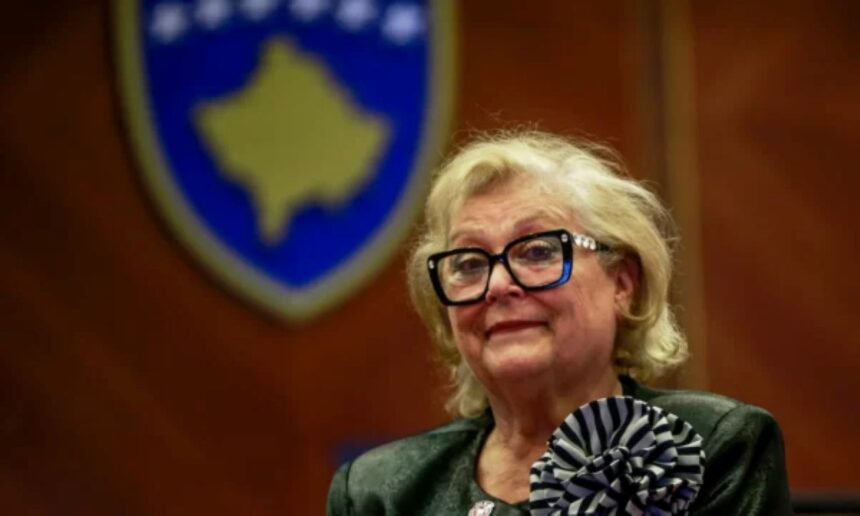
Kosovo’s parliament elected economist and academic Justina Shiroka Pula as the country’s new president in a late-night session, narrowly avoiding snap parliamentary elections and bringing an end to a prolonged political deadlock.
Shiroka Pula secured 81 votes in the 120-seat Assembly, in a vote held shortly before a constitutional deadline that would otherwise have triggered new elections, according to The Washington Post.
Her election marked a significant development in Kosovo’s political crisis, which has been accompanied by legislative paralysis for more than 19 months and two rounds of early parliamentary elections.
Shortly before electing the new president, lawmakers also approved amendments to the law governing Kosovo’s Specialist Chambers, the Hague-based court established to investigate and prosecute alleged war crimes committed during the 1998–99 Kosovo war.
Thousands of protesters had gathered outside the Assembly, calling on lawmakers to approve the legislation aimed at limiting the court’s jurisdiction and powers.
Shiroka Pula, who recently served as president of the Academy of Sciences and Arts of Kosovo, becomes the country’s third woman president since independence. She emerged as a last-minute consensus candidate supported by the ruling Vetëvendosje movement and the largest opposition party, the Democratic Party of Kosovo (PDK).
The Kosovo presidency is largely ceremonial, although the president plays an important role in foreign policy and serves as commander-in-chief of the country’s armed forces. Under the approved legislation, Shiroka Pula will also be required to promulgate the amendments before they can enter into force.
After taking the oath late Tuesday, Shiroka Pula said she accepted the office “with great honor and full responsibility.”
“This mandate does not belong only to one person; it belongs to our citizens, our institutions and the state for which many generations have sacrificed,” she said.
Her election came after more than two weeks of protests following a verdict by the Hague-based Specialist Chambers that found four former senior Kosovo Liberation Army (KLA) figures guilty of war crimes, including former Kosovo President Hashim Thaçi. The four men received prison sentences ranging from 13 to 25 years.
Kosovo officials and political leaders have criticized the verdicts, arguing that the KLA fought against Serbian repression during the 1998–99 conflict. The proceedings and convictions have also triggered concerns among some Kosovo Albanians that the court’s findings could affect the public perception of the country’s independence struggle.
More than 13,000 people were killed during the Kosovo conflict, while approximately one million Kosovo Albanians were displaced from their homes during the fighting.