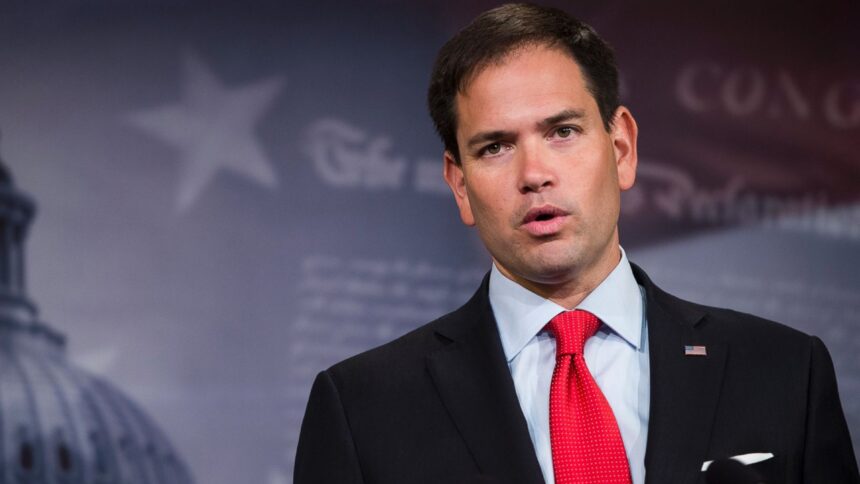
U.S. Secretary of State Marco Rubio said Iran will never be allowed to acquire a nuclear weapon, stating that preventing this is a red line for President Donald Trump.
“Iran cannot have a nuclear weapon. Period,” Rubio said on October 7 in Athens, where he held talks with Greek Foreign Minister Giorgos Gerapetritis during the sixth U.S.-Greece Strategic Dialogue.
Asked whether Washington was prepared to accept a certain level of uranium enrichment by Iran, Rubio declined to specify what enrichment level might be acceptable. Instead, he said any agreement must guarantee that Iran “will never have a nuclear weapon.”
“That is our position. That is why all of this started,” Rubio said.
He also accused Tehran of attempting to build such a large conventional arsenal that it would eventually become difficult for the United States or its allies to act against Iran’s nuclear program.
“What Iran was trying to do was build such a massive conventional capability that it would become untouchable,” Rubio said.
He said U.S. military action had significantly weakened Iran, including by destroying or severely damaging much of its drone and missile capabilities, as well as its naval fleet and air force.
“They are much less militarily powerful today than they were,” Rubio said.
Iran’s military capabilities have been significantly damaged during the conflict, although Tehran retains stocks of missiles and drones. The current state of its nuclear program remains difficult to assess, while the International Atomic Energy Agency has cited limited access for international monitors.
Rubio also described Iran as a country facing a deepening economic crisis, saying its economy was heading toward “a complete free fall.”
He referred to the reopening of the Strait of Hormuz and the resumption of oil shipments through the strategic waterway, saying Tehran had lost control of the vital maritime route.
While oil shipments have resumed, traffic through the strait remains disrupted, and Iran has continued to insist that its full reopening depends on Washington meeting conditions set by Tehran.
Rubio blamed Iran’s leadership for the country’s economic problems, accusing the government of spending its resources on Hezbollah, Hamas, Iraqi militias and the Houthis instead of improving living conditions at home.
“They should have been spending that money on their own people, but instead they spend the money on terrorism, on weapons,” he said.
Rubio said Tehran had previously had numerous opportunities to reach an agreement over its nuclear program but had failed to do so.
Rubio also described Greece as a critical U.S. ally at a time of growing instability in Europe and the Middle East, citing conflicts involving Iran, Russia and Ukraine, as well as the Red Sea.
He called Greece “a source of stability in an unstable world” and praised Athens for increasing its defense spending.
Greece is on track to meet its commitment this year to spend 5 percent of its gross domestic product on defense, Rubio said, with more than 3.5 percent going toward core defense spending.
He also announced that Greece will join the U.S. National Guard’s State Partnership Program and establish a partnership with the Florida National Guard, further expanding military cooperation between the two countries.