A senior American policy expert has warned that Russia’s influence in Serbia is unlikely to disappear with Aleksandar Vučić’s departure from power, arguing that Moscow has built extensive networks across the country that could withstand a change of government.
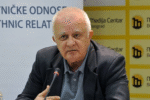
Luke Zahner, Senior Fellow for National Security and International Policy at the Center for American Progress in Washington, said Russia’s presence in Serbia extends far beyond its relationship with the current president.
In an interview with Telegrafi, Zahner pointed to Moscow’s established political, economic, energy, cultural and media networks, stressing that many of them would remain in place even if Serbia underwent a political transition.
“Russia’s influence in Serbia goes far beyond its relationship with Aleksandar Vučić,” Zahner said, adding that it would be unrealistic to expect Moscow’s influence to disappear overnight.
However, he argued that a new government could reassess Serbia’s relationship with Russia and reduce its strategic dependence on Moscow, particularly if it genuinely intends to pursue membership in the European Union.
Among the key issues requiring decisions from Belgrade, Zahner highlighted energy dependence, Serbia’s position on sanctions against Russia and Moscow’s influence over the country’s information environment.
He stressed that Serbia cannot indefinitely pursue European integration while maintaining close strategic ties with Russia.
Student movement has changed Serbia’s political debate
Commenting on Serbia’s domestic political developments and the role of the student movement, Zahner expressed cautious optimism about the possibility of democratic transformation.
He said the student-led movement had succeeded in bringing together citizens from different backgrounds around demands for fighting corruption, strengthening accountability and upholding the rule of law.
According to Zahner, this is something Serbia’s traditional opposition had struggled to achieve for years.
“The student movement has accomplished something that Serbia’s traditional opposition found difficult and failed to do for years: it changed the political debate,” he said.
Nevertheless, the American expert warned that removing an established ruling party does not automatically lead to a transformation of the political system.
He drew parallels with the period following the fall of Slobodan Milošević in 2000, when high expectations for democratic change encountered entrenched political networks, weak institutions and forces seeking to reverse reforms.
Zahner cautioned that Serbia’s next leadership must ensure that political change goes beyond replacing one group of politicians with another.
He also noted that the student movement’s political diversity could prove both an advantage and a challenge, as agreement on democratic reforms does not necessarily mean consensus on economic policy, foreign relations or the Kosovo issue.