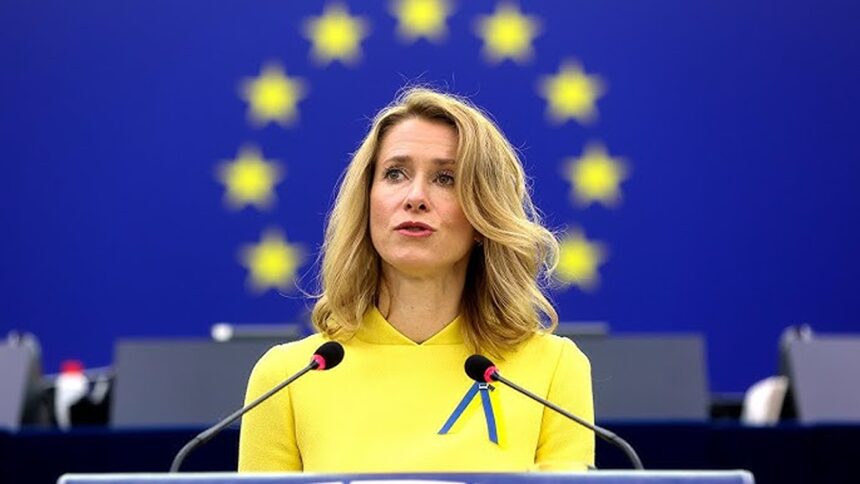
European Union foreign policy chief Kaja Kallas has warned against “falling into the traps Russia is setting”, saying Moscow is trying to reopen debate over European security in an effort to divert attention from its own aggression.
“We have an aggressor and a victim, and the aggressor has no security concerns. Nobody has ever attacked them. They have attacked others. I mean, come on, people, do not lose focus,” Kallas said upon arriving at an EU leaders’ summit in Dublin.
During discussions on the war in Ukraine, Russia has revived its hard-line demands for a complete restructuring of Europe’s security architecture. These demands were rejected in 2021 because they were considered an infringement on the sovereignty of Central and Eastern European countries.
The latest round of talks between Ukraine, Russia and the United States took place this week in Abu Dhabi. US President Donald Trump’s envoy and son-in-law, Jared Kushner, said on Thursday evening that Russia and Ukraine had agreed to include European representatives in the next round of peace negotiations. However, Russia quickly contradicted that statement.
European leaders have repeatedly said they will support Ukraine in any peace negotiation process, but insist that a ceasefire must be reached first. They also point out that Europe has an extensive network of security agreements that Russia has violated.
German Chancellor Friedrich Merz said Russia was seeking discussions on issues related to the European security architecture, but argued that such discussions were unnecessary.
“Russia wants to talk about issues concerning the European security architecture. We do not need to discuss this because it already exists,” Merz said. He added that Germany would naturally be part of any European delegation.
European Commission President Ursula von der Leyen also said that Europe’s participation in peace negotiations was self-evident, both to protect its interests and to support Ukraine.
The Kremlin said on Friday that it first needed to understand “Europe’s true intentions and its readiness to contribute to the peace process” before deciding whether talks should take place in a broader format.
Meanwhile, Russia’s chief negotiator at the Abu Dhabi talks, Vladimir Medinsky, said it was unclear what there would be to discuss with Europe.
The United States’ call for Europe to be included in the negotiations has once again raised the question of who will represent the continent in the process.
Despite more than two years of negotiations that have repeatedly stalled, the European Union has yet to decide whom it will appoint as its representative. However, there is growing recognition that Europe should not be represented by just one person, but by several representatives conveying the positions of different countries across the continent.
Paris and Berlin support maintaining the role of their envoys within the E3 format, comprising the United Kingdom, France and Germany, alongside representatives of the European Union.
Smaller EU member states, on the other hand, want representation to rely more heavily on EU institutions, particularly European Council President António Costa and Kallas, who serves as the EU’s High Representative for Foreign Affairs and Security Policy.
Swedish Prime Minister Ulf Kristersson said the debate over who should represent Europe in the negotiations was receiving more attention than it deserved, stressing that European countries have different interests.