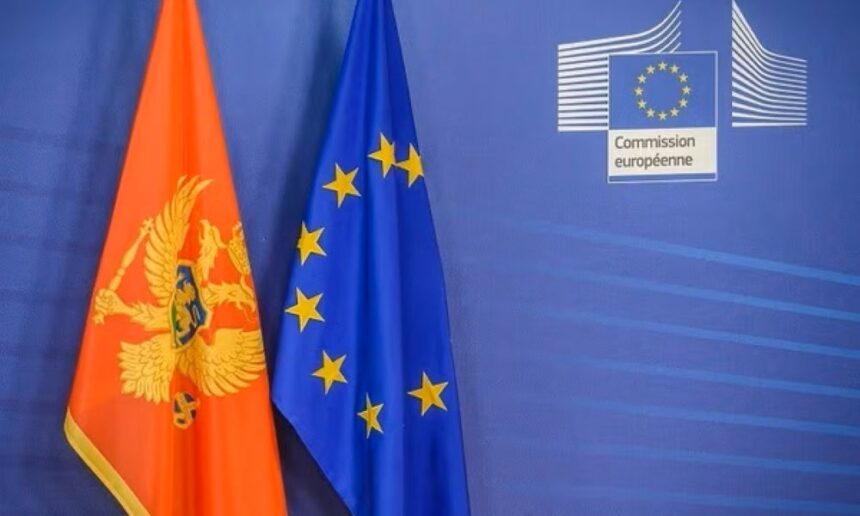
Montenegro has provisionally closed two additional chapters in its European Union accession negotiations, bringing the total number of completed chapters to 25 and strengthening its ambitions to join the bloc by 2028.
The chapters were closed on Thursday during an Intergovernmental Conference in Brussels. They concern Chapter 16, covering Taxation, and Chapter 22, dealing with Regional Policy and Coordination of Structural Instruments.
Montenegro now has eight remaining chapters to close as it enters the final stage of its EU accession process. The country’s goal is to complete negotiations on all remaining chapters by the end of 2026, paving the way for membership in 2028.
Ireland’s Minister of State for European Affairs, Thomas Byrne, said the latest achievement demonstrated that Montenegro was moving closer to its goal of EU membership.
He expressed hope that Podgorica would complete all remaining chapters before the end of Ireland’s presidency of the Council of the EU, which concludes later this year.
Montenegro’s Minister of European Affairs, Maida Gorčević, said the country had submitted all negotiating positions for the remaining chapters and remained confident that the process could be completed by the end of 2026.
European Commissioner for Enlargement Marta Kos noted that Montenegro currently ranks third in the history of EU accession negotiations in terms of the number of chapters provisionally closed within a single year, behind Lithuania and Latvia. She added that Montenegro could potentially surpass both countries.
Montenegro and Croatia continue discussions over bilateral disputes
Addressing the unresolved bilateral issues between Montenegro and Croatia, Kos expressed hope that the two countries would find a solution.
She noted that bilateral disputes arising during EU accession negotiations were not unprecedented and stressed the importance of reaching an agreement that would allow Montenegro to continue closing its negotiating chapters.
Gorčević confirmed that dialogue with Croatia was ongoing and that some issues had already been resolved, while discussions on others were continuing.
She said that if the two countries failed to reach an acceptable agreement on their border dispute, Montenegro could turn to an international court.
Gorčević also stressed that Montenegro recognized the Badinter principles and respected Croatia’s territorial integrity. She said Podgorica wanted to resolve both maritime and land border issues through continued negotiations.
She further noted that Croatia had given the green light for Montenegro to close the two additional EU negotiation chapters, describing communication between the two countries as ongoing at all levels.
Kos emphasized that the choice of how to resolve outstanding disputes remained in the hands of Montenegro and Croatia, adding that any mutually agreed solution would be acceptable.
Ireland backs Montenegro’s ambitious accession timetable
Asked whether there was an alternative plan if Montenegro failed to close all remaining chapters by the end of the year, Byrne said significant progress had already been achieved, exceeding initial expectations.
He acknowledged that the target was ambitious but said considerable efforts were being made both in Montenegro and across EU member states.
Byrne added that completing the negotiations remained the main objective, although failure to meet the deadline would not mean the end of Montenegro’s accession prospects.
Kos said that if Montenegro becomes the EU’s 28th member in 2028, 15 years will have passed since the bloc’s previous enlargement.
She described the unusually long gap between enlargement rounds as an additional reason for EU institutions and member states to accelerate the process.
Gorčević reiterated that Montenegro remained highly motivated to close all negotiating chapters by the end of 2026, expressing confidence in the country’s accession strategy.
She added, however, that the final stage would depend increasingly on the European Commission and EU member states, as Montenegro continued working to fulfil the remaining requirements.