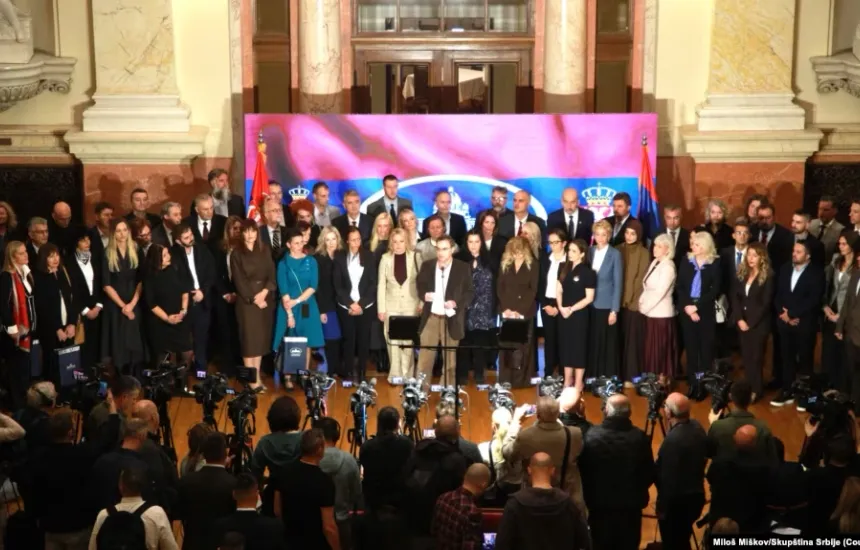
Serbia’s newly victorious Student List has announced plans to review the constitutionality of agreements reached with Kosovo through the Brussels dialogue, prompting the European Union to reiterate that Belgrade remains legally and politically bound by its commitments, regardless of the change in government.
The Student List defeated the Serbian Progressive Party (SNS), which had been in power for 14 years, in the recent parliamentary elections.
In the section of its political programme dedicated to national interests, the Student List says it will oppose Kosovo’s independence and prevent its membership in international organisations.
This position conflicts with Serbia’s commitments under the 2023 Agreement on the Path to Normalisation, through which Belgrade pledged not to oppose Kosovo’s membership in international organisations.
The agreement also requires both sides to respect each other’s territorial integrity and national symbols.
The Student List has additionally threatened legal action against former government officials over what it describes as potentially unconstitutional agreements that harmed Serbia.
EU says Serbia must honour its commitments
The European Union, which facilitates the dialogue between Kosovo and Serbia, has made clear that the outcome of Serbia’s elections does not alter the obligations undertaken by either side.
“The results of the parliamentary elections in Serbia do not change the foundations of the EU-facilitated dialogue or the obligations undertaken by the parties,” an EU spokesperson told Radio Free Europe.
Brussels expects Serbia to remain constructively engaged in the dialogue, fulfil its commitments and contribute to the normalisation of relations with Kosovo.
Serbia continues to refuse to recognise Kosovo’s independence. Since the dialogue began in 2011, the two sides have reached dozens of agreements covering freedom of movement, the integration of police and judicial institutions, energy, telecommunications, diploma recognition and the position of the Serbian community in Kosovo.
Kosovo says normalisation requires recognition
Kosovo’s Ministry of Foreign Affairs and Diaspora told Radio Free Europe that lasting normalisation with Serbia can only be achieved if mutual recognition becomes the foundation of the process.
“Kosovo is an independent and sovereign state, and its independence is irreversible,” the ministry stated.
It added that only on this basis could the two countries establish European relations based on good neighbourliness.
The ministry warned that the Student List’s position could deepen the divisions that the dialogue is intended to overcome.
It also questioned the party’s claims of political renewal, arguing that its programme maintains the same territorial ambitions towards Kosovo that characterised the previous Serbian government’s policies.
Serbia’s Constitutional Court chief questions possibility of reversing agreements
Serbian Constitutional Court President Vladan Petrov said it would be extremely difficult to reverse agreements that Serbia has already implemented.
In written comments to Radio Free Europe, Petrov explained that Serbia could potentially withdraw unilaterally from the dialogue on constitutional grounds only if the Constitutional Court reversed its 2014 position and classified the agreements as international treaties.
In 2014, the court rejected a request to review the constitutionality and legality of the First Brussels Agreement, ruling that it was a political agreement rather than an international treaty.
Petrov, who stressed that he was expressing his personal opinion, questioned what practical consequences a reversal could have, given that Serbia had already implemented the agreements.
Following its electoral victory, the Student List also called for the resignations of several institutional officials, including Petrov.
Experts divided over Student List’s intentions
Constitutional law professor Bogoljub Milosavljević said it remains unclear how the Student List intends to review the agreements or what concrete objectives it hopes to achieve.
He argued that any such move would likely have to take into account Serbia’s ambitions to move closer to the European Union.
Dušan Janjić of the Belgrade Forum for Ethnic Relations interpreted the announcement as a signal about Serbia’s future relationship with Brussels and the need for a minimum level of mutual respect.
He does not expect the Student List to take the matter to the Constitutional Court, arguing that the 2014 ruling remains in force.
Janjić also suggested that a temporary pause in the dialogue could help create conditions for a new approach based on partnership and renewed negotiations.
Political analyst Artan Muhaxhiri, meanwhile, described the Student List’s position on Kosovo as populist rhetoric that contradicts Serbia’s stated ambitions of European integration.
He said the movement had an opportunity to bring significant positive changes to Serbian society but risked undermining that potential by engaging in what he described as an unrealistic confrontation over Kosovo.
Muhaxhiri also argued that relations with Kosovo should be among the Student List’s main priorities if it genuinely intends to transform Serbia’s political landscape.
He suggested that the upcoming presidential elections in Serbia, expected by the end of the year, could help explain the movement’s current position on Kosovo.