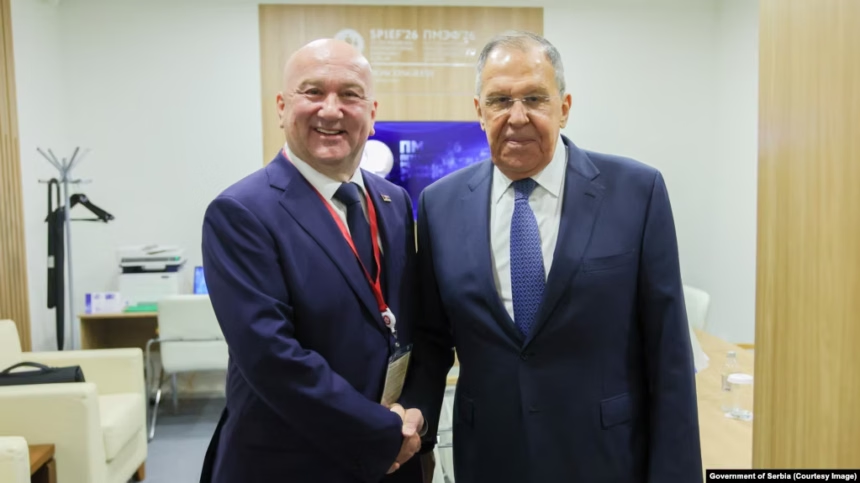
Russia has given Serbian caretaker government minister Nenad Popović a role in coordinating efforts to combat what it describes as “foreign interference in elections”, following the opposition Students’ List victory in Serbia’s October parliamentary elections.
Popović, a minister without portfolio who is under US sanctions over his political and business ties to Moscow, was appointed to the position by Dmitry Medvedev, chairman of Russia’s ruling United Russia party, during a November 16 meeting of the “For the Freedom of Nations!” movement.
Medvedev argued that Western countries were openly interfering in electoral processes and said the experience of countries that had faced similar situations could be useful.
In October, Medvedev had specifically accused the West of attempting to influence Serbia’s early parliamentary elections and destabilise the country, according to Russia’s Interfax news agency.
The narrative of alleged foreign intelligence interference was also promoted by the previous Serbian government led by Aleksandar Vučić, in which Popović served as a minister.
Popović’s new appointment comes after the Students’ List defeated the ruling political bloc in the October 25 elections, marking a major political shift in Serbia.
A movement backed by the Kremlin
The “For the Freedom of Nations!” movement was established in February 2024 by United Russia, with the support of Russian President Vladimir Putin. Its full name refers to a forum of supporters fighting what it calls modern forms of neocolonialism.
According to United Russia, the movement seeks to bring together countries from the so-called “global majority” to promote a multipolar international order.
Its founding meeting brought together 50 political movements from Europe, Latin America, Africa and Asia. Popović represents Serbia through his Serbian People’s Party and is also a member of the movement’s Permanent Committee.
Medvedev has repeatedly called for cooperation between member countries to protect electoral processes from what Moscow describes as external influence. In July 2025, he proposed agreements to provide partners with methodological assistance in countering foreign involvement in domestic elections.
At a November 2025 meeting, he described Western involvement in elections as “electoral neocolonialism” and called for cooperation in election monitoring to prevent results from being challenged on the basis of standards he claimed were imposed by Western countries.
Appointment may be Popović’s own initiative, analyst says
Vuk Vuksanović, a foreign policy and grand strategy lecturer at King’s College London, told Radio Free Europe that Popović’s appointment should not necessarily be interpreted as a strategic move by Moscow.
He believes it is more likely an initiative by Popović himself, aimed at using his established connections in Russia after the political defeat of the previous Serbian leadership.
According to Vuksanović, the appointment could allow Popović to continue promoting the narrative of foreign interference and direct political messaging against Serbia’s incoming authorities.
Radio Free Europe said it had not received a response from Popović or representatives of the movement by the time the article was published regarding what concrete steps would follow his appointment.
Serbia’s former government promoted ‘colour revolution’ claims
During the election campaign and the student-led protests that preceded the October 25 vote, officials from Vučić’s government repeatedly portrayed the demonstrations as a potential “colour revolution”, suggesting that foreign intelligence services were involved.
Russian officials supported similar claims. In August, Russian Ambassador to Serbia Alexander Botsan-Kharchenko warned that the country could face a familiar “colour revolution” scenario after the elections, regardless of the results.
Opposition to alleged colour revolutions had also been discussed by Serbian and Russian officials since December 2021, when then-Serbian Interior Minister Aleksandar Vulin met Nikolai Patrushev, secretary of Russia’s Security Council.
The two officials described colour revolutions as an established instrument used by certain centres of power.
Moscow signals willingness to work with Serbia’s new leadership
Despite the defeat of Vučić’s political bloc, the Kremlin has indicated that it wants to maintain and develop relations with Serbia under its incoming leadership.
Moscow said it hoped the new authorities would recognise that cooperation with Russia was in Serbia’s national interest.
Representatives of the victorious Students’ List have also made statements suggesting that relations with Russia will remain on the agenda. Radomir Saičić previously said the list would seek productive relations with Moscow, while its leading candidate, Ilija Srdanović, told Radio Free Europe that Serbian citizens would have a say in determining the country’s future relations with Russia.
Vuksanović expects Moscow to take a pragmatic approach and continue cooperating with the new government, despite occasional accusations of Western interference.
Russia’s Foreign Intelligence Service also claimed in November that the European Union and major European capitals were seeking to bring the Students’ List leaders into line and were prepared to use intelligence and diplomatic tools to influence them.
Looking ahead, Vuksanović identified Kosovo and energy supplies, particularly the price of natural gas, as two major issues shaping relations between Belgrade and Moscow.
Russia has traditionally supported Serbia’s position in the Kosovo dispute and does not recognise Kosovo’s independence. Serbia also remains heavily dependent on Russian gas, with more than 80 percent of its supplies coming from Russia.
Belgrade has so far refused to impose sanctions on Moscow over its full-scale invasion of Ukraine.