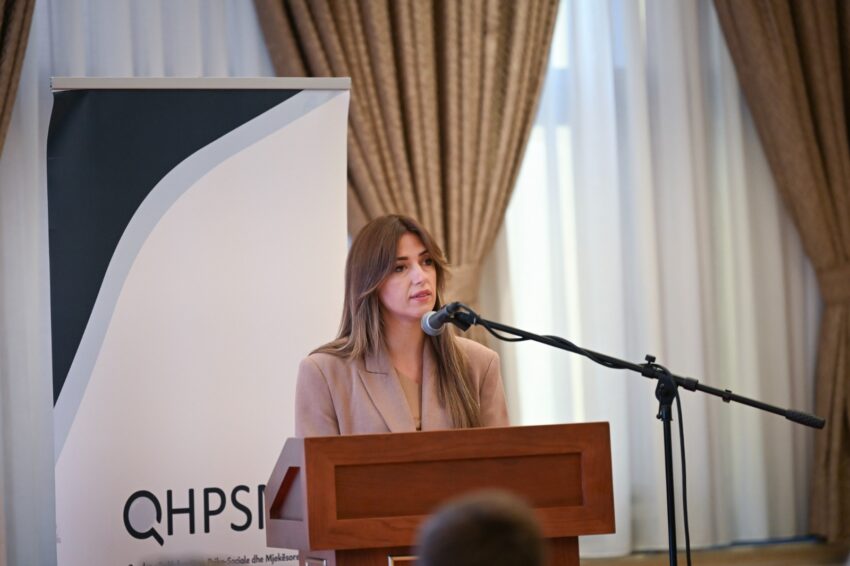
Marking International Children’s Day on Monday, June 1, 2026, the Acting President of the Republic of Kosovo, Albulena Haxhiu, called for a fundamental shift in how the state addresses juvenile protection, mental health, and social equity.
Speaking at the opening session of the Ninth Annual Conference on Children’s Health, Wellbeing, Education, and Rights, Haxhiu emphasized that institutional accountability must extend beyond legislative records to yield measurable, daily protections for youth.
The Reality Gap: Legal Theory vs. Social Execution
While acknowledging the legislative progress Kosovo has achieved over the past decade, the Acting President underscored a persistent disconnect between state policy and the lived experiences of vulnerable children.
“The rights of children represent one of the primary areas where the gap between what is written on paper and what is actually implemented becomes visible very quickly,” Haxhiu stated. “Children are not asking for the impossible. They are asking to feel safe. They are asking not to be despised, excluded, or stigmatized because of their family’s financial status.”
The Acting President criticized the social tendency to trivialize early signs of psychological distress or learning barriers, challenging families and educational systems to abandon dismissive phrases like “don’t worry, it will pass” when professional psychiatric or pedagogical intervention is required.
Redefining Systemic Metrics
Haxhiu argued that the strength of Kosovo’s child-welfare framework cannot be evaluated by the volume of administrative documentation generated by ministries in Prishtina. Instead, she offered a benchmark of precise, field-level questions to gauge institutional efficacy:
- Navigational Clarity: Do families know exactly where to turn when a crisis arises?
- Educational Responsiveness: Do public schools flag developmental and social trauma in real time?
- Resource Sufficiency: Are there enough licensed school psychologists and municipal support services deployed across the state?
- Holistic Protection: Are minors adequately shielded from violence at home, on the streets, and within digital spaces?
[Kosovo Child Protection Framework]
                  |
         +--------+--------+
         |                 |
         v                 v
   [Current State]   [Required Reform]
   Robust laws &     Accessible community clinics,
   policy papers.    omnipresent school psychologists,
                     and zero-tolerance for domestic abuse.
Elevating the Role of Field Research
The conference was organized by the Center for Psycho-Social Research and the “Empatia” Clinic, drawing a diverse assembly of clinical psychologists, social workers, educators, and policy analysts.
Haxhiu expressed gratitude to the frontline professionals working away from the public eye, noting that rigorous psycho-social data and field evaluations are indispensable tools for building a responsive state apparatus. She affirmed that public schools must remain environments where children grow rather than places where they are driven by fear.
Concluding her address, Haxhiu reminded the delegation that June 1 should serve as an institutional wake-up call rather than a superficial celebration. “Children do not need seasonal focus,” she remarked. “They require 365 days of unyielding attention, physical protection, and professional care.”