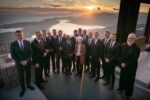
Stepping in amidst the critical campaign final countdown, Haxhiu joins European heavyweights Macron, Merz, and Von der Leyen to challenge Kosovo’s lack of candidate status while an explosive diplomatic and security proxy war erupts between Belgrade and Podgorica.
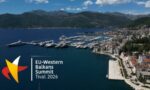
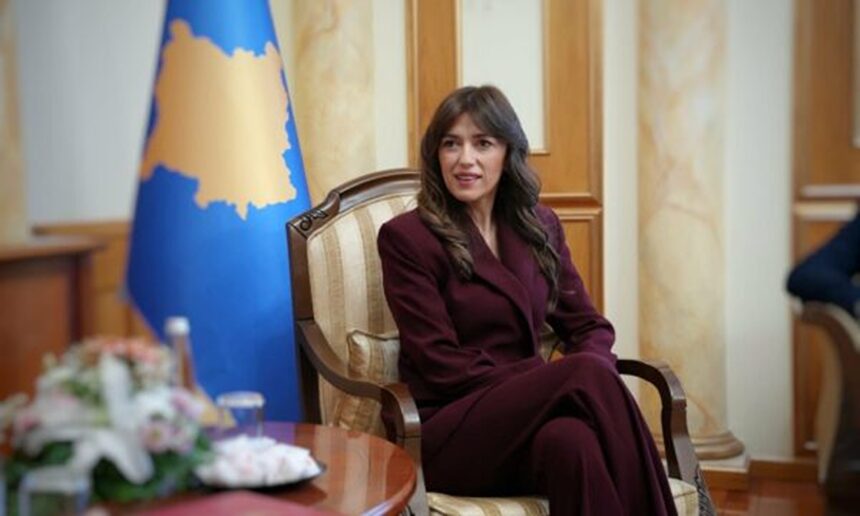
In a pivotal shift that clarifies Kosovo’s status at the historic European Union-Western Balkans Summit, the Presidency confirmed that Acting President Albulena Haxhiu has arrived in Tivat, Montenegro, to officially represent the Republic of Kosovo.
The announcement puts an end to initial speculation surrounding Pristina’s representation, which had arisen after early photo briefs from the summit featured other regional leaders but left Kosovo’s seat temporarily vacant. Haxhiu’s high-visibility presence ensures that Kosovo retains its voice at one of the most critical European enlargement gatherings in recent history, even as the country navigates the final, volatile 48 hours before Sunday’s monumental June 7 snap parliamentary election.
According to an official communique issued by the Presidency on Friday morning, June 5, 2026, Haxhiu’s mission is explicitly focused on equity, fair play, and structural integration:
“At this summit, Acting President Haxhiu will represent the Republic of Kosovo and will reaffirm the country’s commitment to European integration, demanding fair and equal treatment in the enlargement process, as well as regional cooperation in service of peace and stability.”
Dismantling the ‘Five Non-Recognizer’ Structural Wall
The centerpiece of Kosovo’s diplomatic offensive in Tivat is an aggressive push to break the institutional veto power currently blocking its European path. Unlike its regional neighbors, Kosovo remains the only Western Balkan state that has not been granted official EU Candidate Status—a stagnation driven by the persistent refusal of five EU member states (Spain, Greece, Romania, Slovakia, and Cyprus) to recognize its sovereignty.
Haxhiu intends to use the closed-door plenary sessions to formally demand that the European Council bypass these politically motivated bottlenecks. Kosovo’s arguments were bolstered by a pre-summit state visit to Pristina on Wednesday by European Council President Antonio Costa, who offered a highly encouraging assessment of the country’s technical readiness.
┌────────────────────────────────────────────────────────────────────────┐
│             The Pristina Brief: Antonio Costa’s Directive              │
├────────────────────────────────────────────────────────────────────────┤
│ • Technical Alignment: Pristina and Brussels have fully achieved absolute│
│   consensus on the mandatory Growth Plan and technical reform agenda.  │
│ • The Mandate: Costa emphasized that step-by-step domestic execution    │
│   will render any external political objections obsolete.              │
│ • The Brussels Guarantee: "The assessment is that at the end of the    │
│   process, we will no longer have any problems from the EU side."      │
└────────────────────────────────────────────────────────────────────────┘
The Border Scandal: ‘Air Serbia’ and the Tattooed Infiltrators
While Kosovo pushes an agenda of institutional equality, the Tivat Summit has been heavily overshadowed by an explosive, cross-border security crisis between Montenegro and Serbia.
On Wednesday, Montenegrin counter-intelligence and border police intercepted a chartered Air Serbia flight at Tivat Airport, blocking the entry of 87 Serbian nationals. Security services identified the uniformly dressed, heavily tattooed individuals as known criminal operatives with extensive rap sheets and histories of political street violence in Belgrade. The group was immediately detained and deported back to Serbia on the same aircraft.
Former Montenegrin Foreign Minister Miodrag Vlahović openly accused Serbian President Aleksandar Vučić of orchestrating a calculated hybrid-warfare operation to destabilize the host country and eclipse the summit’s pro-European narrative.
“When you rent a flight exclusively for this type of passenger, who look like tattooed Nazis and are uniformly registered criminals, it is a deliberate operation. It is not an accident,” Vlahović stated. “It is a continuation of the Serbian regime’s effort to keep Montenegro in a state of permanent crisis… to make Vučić’s presence the main issue, even in a negative context.”
Tit-for-Tat Arrests: Belgrade’s Retail Retaliation
Following the public humiliation of the deportation, Belgrade launched an immediate retaliatory strike. Serbian security agencies swiftly arrested 30 Montenegrin citizens at Belgrade’s Nikola Tesla Airport and systematically denied entry to dozens of others at land border crossings.
The Ministry of Foreign Affairs in Podgorica has officially demanded urgent, comprehensive reports from Serbian authorities regarding the arbitrary detentions. Analysts note this mirrors Serbia’s hostile 2023 mass detention of Kosovan citizens following Pristina’s successful initial advancement into the Council of Europe.
Despite being advised by his own security chiefs to cancel the trip due to alleged “assassination risks,” a visually agitated President Vučić landed in Tivat on Thursday evening, sourly demanding that no Montenegrin state welcoming delegation meet him at the tarmac.
With French President Emmanuel Macron and German Chancellor Friedrich Merz using the summit to open what Macron called “a new chapter of European future and friendship,” Haxhiu’s delegation is operating in a highly charged environment, using the stark contrast between Pristina’s institutional compliance and Belgrade’s destabilizing tactics to make an undeniable case for Kosovo’s immediate integration into the European family.