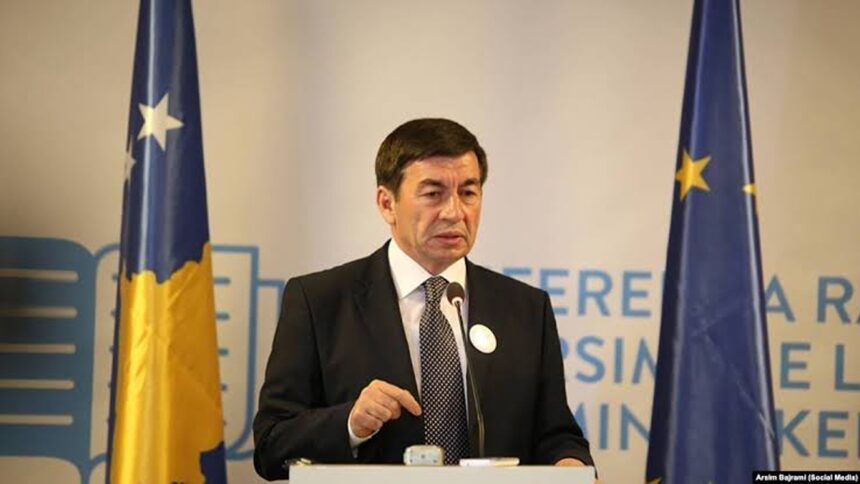
Arsim Bajrami, one of the authors of Kosovo’s Constitution, has submitted what he describes as a comprehensive legal and professional proposal to the State Working Group tasked with drafting a defence strategy for former Kosovo Liberation Army (KLA) leaders Hashim Thaçi, Jakup Krasniqi, Kadri Veseli and Rexhep Selimi.
Bajrami said he had also shared the proposal with the defence teams currently preparing appeals against the first-instance judgment issued by the Kosovo Specialist Chambers.
According to Bajrami, the proposal is intended to provide a conceptual platform and structured framework for examining the main historical, legal, criminal and procedural issues that could be relevant during the appeals process.
“It is not intended to interfere with the work of the Working Group or replace the independent strategies of the defence lawyers, but to offer a professional contribution that may serve as supplementary guidance during the preparation of the appeals,” Bajrami wrote in a Facebook post.
The proposal is organised around ten main areas of legal argument. These include challenging factual findings and legal interpretations, examining individual criminal responsibility and the doctrine of joint criminal enterprise, reassessing the evidence, and reviewing compliance with fair-trial standards and the requirement to prove guilt beyond reasonable doubt.
Bajrami said the ultimate aim was to make the proposal available to the defence teams as an additional basis for legal analysis and professional discussion, in order to explore all available legal grounds for challenging the first-instance judgment and seeking acquittals.
“The final objective is to provide the defence teams with an additional basis for analysis and professional debate, in order to examine all available legal avenues for challenging the first-instance judgment and seeking an acquittal, in accordance with the law and the standards of criminal justice,” he said.
The proposed strategy places particular emphasis on the historical context of the 1998–1999 war in Kosovo, the need to assess the prosecution’s claims against the broader circumstances of Serbian repression, and the distinction between the political and military objectives of the KLA and the alleged criminal conduct of individuals.
It also calls for a detailed examination of whether the prosecution established the elements of joint criminal enterprise beyond reasonable doubt, whether responsibility was properly attributed to each defendant individually, and whether the trial panel correctly assessed the evidence and applied the relevant law.
The document further identifies the presumption of innocence, the right to a fair trial, equality of arms and the prosecution’s burden of proof as central issues for the appeals process.
Bajrami’s proposal also recommends that defence teams prepare a detailed analytical matrix linking each challenged finding in the judgment to the relevant evidence, alleged factual or legal error, applicable legal principle and the specific remedy sought before the Appeals Panel.
The first-instance panel sentenced Hashim Thaçi and Jakup Krasniqi to 25 years in prison each, Kadri Veseli to 18 years and Rexhep Selimi to 13 years.