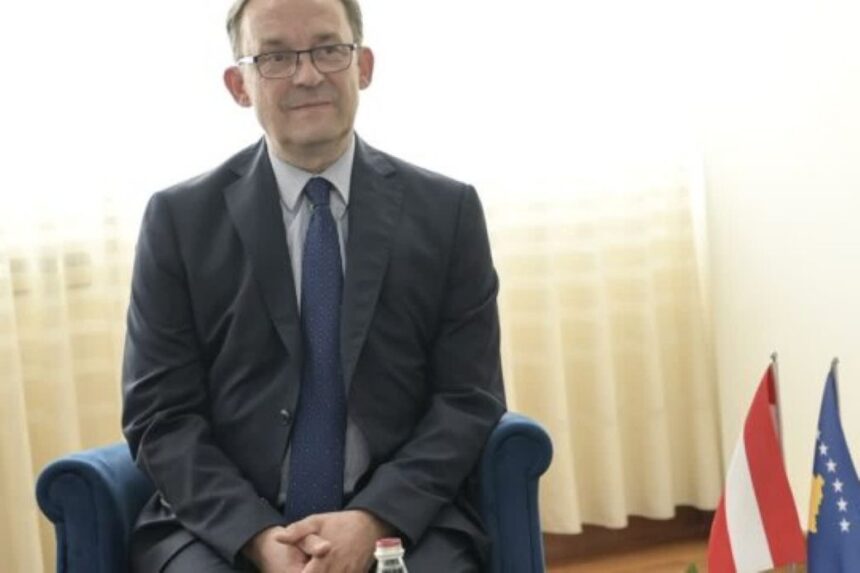
Austria’s Ambassador to Kosovo, Georg Schnetzer, has said that European Union enlargement is essential to strengthening security and stability in the Western Balkans, arguing that the process should include concrete steps toward granting Kosovo candidate status.
Schnetzer made the remarks at the conference “Enlargement and Regional Energy Security,” held in Prishtina, where he stressed the strategic importance of the Western Balkans for Europe’s security, prosperity and economic development.
He said Prishtina had been deliberately chosen as the venue for discussions on EU enlargement and regional cooperation, while thanking the Kosovo Civil Society Foundation (KCSF), the Open Society Foundations (OSF) and the Austrian-French Centre for Rapprochement in Europe for organizing the conference.
Austria urges faster progress on EU enlargement
Speaking from an Austrian perspective, Schnetzer described European integration as a key instrument for strengthening Europe’s security.
“European integration, if genuinely pursued as a success story, is the best guarantee of our security,” Schnetzer said, adding that the Western Balkans plays a “vital role” in European security, prosperity and economic growth.
He argued that EU enlargement is also important for the bloc’s strategic autonomy and said a credible enlargement process that delivers tangible benefits remains a strategic priority.
However, according to Schnetzer, progress has been too slow and the current approach does not adequately reflect what he described as the geopolitical urgency facing Europe.
“We need to act immediately”
The Austrian ambassador questioned whether the existing enlargement framework is sufficiently adapted to the current geopolitical environment.
“Our strategic interest is to have stability, security and prosperity in the Western Balkans. We need to act in this direction immediately,” Schnetzer said.
He stressed that accelerating the process should not mean compromising the EU’s fundamental values or the Copenhagen criteria, but rather taking concrete measures to overcome existing political blockages.
“This should also include steps toward candidate status for Kosovo, with the European Commission assessing the official application for EU membership,” he said.
Kosovo submitted its application for EU membership in December 2022. The European Commission has said it remains ready to prepare an Opinion on the application once requested by the EU Council.
The issue of candidate status has also been raised recently by Kosovo’s chief negotiator with the EU, Jeton Zulfaj, who said on September 29 that Kosovo had fulfilled its reform obligations and called for the EU to move toward granting candidate status.
EU integration and regional security
Schnetzer’s remarks come as the EU continues to emphasize enlargement as a strategic priority for the Western Balkans. EU-Kosovo discussions in 2026 have focused on reforms, alignment with the EU acquis and implementation of commitments under the Stabilisation and Association Agreement.
The ambassador’s call also comes amid renewed discussions about accelerating the European integration process for the Western Balkans, including through closer economic, energy and security cooperation.
For Kosovo, however, the path toward EU membership continues to involve both domestic reforms and the broader political context of relations with Serbia. The EU has repeatedly identified the normalization of relations between Prishtina and Belgrade as an important element of Kosovo’s European perspective.