Bosnia and Herzegovina’s general election campaign has once again become dominated by narratives about ethnic divisions, security threats, historical grievances and the need to protect different national communities, with the death and state funeral of convicted war criminal Ratko Mladić further intensifying the rhetoric.
The election campaign officially began on September 4, while three days later Mladić, the former commander of the Army of Republika Srpska, was buried in Belgrade with state honors. He had died in custody in The Hague while serving a life sentence for genocide and other war crimes committed during the 1992–1995 war in Bosnia and Herzegovina.
Political leaders from Republika Srpska (RS), including several election candidates, attended the funeral, prompting criticism from the international community and political parties in the Federation of Bosnia and Herzegovina.
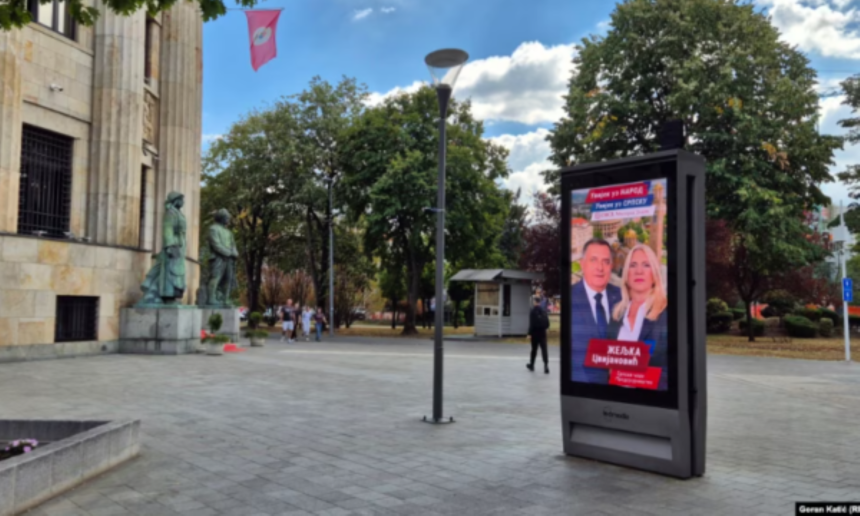
Although he is not an electoral candidate, Milorad Dodik has emerged as a central figure in the campaign of the Alliance of Independent Social Democrats (SNSD), appearing at pre-election rallies and on campaign posters alongside the party’s candidates.
Responding to warnings from the international community that the glorification of convicted war criminals is unacceptable, Dodik said that “no one will tell the Serb people whom they should mourn,” while continuing to promote calls for closer ties between RS and Serbia.
At one campaign rally, Dodik said efforts were underway to eliminate the border between Serbia and Republika Srpska.
“We are turned toward Serbia. The border on the Drina is an obstacle for us, and we are working to make it disappear,” Dodik said.
On September 25, appearing on the “War Zone” podcast hosted by U.S. political commentator Wayne Allyn Root, Dodik said that “Christians in Bosnia and Herzegovina no longer want to live under Muslim rule.”
Dodik had been under U.S. sanctions for years over actions Washington described as threats to the Dayton Peace Agreement and Bosnia and Herzegovina’s constitutional order. Those sanctions were lifted at the end of October last year.
In March, a bipartisan group of U.S. senators and representatives called on the administration of President Donald Trump to reimpose sanctions, citing what they described as Dodik’s continued separatist rhetoric.
Stronger ties between Republika Srpska and Serbia
Messages emphasizing the close relationship between Republika Srpska and Serbia have also featured in the campaigns of other political parties in the entity.
The issue was highlighted in mid-September during events marking Serbian Unity Day in Banja Luka. Draško Stanivuković, mayor of Banja Luka and leader of the opposition movement “Sigurna Srpska,” posted a message on social media saying that “Republika Srpska and Serbia are one” and that “unity, togetherness and freedom are sacred Serbian words.”
The Office of the High Representative (OHR) responded by warning that calls for secession, independence or unification with another state are contrary to Bosnia and Herzegovina’s constitutional framework.
The Organization for Security and Co-operation in Europe (OSCE) Mission to Bosnia and Herzegovina likewise said rhetoric questioning the existence of Bosnia and Herzegovina or its entities is inconsistent with the Dayton Peace Agreement, which ended the war in 1995.
Some candidates from Republika Srpska have also used the campaign to accuse politicians from the Federation of Bosnia and Herzegovina of hostility toward Serbs.
Srgjan Amidžić, Bosnia and Herzegovina’s current finance minister and an SNSD candidate for the state House of Representatives, said on September 20 that he had not experienced “real hatred” until he began working in Sarajevo. Referring to politicians from Sarajevo, he said he would take them to churches so they could be taught “the difference between good and evil.”
Amidžić had previously made similar statements accusing “political Sarajevo” of hostility toward Serbs, prompting criminal complaints.
Mobilizing emotions
Adis Maksić, a university professor who analyzed the campaign for Bosnia and Herzegovina’s 2022 general elections, told Radio Free Europe that this year’s campaign is largely repeating patterns seen four years ago.
In his analysis of the previous campaign, Maksić found that issues of identity, attitudes toward the past, unrealized wartime aspirations and perceptions of injustice received more attention than concrete party programs and policies. Such narratives often portray one’s own group as a victim and the political party as the force capable of protecting it.
“These issues continue to dominate. This is not surprising because our politicians, to a large extent, are people who do not have much knowledge about governance and the concrete issues important for administering and building the state. But they have perfected the ability to manipulate and mobilize emotions,” Maksić said.
He argued that Mladić’s death at the beginning of the campaign further strengthened these narratives.
“The events following Mladić’s death raised the intensity by one or two levels. It became the axis around which these narratives will revolve. On the one hand, they competed over who would attend the funeral, while on the other they competed through condemnations and messages: ‘Be ready, be united,’” Maksić said.
According to Maksić, the problem emerges when political parties present themselves as the only forces capable of protecting the country or their respective communities.
“What is being celebrated in RS has a serious dimension, but in terms of political tactics in general, things are similar. Here we have a continuous recycling of a sense of injustice from the past, which continues into the present and is presented as a threat in the future. This simply creates space to present yourself as a savior,” he said.
Campaign messages built around wartime memories
The Party of Democratic Action (SDA), the largest Bosniak party and currently in opposition, launched its campaign in Stolac, a town in southeastern Bosnia and Herzegovina that witnessed persecution and displacement of Bosniak civilians during the war.
The party campaigned around messages concerning wartime persecution and post-war discrimination against Bosniaks. Several days later, its leader and candidate for the state Presidency, Bakir Izetbegović, said that “only the SDA can save the country.”
Political parties have also sought to reinforce their campaign messages through music and social media.
The “Snaga naroda” party released the song “Bosno moja” at the beginning of the campaign. Its video features images of flags, mosques, cemeteries and locations across Bosnia and Herzegovina, alongside party leader Ramo Isak and other members.
Another video that attracted attention on social media featured SDA deputy leader Haris Zahiragić. Created using artificial intelligence, it portrays Zahiragić flying on a dragon while carrying a flag bearing lilies before fighting monsters and ultimately planting the flag on a rock.
Maksić said the use of emotions in political campaigns is not unique to Bosnia and Herzegovina, pointing to campaigns in the United States and Europe, where identity issues and various forms of xenophobia have also become increasingly prominent.
However, he said Bosnia and Herzegovina has a particularly strong emotional legacy of war, providing politicians with what he described as a large and easily accessible “reservoir” for political messaging.
Calls for political representation and a third entity
While the opening weeks of the campaign were heavily influenced by developments surrounding Mladić’s death and funeral, parties seeking the Croat electorate continued to emphasize political equality and what they describe as the legitimate political representation of Croats in Bosnia and Herzegovina.
The campaign has also reopened debate over territorial reorganization, including proposals for a third entity, at a time when the European Union has stressed the importance of preserving Bosnia and Herzegovina’s existing constitutional order.
The leader of the Croatian National Movement (HNP), a political party based in Livno, appeared on a campaign poster carrying the message: “HNP is for the third one, what about you?”
The party has previously promoted the creation of a third entity for Croats and supported a model based on “three peoples, three entities.”
Ahead of the campaign, Croatia’s parliament adopted a resolution supporting changes to Bosnia and Herzegovina’s electoral system aimed at ensuring what it called “legitimate political representation” of Croats.
The resolution was initiated by Croatia’s right-wing Domovinski pokret, which had argued that, if an agreement could not be reached, the restoration of Herceg-Bosna, the wartime political project abolished under the 1994 Washington Agreement, should be considered.
Former High Representative Christian Schmidt also warned about the debate over a third entity in his May report to the United Nations, saying it demonstrated the sensitivity of attacks on Bosnia and Herzegovina’s constitutional order and efforts to further divide the country along ethnic lines.
Candidates from different parties have meanwhile continued to use commemorations of wartime battles and the establishment of wartime brigades to deliver messages about national unity and the preservation of identity.
HDZ candidate for the state Presidency Darijana Filipović launched her campaign in Ravno, a town in Herzegovina that was among the first locations destroyed during the Yugoslav People’s Army offensive in 1991. She described it as “a place that knows well how much freedom can cost.”
Although the creation of a third entity does not dominate her campaign, Filipović had said several months earlier that such an entity remained “one of the models or possibilities to be considered.”
Bosnia and Herzegovina’s general elections are scheduled for October 4, when around 3.4 million registered voters will elect members of the state Presidency, representatives to state and entity parliaments, the president and vice presidents of Republika Srpska, and members of cantonal assemblies.