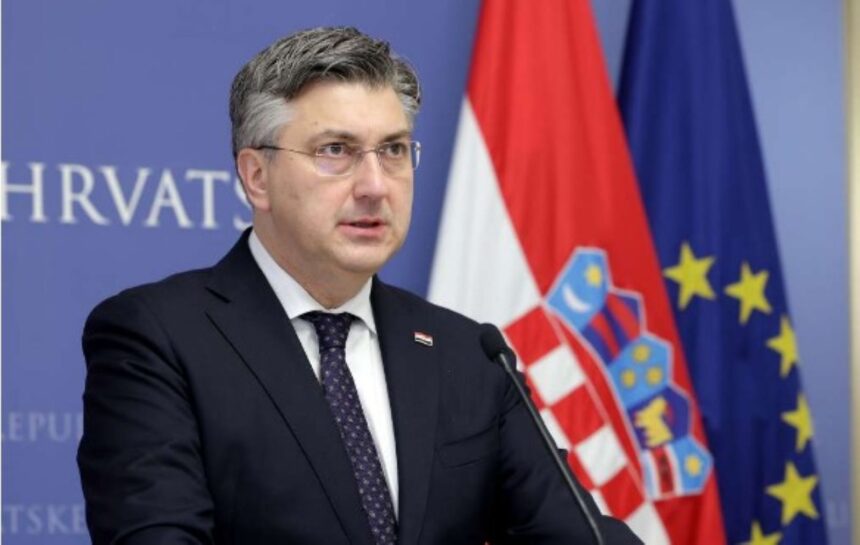
During an official state visit to Ohrid on Wednesday, Croatian Prime Minister Andrej Plenković explicitly rejected a controversial multi-tier enlargement blueprint proposed by German Chancellor Friedrich Merz.
Plenković warned that altering the core integration architecture of the European Union by offering proxy statuses could compromise the bloc’s foundational merit-based accession system.
Dismantling the “Merz Plan”
The diplomatic row centers on a formal letter dispatched by Chancellor Merz to EU leaders. In it, Merz proposed a transitional integration framework: granting immediate “observer status” to candidate nations in the Western Balkans and a specialized “associate member status” to Ukraine.
While Merz defended his strategy as an innovative mechanism to accelerate institutional proximity without replacing full expansion, Plenković countered that inventing sub-categories of membership creates a dangerous precedent.
                    [THE MERZ VS. PLENKOVIĆ EXTENSION DEBATE]
                                       │
         ┌─────────────────────────────┴─────────────────────────────┐
         ▼                                                           ▼
THE GERMAN PROPOSAL (Chancellor Merz):               THE CROATIAN POSITION (PM Plenković):
• Western Balkans: Institutional Observer Status     • Rejects proxy tiers or intermediate blocks.
• Ukraine: Advanced Associate Member Status          • Absolute adherence to individual merit.
• Goal: Rapid geopolitical alignment.                • Goal: Shield the standard enlargement track.
Prime Minister Andrej Plenković on EU Accession Integrity: “If we abandon the concept of individual merit, and if we pursue shortcuts or fundamentally transform membership perspectives into something akin to the European Economic Area (EEA) agreement—albeit with added institutional participation—then we must examine how this applies uniformly across the board. There should be no shortcuts for certain candidate states, nor artificial stagnation for others.”
The Absorption Dilemma: Ukraine vs. The Balkans
Plenković illustrated a vast structural disconnect between the macro-demographics of Ukraine and the highly localized footprints of Western Balkan candidates like Montenegro, Albania, and North Macedonia.
He emphasized that treating these two completely different geopolitical entities with a single blanket policy ignores the realities of the EU’s internal financial architecture:
- The Scale Discrepancy: Ukraine’s pre-war population and massive geographic size present an unprecedented absorption challenge compared to the much smaller, less populated Balkan states.
- Budgetary Implication Shock: Integrating a major agricultural superpower like Ukraine under current EU frameworks would instantly trigger a redistribution crisis, heavily straining the Common Agricultural Policy (CAP) and Cohesion Funds.
- Sectoral Demand: Balkan countries require significantly lower budget allocations for regional development, making their structural absorption seamless compared to the sweeping restructuring Ukraine requires.
                [EU BUDGETARY & POPULATION ABSORPTION RATIOS]
                                      │
       ├─► WESTERN BALKAN CANDIDATES ──► Minimal budgetary impact / Small populations
       │                                 Easily absorbed into regional/agricultural funds.
       │
       └─► UKRAINE ────────────────────► Massive agricultural market / Large population
                                         Requires total overhaul of EU internal funding.
High-Stakes June Summits Blocked Out
The rejection from Zagreb indicates that Germany’s attempts to fast-track a intermediate, geopolitically motivated solution for Ukraine will face intense resistance from Central and Southeastern European member states who demand a strict, traditional path to full inclusion.
The debate is slated to top the continental agenda immediately. Plenković confirmed that EU leaders will hold preliminary, closed-door negotiations next week during a regional summit in Montenegro, ahead of a decisive, formal showdown at the regular European Council meeting in Brussels in mid-June 2026.