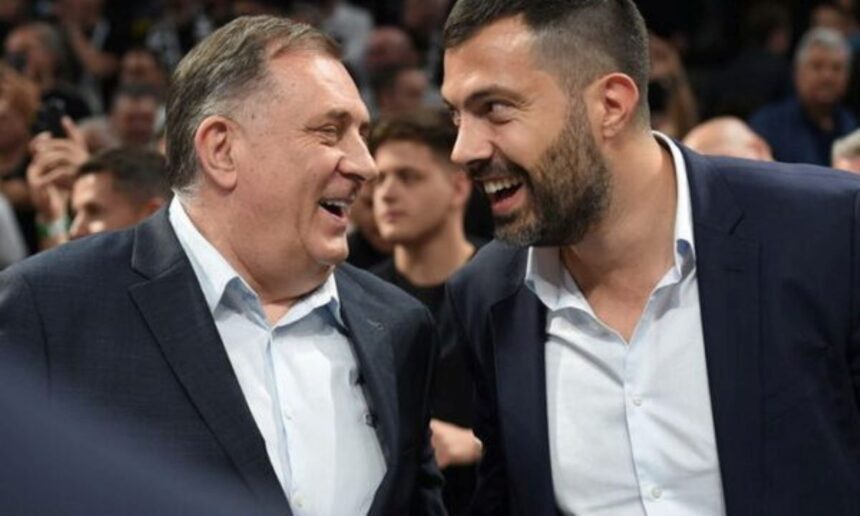
The appointment of 37-year-old Igor Dodik, son of longtime Republika Srpska leader Milorad Dodik, as the candidate to form the entity’s new government has raised questions about whether a change of leadership will bring any meaningful shift in its political direction.
Igor Dodik’s rise from general manager of a basketball club in Banja Luka to a potential head of government comes as his father is barred from holding public office following a six-year sentence handed down by the Court of Bosnia and Herzegovina for failing to comply with decisions issued by the High Representative.
Igor has been presented as the candidate who will form a professional, renewed and efficient government, as his father announced several days earlier.
Both father and son have also faced US sanctions. Milorad Dodik was sanctioned over actions undermining the Dayton Peace Agreement, threatening stability and allegations of corruption, while Igor was described in 2023 as part of a financial network allegedly used to enrich the family. The sanctions against both were lifted around 13 months ago.
Will Igor pursue a different political course?
Over the past year, Igor has increasingly appeared alongside his father at major political events. He also secured a seat in the Republika Srpska Assembly as the lead candidate on his party’s electoral list.
However, analysts question whether his appointment signals a genuine political transition or simply an effort by Milorad Dodik to maintain control through his son.
Vedran Džihić, a lecturer at the University of Vienna’s Faculty of Political Science, told Radio Free Europe that Igor’s appointment demonstrates his father’s continuing influence over political developments in Republika Srpska.
He argued that the SNSD has established control over the entity’s institutions and that real political power remains concentrated in Milorad Dodik’s hands.
Adi Ćerimagić, an analyst at the Berlin-based European Stability Initiative, also expressed doubts about the possibility of a significant change in policy towards the European Union and NATO.
He argued that major strategic decisions would unlikely be made without Milorad Dodik’s approval.
Although Igor has expressed support for European integration, adding that this support depends on how much the EU respects Republika Srpska, analysts remain sceptical about whether his position represents a genuine departure from his father’s political approach.
Analysts see little change in Republika Srpska’s EU policy
Toby Vogel of the Brussels-based Democratization Policy Council said it was still too early to determine whether Igor Dodik was an independent political figure or simply acting on behalf of his father.
He questioned whether the appointment was effectively designed to replace Milorad Dodik while maintaining the same political positions and policies.
Regarding European integration, Vogel said Republika Srpska’s position had not fundamentally changed, pointing to the repeated conditions and reservations Milorad Dodik had attached to his declared support for EU membership.
He also stressed that Bosnia and Herzegovina remained far from making substantial progress towards EU accession.
Bosnia and Herzegovina received EU candidate status in 2022, while the European Council decided in March 2024 to open accession negotiations, subject to further reforms.
However, progress has stalled. Authorities have yet to fulfil key requirements, including adopting legislation concerning the Court of Bosnia and Herzegovina and the High Judicial and Prosecutorial Council, as well as appointing a chief negotiator.
The country has also lost access to the first €108.5 million in funding under the EU’s Western Balkans Growth Plan because political leaders failed to agree on the distribution of responsibilities. The money is expected to be redirected to other regional countries or returned to the EU budget.
Will Serbia’s new government change relations with Banja Luka?
Another major question concerns the future relationship between Republika Srpska and Serbia following the Students’ List victory in the October 2026 parliamentary elections.
During his first public appearance as the candidate for prime minister, Igor Dodik said cooperation with Serbia would remain a priority, expressing his desire to continue joint projects.
Relations between Belgrade and Banja Luka have expanded considerably under former Serbian president Aleksandar Vučić, with Milorad Dodik maintaining close political ties with the Serbian leadership.
Both Milorad and Igor Dodik openly supported Vučić during the election campaign and made critical remarks about the Students’ List.
However, the new Serbian authorities’ approach towards Republika Srpska remains unclear.
The Students’ List’s pre-election programme pledged to preserve Republika Srpska’s constitutional position within Bosnia and Herzegovina, including its veto powers in state institutions and its property rights.
It also proposed reviewing the implementation of the High Representative’s Bonn Powers and considering diplomatic and legal action in cases where it believes the High Representative exceeded his mandate.
Nevertheless, Džihić believes the new Serbian government could adopt a more pragmatic foreign policy than the positions outlined during the election campaign.
He expects greater openness towards Sarajevo, a possible new approach to dialogue between Belgrade and Prishtina, and a more constructive regional policy.
Anti-corruption efforts could put pressure on the Dodik family
Džihić also highlighted the Students’ List’s commitment to fighting corruption and investigating illicit financial flows.
He suggested that implementing these promises could eventually bring scrutiny to the considerable wealth accumulated by the Dodik family in Serbia, as well as financial connections between officials in Republika Srpska and Serbia.
Ćerimagić similarly argued that the political transition in Belgrade could have both positive and negative consequences for the way Banja Luka and Belgrade have cooperated in recent years.
He believes the changing political circumstances could create opportunities not only for the European Union but also for Sarajevo to strengthen direct relations within Bosnia and Herzegovina.
For now, Igor Dodik’s appointment leaves a central question unanswered: whether Republika Srpska is entering a genuine political transition or whether Milorad Dodik is seeking to preserve his influence through the next generation of his family.
The constitutional deadline for the Republika Srpska National Assembly to elect a new government is 40 days from the day the candidate is formally nominated.