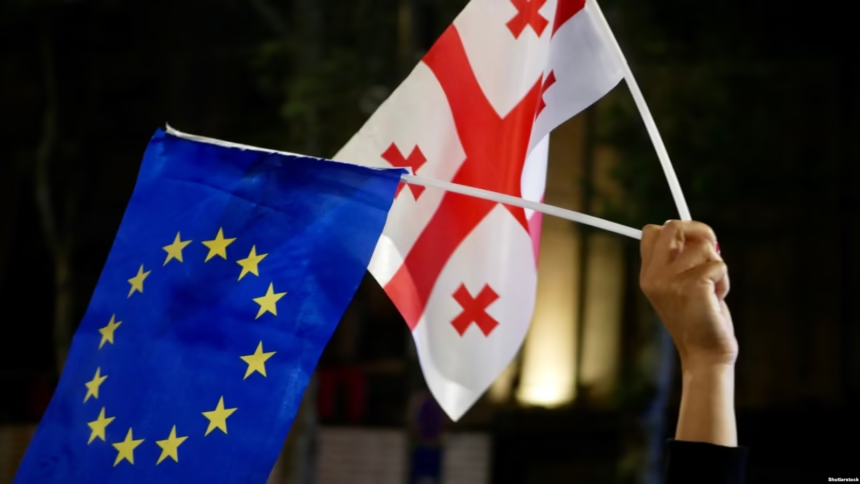
The European Commission announced that it will suspend visa-free travel for holders of Georgian diplomatic passports once the EU’s new visa rules come into effect at the end of December 2025. The Commission did not rule out extending this measure to the entire population of Georgia if the country fails to implement reforms to strengthen democratic rights and freedoms.
This decision follows the Commission’s annual report on non-EU countries whose citizens currently enjoy visa-free travel for up to 90 days within any 180-day period, applicable across most EU member states, as well as Iceland, Liechtenstein, Norway, and Switzerland. Georgian citizens have benefited from visa-free travel since 2017.
Alleged Violations in Georgia
The Commission stated that Tbilisi has breached multiple commitments made under the visa liberalization dialogue and has failed to implement recommendations from last year’s report, including the protection of fundamental rights, such as freedom of assembly, association, and expression.
Brussels also criticized Georgia for controversial laws on “foreign influence transparency” and “family values and protection of minors.” The report emphasized that, due to the systematic and deliberate nature of these regressions, the Commission will consider appropriate measures under the revised Visa Suspension Mechanism, effective December 30, 2025.
EU foreign policy chief Kaja Kallas previously warned that Georgia currently has no sustainable path to EU membership unless significant reforms are enacted. The report highlighted policies perceived as favoring Moscow and actions against political opponents, which have strained relations with the EU.
New Visa Rules
Under the EU’s new rules approved earlier this year, the Commission can partially or fully suspend visa liberalization not only due to internal issues—such as overstays or asylum abuses—but also due to human rights violations. The Commission can make such decisions independently, although consultations with EU member states are expected before final implementation.
Georgian Response
Salome Papuashvili, speaker of the Georgian Parliament, accused the EU of “blackmail.” Diplomatic sources indicated that most EU member states support suspending visa-free travel for political decision-makers while sparing ordinary citizens. However, the Commission left open the possibility that suspension could extend to the general population if Georgia does not address the issues.
In the final stage, Georgia could lose its visa-free status entirely and be added to the list of third countries requiring a visa—a fate previously experienced only by Vanuatu in late 2024 due to its “golden passport” scheme.
Tensions between Georgia and the EU intensified after Tbilisi passed anti-LGBT laws and the so-called foreign agents law, leading the EU to halt accession talks. The situation worsened after the October 2024 parliamentary elections, when the ruling Georgian Dream party froze EU accession negotiations and accused the bloc of attempting a coup.
Georgian President Mikheil Kavelašvili, during a visit to Belgrade, criticized the EU for what he called “double standards” in its treatment of Georgia and Serbia, emphasizing both nations’ ties to European heritage.