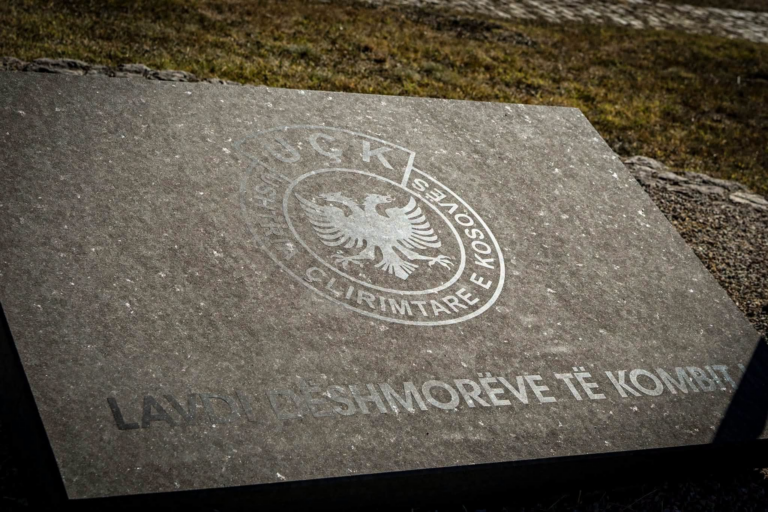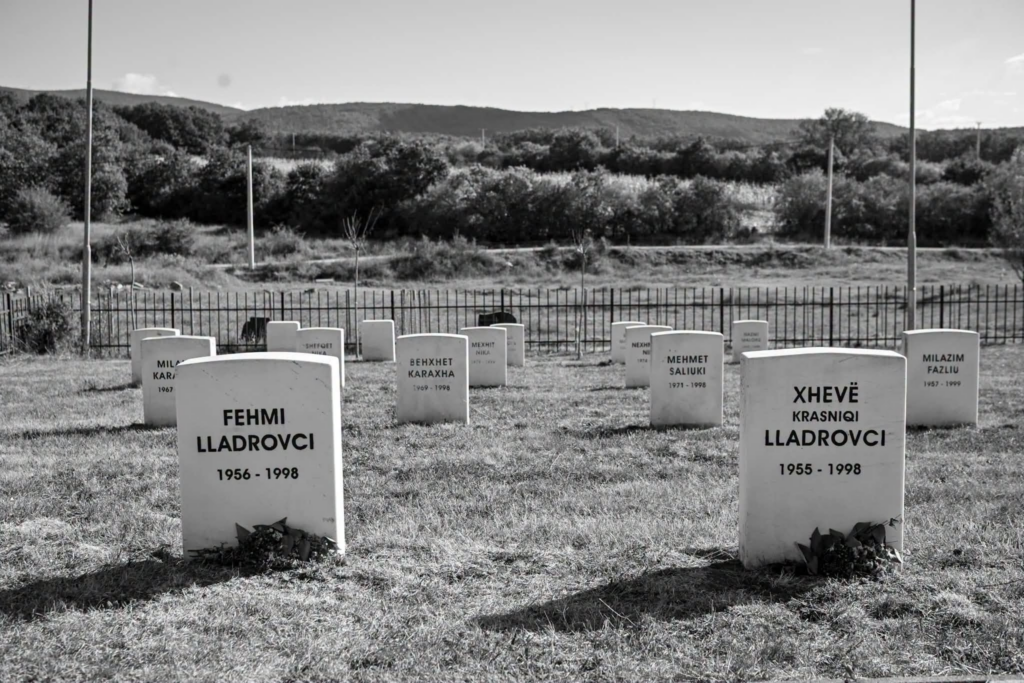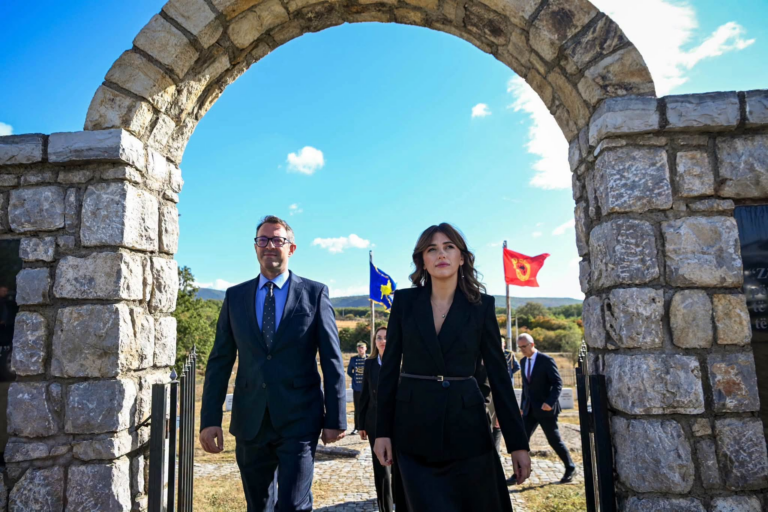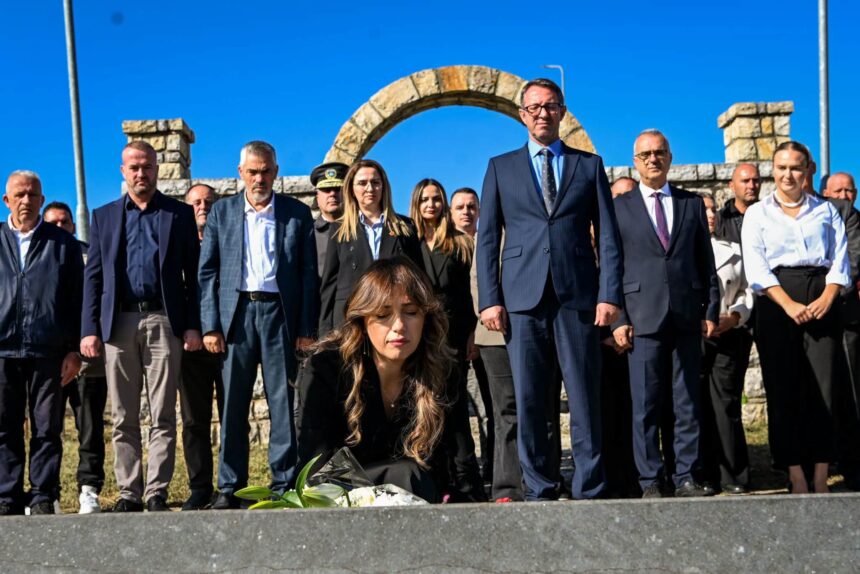
On the 28th anniversary of the heroic deaths of Fehmi and Xhevë Lladrovci, Albulena Haxhiu, Speaker of the Assembly of the Republic of Kosovo and Acting President, paid tribute to the couple and laid flowers at their graves in Gllanasellë, Drenas.
Remembering their patriotic activity, Haxhiu said that throughout their lives, their love for each other and their love for Kosovo always went hand in hand, until the day they both fell fighting for its freedom.
She said Kosovo’s history keeps the two figures together because they also walked their entire path toward liberation side by side.
“He was an engineer and she was an Albanian language teacher. They began their path toward liberation decades ago, at a time when opposition to the Yugoslav regime was punished with persecution, imprisonment and dismissal from work. Fehmi Lladrovci was involved in the political organization of the 1980s and spent years in Yugoslav prisons because of his beliefs and activities. When he was arrested in September 1985, he and Xhevë had only just begun their life together. His long imprisonment did not break either their bond or the path they had chosen. Xhevë immediately joined the Lladrovci family and, despite Fehmi being in prison, continued her own political activity during years when any connection to the underground movement carried enormous risks,” Haxhiu said.
After Fehmi was released from prison, she added, their life continued outside Kosovo, but never away from its cause. They participated in the war in Croatia, continued their political activity in Munich, Germany, and became involved in preparations that, over the years, would lead to the organization of the liberation war in Kosovo.
“Fehmi himself would say it in a sentence that remained one of the most powerful statements from the time of the war: ‘Freedom is more precious than life.’ Xhevë did not need to say it. Her entire life, until her final stand alongside him in Gradina, demonstrated the same conviction. This is why Fehmi and Xhevë cannot be remembered through one another. Each had taken their own path toward the same freedom and, when the final moment came, both placed their lives at its service,” Haxhiu said.
She recalled that Fehmi became commander of the 114th Brigade and took part in organizing, training and commanding KLA units.
“At a time when the KLA was growing rapidly and needed to establish structures, positions and military discipline, his experience carried particular weight,” Haxhiu said.
According to her, the experience Fehmi gained during the war in Croatia helped him organize and command KLA units in Drenica. Xhevë, meanwhile, had her own direct role in the war.
“She took part in organization and combat, and during the summer of 1998 she was on the front line in several KLA battles. Her presence there did not stem merely from her life with Fehmi. Xhevë had also arrived on that path with her own history and convictions,” Haxhiu said, recalling that Xhevë was a professor of Albanian language and literature, raised in a family with a patriotic tradition and involved in political activity from an early age.
Therefore, she said, when speaking about Fehmi and Xhevë, they should not be portrayed simply as a fighter and the wife who followed him. They were two activists who had chosen the path of freedom and accepted the successive risks that came with it.
For Fehmi and Xhevë, Haxhiu emphasized, Kosovo’s freedom was not a distant ideal, but a cause to which they devoted their years, work, exile, war and, ultimately, their lives.
“On September 22, 1998, Serbian forces launched a broad offensive against KLA positions in Drenica. In Gradina, one of the most important defensive positions of the 114th Brigade, fighting took place at close range and lasted for hours. Accounts from fellow fighters that day indicate that Fehmi directed the fighting and maintained contact with other positions until their position came under attack. When Fehmi fell, Xhevë remained at the position and continued fighting for liberation, refusing to withdraw,” Haxhiu said.
She added that on September 22, 1998, the place where they had arrived together after years of imprisonment, persecution, exile and preparations for war was also where their journey came to an end.
“Today, alongside Fehmi and Xhevë, we also honored Fatime Hetemi, Shefqet Zeka, Behxhet and Milaim Karaxha, and Hamit Lladrovci. Their names are an inseparable part of our history of sacrifice, of the war and of the struggle through which Kosovo’s freedom was won,” Haxhiu said.