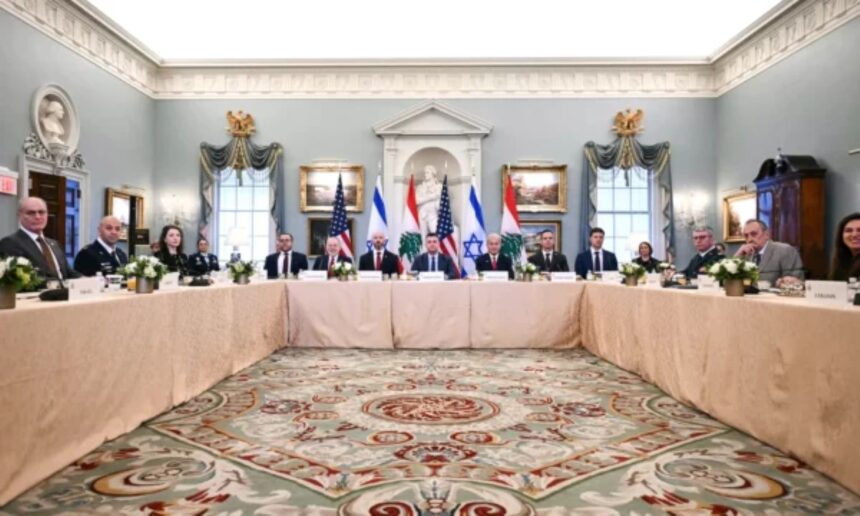
Critical, high-level diplomatic talks between official delegations from Israel and Lebanon officially commenced at the U.S. Department of State on Tuesday, June 2, 2026. The direct diplomatic track is racing against the clock as continuous kinetic clashes between the Israel Defense Forces (IDF) and Hezbollah threaten to completely derail parallel, backchannel nuclear and security negotiations between Washington and Tehran.
The current Washington summit is being mediated on the American side by Mike Needham, the newly appointed Deputy National Security Advisor, alongside Dan Holler, his successor as the chief Counselor to the State Department. Both Israel and Lebanon have deployed their respective Ambassadors to the United States to lead the diplomatic maneuvering.
The State Department Briefing: Two-Track Diplomacy
The diplomatic atmosphere remains intensely constrained. During a brief, restricted photo opportunity at the launch of Tuesday’s plenary session, American, Israeli, and Lebanese officials uniformly declined to take questions from the White House press corps.
The political framework at the State Department is designed to run parallel to a more practical, military-to-military channel. Last Friday, specialized defense delegations from both Middle Eastern nations launched highly technical security coordination talks at the Pentagon to map out a structural buffer zone.
[The Dual-Track Washington Negotiations]
       ├── Pentagon Channel: Technical military delegations mapping out a physical buffer zone.
       └── State Department Channel: High-level Ambassadors brokering political & sovereignty terms.
The Iran Complication and Nuclear Posturing
The geopolitical stakes of the Israel-Lebanon border war have directly spilled over into wider Western engagement with Iran. On Monday, Iranian state media channels reported that supreme authorities in Tehran were formally freezing ongoing, sensitive peace talks with the United States to protest Israeli actions in Lebanon.
By Tuesday morning, Iranian state apparatuses signaled a tactical reversal, indicating that the Washington-Tehran backchannels had quietly resumed. However, Iran’s chief nuclear negotiator issued an explicit, public ultimatum: Tehran will orchestrate a severe, asymmetric regional escalation if the IDF continues to expand its air and ground footprint inside Lebanese territory.
Friction in the Trump-Netanyahu Bilateral Channel
The launch of the State Department talks follows an unusually tense diplomatic dispute between U.S. President Donald Trump and Israeli Prime Minister Benjamin Netanyahu.
On Monday, President Trump publicly declared that Israeli forces had guaranteed they would not advance their ground maneuvers toward Beirut. Just hours later, Netanyahu delivered a televised address explicitly stating that the IDF would continue its offensive operations in southern Lebanon “strictly according to plan.”
| Key Actor | Official Policy Stance (June 1-2, 2026) | Tactical Priority |
| President Donald Trump | Demands containment; enforces a red-line against a Beirut advance. | De-escalation to preserve regional oil transit and broader U.S.-Iran accords. |
| PM Benjamin Netanyahu | Rejects artificial limits; vows to prosecute the war “according to plan.” | Complete terrain denial up to the Litani River and destruction of structural infrastructure. |
According to regional officials familiar with the communication, a subsequent phone call between Trump and Netanyahu on Monday evening was conducted in “highly strained and aggressive tones.” The American President reportedly demanded that his Israeli counterpart immediately scale back the operational scope of the IDF’s cross-border maneuvers.
Hezbollah Signals Acceptance of US Truce Proposal
In a major, unexpected diplomatic breakthrough, President Trump also claimed on Monday that his intermediaries had conducted a successful backchannel call with direct “representatives of Hezbollah’s leadership,” asserting that the militant group had consented to freeze all rocket and drone strikes targeting northern Israel.
This claim was formally validated on Tuesday by the Lebanese Embassy in Washington. In an official diplomatic communique, Lebanese authorities confirmed they received explicit, verifiable confirmation that Hezbollah has accepted a comprehensive U.S.-drafted de-escalation blueprint.
The American proposal outlines an immediate, conditional ceasefire, requiring Hezbollah to withdraw its heavy rocket infrastructure north of the Litani River in exchange for a full cessation of Israeli airstrikes on Beirut and a phased withdrawal of IDF forces from newly captured border redoubts like Beaufort Castle.