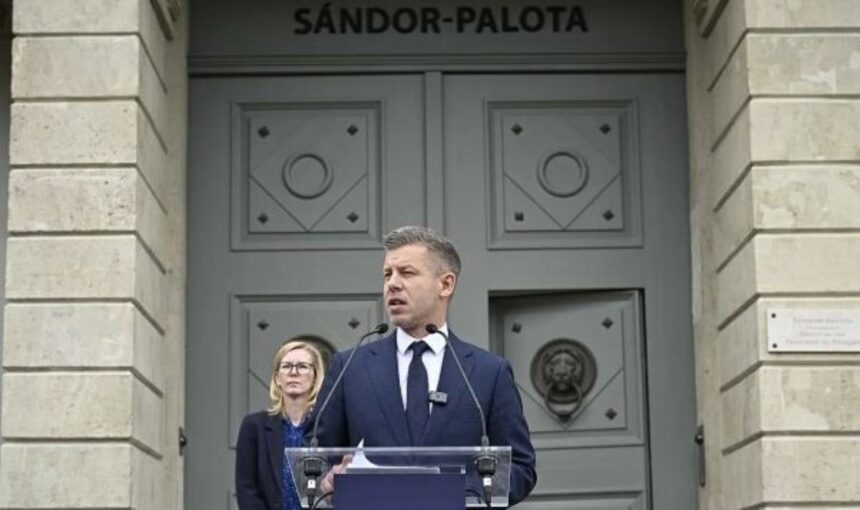
The high-stakes political transition in Hungary has officially devolved into a full-scale institutional crisis. Newly inaugurated Prime Minister Péter Magyar announced on Monday, June 1, 2026, that his government will move forward with sweeping legal and constitutional procedures to forcibly remove President Tamás Sulyok from office, following Sulyok’s formal refusal to step down.
The direct clash at the Sándor Presidential Palace occurred just one day after Magyar’s strict May 31 ultimatum expired. Magyar, whose center-right Tisza party secured a landslide victory in April’s parliamentary elections—ending the 16-year rule of former populist Prime Minister Viktor Orbán—is systematically targeting top officials appointed under the previous administration.
The Ultimatums and the “Puppet” Accusation
Since winning 141 of the 199 seats in the Hungarian National Assembly, Magyar has maintained a relentless campaign against what he brands as “servants of the Orbán regime.” Following his closed-door morning meeting with Sulyok and Justice Minister Márta Görög, the Prime Minister held a press conference declaring that the time for voluntary compromise had officially passed.
“Hungary does not belong to Tamás Sulyok, nor to Viktor Orbán. It doesn’t belong to a single party or political system,” Magyar stated. “I have told the President that if he maintains his stance and does not resign, I will inform the lawmakers of Tisza about our legislative proposals today, and we will immediately start the necessary procedures.”
Magyar added that the legislative process to modify the Fundamental Law (Constitution) and remove Sulyok would take approximately one month, describing it as a necessary step to “remove all the puppets” who participated in dismantling the country’s democratic checks and balances.
Sulyok Flees to the Venice Commission
President Tamás Sulyok, a former head of Hungary’s Constitutional Court who was elected to the presidency by Orbán’s Fidesz party in early 2024, has adamantly refused to capitulate to executive pressure.
In a defensive legal maneuver, Sulyok submitted an emergency request to the Council of Europe’s advisory body on constitutional law—the Venice Commission (the European Commission for Democracy through Law). Sulyok has requested an expert international evaluation of the situation, arguing that weaponizing political ultimatums to truncate a fixed presidential mandate directly violates European democratic principles.
In an official communiqué, the presidential office outlined its rationale for involving international experts:
“Dr. Tamás Sulyok, President of the Republic, asked the constitutional advisory body of the Council of Europe… to assess the existing constitutional issues and to provide the Board with expert assistance in resolving the controversial situation, taking into account European constitutional values.”
Sulyok maintains that the president’s role is to “showcase the unity of the nation and guard the democratic functioning of the state,” and that shifting political majorities do not alter his lawful mandate, which is legally set to run until 2029.
The Battle for the Supermajority
Though the Hungarian presidency is largely a ceremonial role, the officeholder possesses critical systemic powers. The president can delay legislation by sending bills back to parliament or rerouting them to the Constitutional Court for judicial review—a mechanism that Magyar’s allies fear Sulyok will use to systematically paralyze the incoming government’s aggressive anti-corruption and pro-European reform agenda.
| Political Actor | Position / Party | Strategy in the Standoff | Legal Leverage |
| Péter Magyar | Prime Minister / Tisza | Force resignation or execute a targeted constitutional amendment to dissolve the mandate. | Controls a two-thirds supermajority in Parliament. |
| Tamás Sulyok | President / Independent (Fidesz appointee) | Resist executive overreach; appeal to international bodies and the Constitutional Court. | Backed by Fidesz lawmakers who hold over 25% of seats (enough to trigger judicial reviews). |
The now-opposition Fidesz party immediately condemned Magyar’s maneuvers, labeling them an “unlawful ultimatum” and an authoritarian assault on independent state institutions.
Because Magyar commands a strict constitutional supermajority, he possesses the raw legislative votes to rewrite the laws governing the presidency. However, legal analysts warn that forcing an active head of state out of office through tailored constitutional changes could trigger a profound judicial crisis, especially if the Constitutional Court—which remains populated by Orbán-era appointees—steps in to strike down the amendments.
As crowds of competing protesters gather outside the presidential palace in Budapest, the conflict marks the first major systemic test for Hungary’s post-Orbán democratic transition.