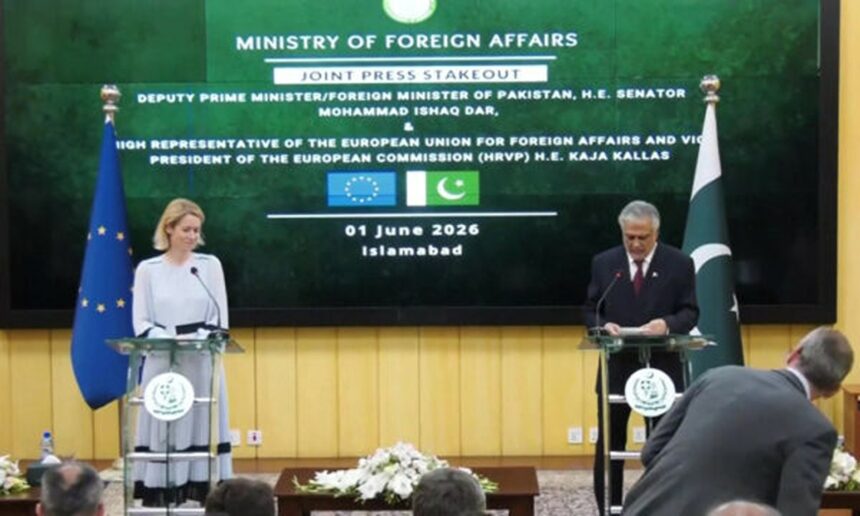
The European Union’s foreign policy chief, Kaja Kallas, said on Monday that any temporary peace agreement between the United States and Iran should be followed by deeper negotiations on Tehran’s nuclear stockpiles, missile program, and other critical issues.
Speaking at a press conference in Islamabad, Kallas said she sees a “fragile diplomatic opportunity” to extend the current ceasefire and reopen the Strait of Hormuz, despite overnight exchanges of attacks between Iran and the United States.
“Any temporary understanding between the U.S. and Iran must be followed by deeper discussions on Tehran’s nuclear stockpiles and other critical issues,” the EU’s top diplomat said during a joint press conference with Ishaq Dar.
Kallas praised Pakistan’s role as a mediator in the Gulf crisis and expressed the European Union’s readiness to contribute to a peaceful resolution of the U.S.–Iran dispute. She cited the EU’s economic influence, hard-earned nuclear expertise, long-standing relationships with Gulf partners, and direct engagement with Iran.
“I see a concrete role for the EU in helping make any future agreement sustainable—whether through maritime operations or economic incentives that support long-term stability,” she said, suggesting “strict conditions” for a “calibrated pathway toward sanctions relief” for Iran.
The United States and Israel launched airstrikes against Iran on February 28 following ongoing disputes over Iran’s nuclear capabilities.
Pakistan has been mediating between the United States and Iran in an effort to secure a permanent ceasefire after a fragile truce was reached on April 8.
A Pakistan-mediated draft agreement has reportedly been exchanged repeatedly between the parties, while Donald Trump stated on May 31 that the primary focus remains Iran’s nuclear capabilities.
In a social media post, Trump said his proposed agreement “makes it very clear that Iran will not possess nuclear weapons.”
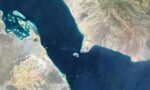
During the conflict, actions taken by Tehran and Washington effectively led to the closure of the Strait of Hormuz, a narrow but strategically vital maritime route through which nearly 20 percent of the world’s oil supply passes from the Gulf to international markets.
The disruption triggered a sharp rise in global oil prices and heightened concerns about inflation, supply chain disruptions, and broader economic instability worldwide.
Pakistan–EU Partnership
Kallas said her first visit to Islamabad “underscores the continued momentum of high-level political exchanges between Pakistan and the EU and reflects a shared commitment to further strengthening the Pakistan–EU partnership.”
Referring to recent border clashes between Pakistan and the Taliban authorities in neighboring Afghanistan, she said the fighting had serious humanitarian consequences and risked fueling further instability and radicalization.
She added that “Pakistan has the right to defend itself and its citizens in accordance with international law. But dialogue, not airstrikes, is the best way out of this situation.”
After decades of alliance, deadly border clashes erupted between Pakistan and the Taliban in October last year, resulting in military and civilian casualties and the displacement of civilians on both sides of the border.
Pakistan accuses the Afghan Taliban of sheltering members of the Pakistani Taliban on Afghan territory, who have carried out attacks inside Pakistan. The Afghan Taliban, for their part, insist that they will not allow anyone to use Afghan territory against another country.
Last year, Pakistan conducted airstrikes inside Afghanistan, targeting several cities, including Kabul. Afghan Taliban forces responded with mortar and artillery fire against Pakistani border posts along the 2,600-kilometer frontier known as the Durand Line.