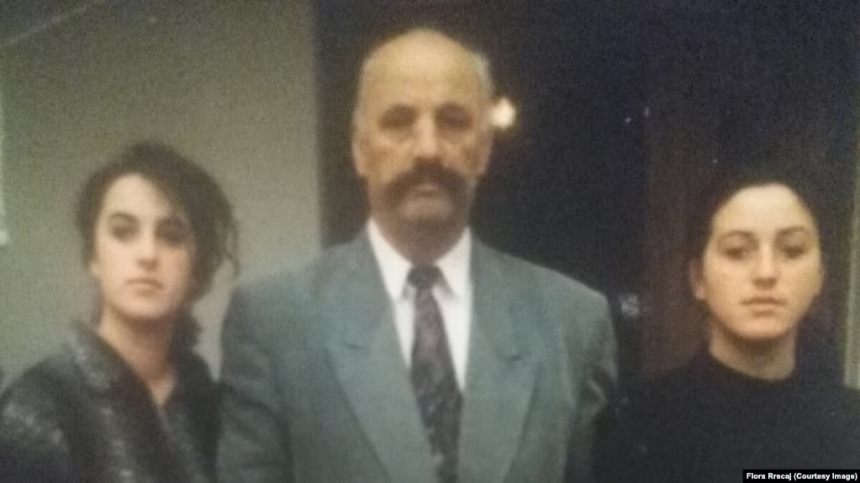
Political activist Idriz Rrecaj from Skenderaj has been identified among the victims whose remains were recently exhumed from mass graves at several locations in northern Kosovo, his family said Sunday.
Rrecaj was identified through DNA analysis in The Hague, nearly two months after the remains were recovered from mass graves in the villages of Mala Kaludra and Jabuka in the Zubin Potok area.
His son, Shpetim Rreci, announced the identification on Facebook, saying the family had waited 27 years for confirmation of his father’s fate.
“After 27 years of waiting, pain and uncertainty, we received news from our institutions that the DNA laboratory in The Hague had officially confirmed the identity of my parent, Idriz Rrecaj,” Rreci wrote.
He added that the question of what happened to his father had finally been answered.
Rrecaj, who was posthumously awarded the title “Hero of Kosovo” in 2019, was among 23 Albanians known as the “Group of Intellectuals” who disappeared during the Kosovo war in 1999. According to Kosovo authorities, members of the group were forcibly taken away by Serbian forces on April 19, 1999.
Kosovo Prime Minister Albin Kurti announced a day earlier that the remains of three people recovered from the mass graves had been identified through DNA analysis. He said the three victims belonged to the “Group of Intellectuals,” which largely consisted of residents of Skenderaj and Mitrovica. Kurti did not disclose their names.
Rrecaj’s family had been searching for him for nearly three decades, including through prison records in Serbia, witness accounts and reports concerning the discovery of human remains.
His daughter, Flora Rrecaj, told Radio Free Europe in August that the family had experienced a mixture of hope, fear and pain while awaiting the DNA results.
“After so many years, you begin to fear the answer. Nevertheless, it is crucial to learn the truth,” she said.
The identification of Rrecaj leaves the identities of the other two victims undisclosed.
The remains were recovered from three mass graves in the Zubin Potok area, where the Kosovo authorities say at least 23 people were found following a two-year investigation into suspected war crimes. Samples were subsequently sent to The Hague for DNA analysis.
Kosovo authorities have said additional identification results are expected in the coming days and weeks.
The Kosovo Special Prosecution is investigating four people — identified by the initials J.R., M.J., R.K. and M.B. — in connection with suspected war crimes against the civilian population. All four are reportedly in detention.
According to Kosovo’s Institute for War Crimes, 1,577 people remain officially listed as missing from the 1998–1999 war, while 12,230 war victims have been documented.
Kosovo authorities have repeatedly called on Serbia to cooperate in determining the fate of missing persons and to provide access to military archives that could help identify the locations of potential mass graves.