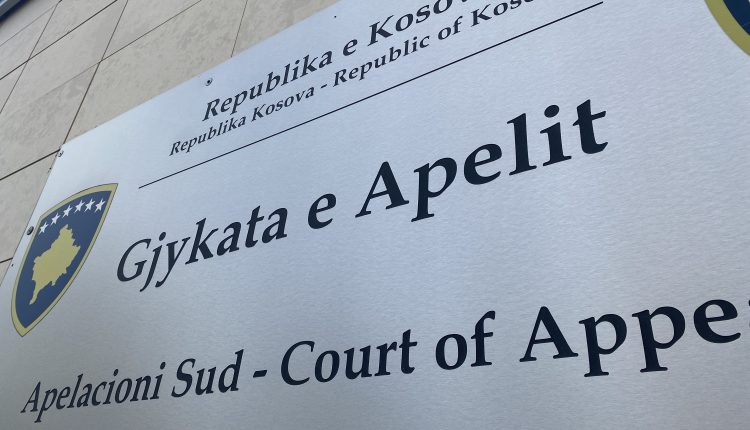
The Kosovo Court of Appeals has officially annulled a lower court’s decision to confirm the indictment against 53 former Serbian military, police, and paramilitary officials accused of orchestrating the 1999 Meja Massacre.
In a ruling finalized on May 25, 2026, and made public on Tuesday, June 2, 2026, the secondary court voided the Prishtina Basic Court’s August 2025 decision, ordering a complete procedural reset and sending the case back to the first-instance court for reappraisal.
The landmark case involves the mass execution of 370 ethnic Albanian civilians in the Gjakova municipality during the Kosovo War. Because all 53 defendants remain at large and are believed to be residing in Serbia, the legal setback centers entirely on the strict statutory hurdles required to try war crimes suspects in absentia.
Strict Legal Hurdles Violated in Trials In Absentia
The Appeals Court sustained structural challenges brought forward by 37 defense attorneys appointed to represent the fugitives. The defense successfully argued that the first-instance court committed essential violations of the Criminal Procedure Code by attempting to fast-track the judicial process without meeting the baseline definition of “reasonable effort” to secure the defendants’ presence.
Under the Kosovo Criminal Procedure Code, a trial in absentia for war crimes against a civilian population is governed by rigorous, non-negotiable protocols. The secondary panel found that the Prishtina Basic Court failed to fulfill two out of three mandatory criteria:
[Trial In Absentia: Mandatory Legal Checklist]
  ├── 1. Exhaustion of Local and Regional Search Procedures ──> [PASSED] ✅
  ├── 2. Verification of Publicly Archived Notices & Gazette ──> [FAILED] ❌
  └── 3. Implementation of an Intensive Mass Media Campaign  ──> [FAILED] ❌
- Absence of Verifiable Publication: While the court had properly translated the summonses into Albanian and Serbian for a scheduled April 2025 initial hearing, judicial records lacked any concrete proof or digital audit trails confirming that these notices were officially published on the portals of the Basic Court, the State Prosecutor, and the Official Gazette of the Republic of Kosovo.
- Failure to Launch a Public Information Campaign: The appellate judges ruled that merely uploading formal files to a website does not satisfy the legal standard of an exhaustive search. The first-instance court completely bypassed a mandatory, police-backed public information campaign designed to broadcast the indictments across regional news outlets and issue an open call for any citizens with geographic data on the suspects to contact law enforcement.
“The first-instance court proceeded with the initial review under the formal assumption that digital publication alone was sufficient to satisfy the legal threshold,” the Appeals Court noted in its findings. “Even if such publication had occurred, it would not have been sufficient to meet the strict legal standard of ‘reasonable efforts’ required to strip a defendant of their right to physical presence.”
The Basic Court has now been ordered to reconvene the initial hearing, rectify the administrative omissions, and execute a comprehensive public campaign before attempting to move forward with an in absentia war crimes trial.
The Indictment: Operation “Reka e Keqe”
The underlying indictment, initially compiled by the Special Prosecution Office of Kosovo (PSRK) in December 2023 and amended in late 2024, charges the 53 defendants with operating a Joint Criminal Enterprise (JCE) aimed at the systematic ethnic cleansing of the Albanian population in the Caragoj valley.
According to the prosecution, the mass executions were meticulously planned during a clandestine meeting in Gjakova in April 1999, organized by senior Yugoslav security officials following the Kosovo Liberation Army’s (KLA) killing of five Serbian police officers. The retaliatory operation, codenamed “Reka e Keqe” (The Bad River), aimed to execute over 100 individuals and burn down entire villages.
| Mass Execution Sites (April 27–29, 1999) | Confirmed Civilian Casualties |
| Meja Village | 283 Civilians |
| Korenica Village | 66 Civilians |
| Bishtazhin Village | 7 Civilians |
| Ramoc Village | 5 Civilians |
| Dobrosh & Rracaj Villages | 6 Civilians (3 per village) |
| Nec Village | 2 Civilians |
| Pacaj Village | 1 Civilian |
| TOTAL ETHNIC ALBANIAN VICTIMS | 370 Civilians |
The prosecution asserts that heavily armed military formations—including the 63rd Parachute Brigade, the 52nd Military Police Battalion, and the 125th Motorized Brigade—bombarded the villages with heavy artillery before entering on foot.
Sifting through the fleeing columns of over 20,000 residents, Serbian forces systematically separated men and teenage boys from women and children. While the women and children were forcibly deported to Albania via the Morinë and Qafë Prush border crossings, the men were executed in various locations across Meja and Korenica. To conceal the war crimes, the bodies of the 370 victims were transported to Serbia, where they were later uncovered in eight separate clandestine mass graves in Batajnica, on the outskirts of Belgrade.
Command Structures Named in the Case
The extensive list of the 53 accused highlights individuals who held critical command and operational portfolios within the absolute chain of command of the former Federal Republic of Yugoslavia:
- Momir Stojanović: Chief of the Security Department of the Pristina Corps Command.
- Sreten Ćamović: Regional Chief of the State Security Department (UDB).
- Milovan Kovačević: Chief of the Secretariat of Internal Affairs (SUP) in Gjakova.
- Radomir Čolić: Commander of the Special Police Units (PJP) in Gjakova.
- Franko Simatović (“Frenki”): Commander of the paramilitary Special Operations Unit (JSO).
- Ilija Todorov: Commander of the 63rd Parachute Brigade.
The defendants face charges of violating common Article 3 of the Geneva Conventions and its supplementary protocols, encompassing murder, torture, inhuman treatment, mass deportation, and the unlawful destruction and pillaging of civilian property. While the procedural reset stalls active prosecution, justice advocates note that the decision preserves the long-term legal integrity of any future verdicts by guaranteeing complete adherence to constitutional standards.